
An excerpt from Mr. N. K. Mukarji’s oral history
My maternal grandfather was the last ICS officer. He belonged to the Punjab cadre. I recall his telling us accounts of him as a young officer overseeing the partition of Punjab once Independence had been announced. He recorded his oral history at the Teen Murti Library. It is the longest oral history recorded so far. Given that today is 14 Aug 2025, I am posting a snippet from it, where he talks about being Under Secretary (Political) in undivided India in Lahore from 3 January 1947 to 14 August 1947. He continued as Under Secretary (Political) with the East Punjab Government in Simla from 15 August 1947 to 19 September 1947. He was then promoted to a senior scale post, Governor’s secretary, with effect from 19 September 1947. He became Governor of Punjab in 1989.
In the 1990s, I remember driving him to the Teen Murti library for these recording sessions. I would wait outside the recording room while he was being interviewed. It took nearly two years to record. It was a slow and methodical process. The research team would ask my grandfather detailed questions. He would usually prepare in advance, knowing the topic that they were going to talk about. But much before the recordings began, he had discussed with them the narrative that he would share. They would then share the rough transcripts of every recording which he would later edit. It was the final version that he had passed that was finally put on the shelves of the library.
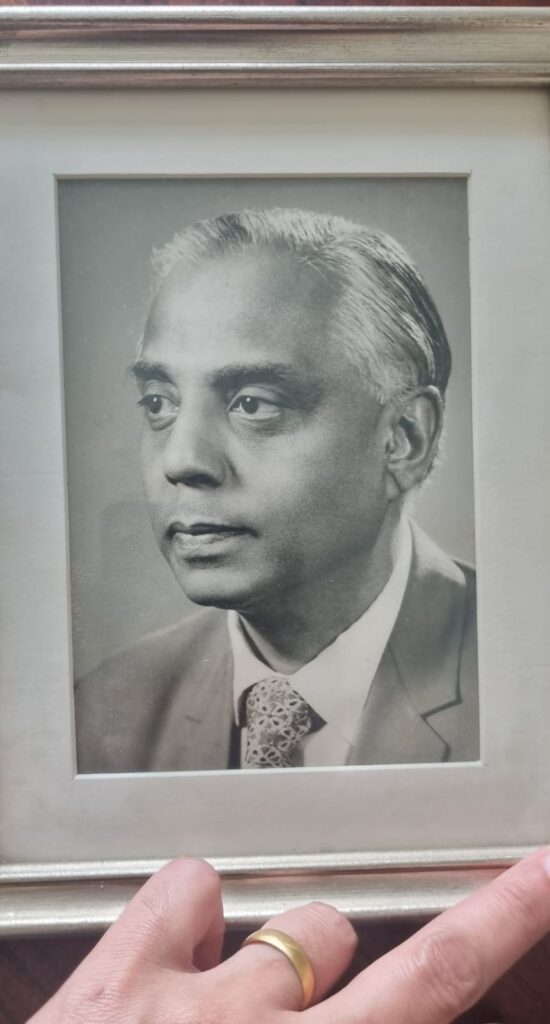
Here he is in his own words (Part 1, Vol 1, pp. 275 onwards). Manchanda was his interlocutor on behalf of Nehru Memorial Museum and Library, Oral History.
Mukarji: I took over as Governor’s Secretary on the 20th September 1947 and stayed in that post up to the 19th December 1948. At the time that I took over, the East Punjab’s Government’s temporary headquarters was at Jullundur. The Governor was also there. He had taken up residence in a sort of bagicha building of a rayees on the Grand Trunk Road, north of Jullundur going towards Amritsar, about five miles out of Jullundur. I was the second person to be Governor’s Secretary.
When I went back as the Governor of Punjab much later, I found that there was a board in the room of the Governor’s Secretary listing all the names of the previous Secretaries and, sure enough, my name was there at Number 2. I suppose I am one of the few, if not the only, Governor’s Secretary who has gone on to become Governor of the same State.
My spell as Governor’s Secretary can be divided into two parts. The first one was during the period that East Punjab Government was locaed in Jullundur. This was, you might call, an emergency period. When the emergency period was over, the East Punjab Government went back to its regular headquarters at Simla and thereafter you might say the conditions were normal. The emergency conditions under which I served as Governor’s Secretary stretched from the 20th September when I took over to about the end of February or beginning of March 1948. I cannot recall the exact date. The East Punjab Government felt that by then all was reasonably under control and they could go back to their regular headquarters.
I shall now talk about this emergency period. The Governor, as I said, was Sir Chandulal Trivedi. He was a Gujarati, a former ICS man from the Central Provinces and Berar cadre. He had been Secretary in an important Ministry of the Government of India. After that, during the British period, he ahd been elevated to the post of Governor of Orissa. It was from there that he came to take over as Governor of East Punjab. He was an experienced man, very able, thoroughly honest and a solid worker. I do not think he was brilliant in any sense, nor did he possess the faculty of being a visionary. He was very down-to-earth.
Manchanda: Pragmatic, you mean.
Mukarji: No. I mean a practical, nuts-and-bolts administrator, which I suppose was what East Punjab needed at that time. He seemed to us, Punjab civilians, somewhat overanxious to prove that although he was from a backwater province like C.P. and Berar and had been Governor of an even more backwater province like Orissa, he was as good if not better than all of us put together. I think there was a psychological factor involved here. This, coupled with the strain and stress of having to be responsible for a province in such a high state of chaotic turbulence, probably accounted for his gruff and generally aggressive style of functioning. In his own way my predecessor my old friend, Saroop Krishen, warned me about this at the time of taking over. … .
Now I have spoken of the Governor as having been responsible for the province. But was he? Considering that there was a ministry. I would like to mention four reasons for the special role which the Governor was required to play in the early months of this emergency period. Firstly, the aura of Governorship under the British especially in Punjab continued for some time even after the British left. Everybody, whether they were Ministers of civil servants or even in the people, tended in those early months to view Trivedi as some kind of reincarnation of Jenkins. Secondly, Trivedie had been hand-picked by the national leadership, maybe on Mountbatten’s advice, because East Punjab was obviously going to be a difficult province to be governed and would therefore need an experienced administrator. All concerned showed him due deference because they saw him as the Centre’s man, one who enjoyed the confidence of the then power structure at the Centre, comprising Mountbatten, Jawaharlal Nehru and Vallabhai Patel. Thirdly, following the pattern adopted at the Centre for handling the prevailing emergency in the country as a while, and at the instance of the Centre, East Punjab also set up an Emergency Committee which was headed by the Governor, just as at the Centre it was headed by Mountbatten. For all practical purposes this became the supreme decision-making body. So long as it lasted, the Cabinet functioned in a shadowy manner handling only routine issues. Fourthly, no constitution had yet come into being. The role of the Cabinet vis-a-vis the Governor in the changed conditions of freedome was thus undefined. In this vacuum, the Rules of Business carried over from the British days tended to persist and, under those rules, the Governor continued to have a special position. For all these reasons, the Governor of East Punjab was indeed responsible for the good governance of his province. Maybe, he was uniquely so in the whole country. He himself saw his role in that way. I believe the Centre also held his responsible. After all, as I said, he had been hand-picked by the Central leadership.
The Governor’s role as the de facto ruler in those early emergency days inevitably affected the role of the Governor’s Secretary. Although he had less than three years service — four years if you count the probabtionary year also — he found himself, that is to say I found myself, pitch-forked into a fairly key role. During this emergency period, there were two aspects to my work. There was work relating to the Emergency Committee and other work …
Manchanda: … other usual work which was assigned to the Secretary.
Mukarji: Nothing was usual at that time.
Manchanda: I mean which was given by the Governor.
Mukarji: No, I will come to that.
Again following the central pattern, Governor’s Secretary was appointed the Secretary of the Emergency Committee, because at the Centre Mountbatten had insisted that his own secretary should be the Secretary of the Emergency Committee there. So the same pattern was followed here. The Emergency Committee — I am talking from memory — consisted of the Governor as the Chairman, and the Chief Minister, Gopichand Bhargava, the Home Minister, Swaran Singh, and two or three selected Ministers as members. One of them was the newly-appointed Transport Minister, none other than Saradar Partap Singh Kairon. The Committee also had senior officials, the Chief Secretary, the Home Secretary, the Inspector-General of Police and the Financial Commissioner for Relief and Rehabilitation. These were regular members. Other Secretaries or Heads of Departments attended when required for an agenda item covering them. The General Officer Commanding in Jullundur, who was none other than Major General Thimayya, or his representative also used to attend when required.
In the early days the Committee met every single day in the late afternoon. No notice went out. It was understood that everybody would come at that time. It was understood that everybody must come at that time. The Committee broadly attended to three things: It took stock of the latest information, from the districts as also from Pakistan, in regard to law and order and the movement of refugees both to and from East Punjab. Secondly, it reviewed the action taken on the previous days decisions. Thirdly, it took decisions on points arising indicating the nature of action to be taken. The discussions were not always in the sequence that I have mentioned.
Manchanda: Was the third point not about relief and rehabilitation?
Mukarji: Yes.
Manchanda: What you are saying was movement of refugees to and from East Punjab. But what about the setting up of camps, providing them shelter, etc.?
Mukarji: This was connected with the movement of refugees. We were constantly in touch with West Punjab. Whenever we heard that some kafila was being attacked or had been attacked on that side, we had to be on guard to prevent or contain retaliation on our side, because we were responsible for the Muslim kafilas going from this side to the other. The agenda thus changed according to the circumstances. The discussions were not always orderly or in any kind of sequence, as I have mentioned. Whatever was hot on anybody’s mind was brought up. Maybe a letter from Jawaharlal Nehru or a reported massacre in Lahore or a huge refugee caravan moving from point X to point Y, whether in East or West Punjab.
Manchanda: That means there was no fixed agenda.
Mukarji: There was this broad agenda always.
Manchanda: I mean on a particular day, there was no fixed agenda . . . .
Mukarji: . . . unless someboady wanted to discuss a special subject. There was no time to issue agenda notices anyway. The atmosphere was such that these discussions were, though fairly tightly controlled by the experienced Trivedi, inevitably somewhat chaotic. It was left to the Governor’s Secretary to distill coherence and sense out of what was discussed in the shape of action points. Immediately after each meeting I was required to dictate crisp minutes, setting out action points. This was important as each minute indicated who was to take action on what and by when. The minutes were dispatched that very evening to all concerned who had to take action so that they could initiate action without delay. Of course, in most cases action was initiated by the concerned persons without waiting for the minutes to arrive. That was just as well because the situation demanded that. For a young officer like myself it was a unique opportunity to learn what crisis management was all about. The writing of minutes, which I did, was solely my responsibility. There was no question of obtaining the Governor’s approval before sending the minutes out. There was never time for it anyway.
Mukarji: Just the action points.
Manchanda: But you would write something in the minutes . . . .
Mukarji: . . . if there was something that required explanation. That would be mentioned.
Manchanda: Generally, how many pages did a single days’s minutes contain?
Mukarji: Anything up to half a dozen pages.
Manchanda: That’s right.
Mukarji: It was a treat to see the next day how promptly and efficiently all action had been attended to. The East Punjab Government was still finding its feet, but even so it was dealt with this wholly unprecedented crisis, I would say, rather well.
The following is a sample of the issues that were attended by the Emergency Committee: (1) Monitoring the movement of refugee kafila from and into East Punjab, (2) Providing protection to outgoing Muslim kafilas, (3) Directing incoming kafilas to refugess camps, (4) Setting up refugee camps and seeing to the required logistics and the organisation. Setting up these camps involved enormous problems, getting tents, making food arrangements, seeing to the layout of camps, selecting camp officers, defining the precise responsibilities of the Deputy Comissioners and his officers, making health and sanitary arrangements, and ensuring special attention to widows and children, (5) Initiating action for rehabilitation as distinct from relief. It was the first time anybody was addressing this kind of action agenda.
Manchanda: This was unprecedented thing in the history of India.
Mukarji: These were the kinds of issues that used to come up and they were dealt with regularly. On the whole the Emergency Committee worked with smooth efficiency.
I recall an occassion when this smooth functioning was rather rudely interrupted. This was when the Director of Health Services, a very eminent medical man, highly respected by everybody, by the name of Colonel B. S. Nat, was invited specially to attend a particular meeting because health arrangements in the camps were being discussed. There had been complaints of inadequacies here and there. Before Colonel Nat could speak a word, Governor Trivedi jumped on him, as it were, and was very rough in what he said to him. I remember Colonel Nat was almost reduced to tears. After the meeting the Chief Secretary M. R. Sachdev asked me whether I would like to have a lift back to where I was staying.
He took Colonel Nat and me in his station wagon. The Chief Secretary and I tried to pour oil on troubled waters on this return journey. The Chief Secretary said that the Governor’s outburst should be seen in the light of the heavy strain on him. He reassured Colonel Nat that he would still be highly regarded by all of us as before. Sachdev told him: You have to deal with the new Governor only once like this. Look at young Mukarji here, he has to face him everyday and yet carry on! In other words he said that the times were such that we all had to go on doing our best for East Punjab and the country. Colonel Nat of course responded accordingly, being the great and good man that he was.
The most terrible aspect of the emergency period was the mass killings and also other killings. The Emergency Committee was at its wits’ end about how to control this because normal law and order methods or even extra-normal law and order methods were just not good enough. The mood of anger, resentment, revenge was so great: the temperature was so high that there was nothing that could be done. This most terrible aspect came to a full stop through what I can only think of as divine intervention. This came in the form of the heaviest downpour of rain that I have personally witnessed in Punjab in all the years that I was there. It rained heavily, non-stop, for four to five days. It started raining at night on the 27th September. Every river and stream was in flood. All communications were broke down. There were two streams called the East and West Beins. They lie on either side of Jullundur on the Grand Trunk Road. They both became swollen and overflowed, so the East Punjab Government and its officers, all of us, were imprisoned between the two Beins. We could not move out. The points at which these two crossed the Grand Trunk Road were about ten to twelve miles apart. At each crossing point there was a Muslim kafila lying encamped, each other ten to fifteen thousand in numbers. When the rains started these thousands of fleeing Muslims were encamped on the banks of the two Beins. I should explain that these kafilas were spaced out at ten to twelve miles distance from each other. This was done so as not to allow one kafila to telescope into the kafila ahead. When the two Beins were suddenly flooded, the two camps, each in the lowlands adjoining the streams, anything up to 20,000 people plus tens of thousands of cattle, were simply drowned or washed away. Any attempt by these people to escape was futile. The lowlands stretched from the streams to the bluffs from where the highlands started. Along the periphery of the highlands roamed armed Sikh peasants ready to kill or loot anyone trying to escape.
After the rains stopped, J. M. Shrinagesh who was the Commissioner, Jullundur Division asked me if I would like to visit one one of these camp sites. I said: Yes. We went by jeep to the East Bein site. There were corpses of humans and animals bloated and rotting. It was difficult to breathe. The stink was nauseating. It was easily the worst disaster I have personally seen.
Now all this rain meant that agricultural lands became ready for the Rabi crop. It has to be borne in mind that East Punjab was largely barani, that means rainfed. The bounty of Bhakra waters was far off. So the peasantry laid down their arms and picked up their ploughs. It was thus that the killings came to a sudden stop. Even otherwise, a feeling had probably come about that enough was enough.
14 August 2025

No Comments