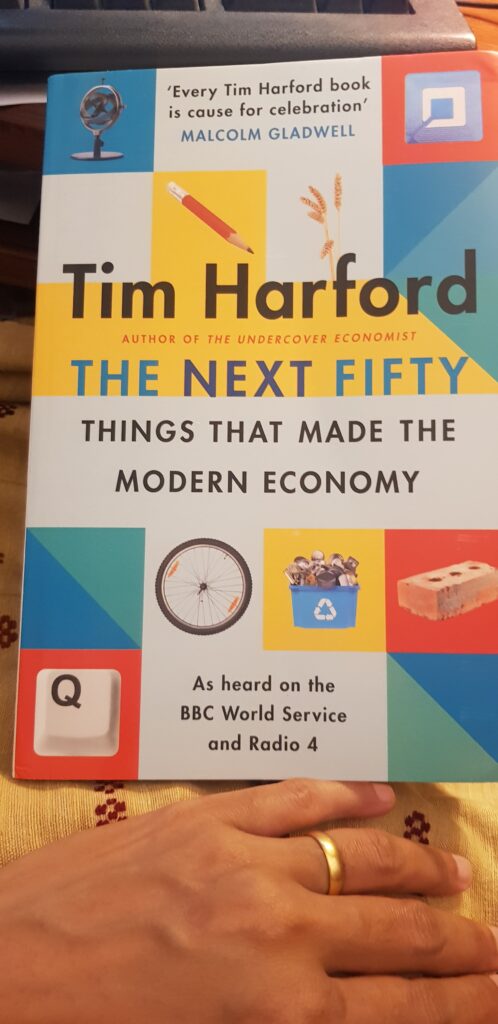
May I just say that I absolutely adore such books? Books that one can dip into and emerge with information shared simply. No fussy narratives. No jargon. No back and forth in timelines. Just a story well told. A story told around an object but in good old-fashioned style with a beginning, middle and end. No clever turn of phrase. A lovely combination of historical facts with modern relevance and application. It is a style first made famous by Neil MacGregor’s A History of the World in 100 Objects. It is an easy way of retelling stories about the significant moments in history. It is a dangerous trap too for there is a tendency to over simplify and scrub out of the narratives any nuances that may prove to be uncomfortable irritants. But that is not rhe case with Tim Harford’s essays based on his popular podcasts. His selection of very unlikely collection of topics includes the postage stamp, canned food, auctions, fund-raising appeals, Santa Claus, the blockchain, stock options, RFID, movable-type printing press, menstrual pads, pornography, QWERTY, vulcanisation, dwarf wheat, gyroscope, spreadsheets and chess algorithms. These read like short stories except that they are all based in facts anre absolutely rivetting!
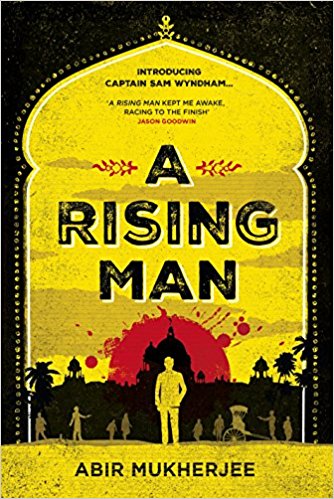
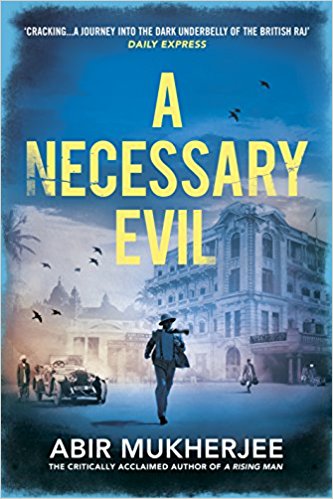
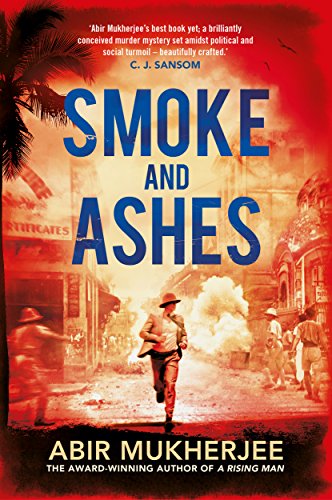
Crime writer-cum-accountant Abir Mukherjee has written three novels — A Rising Man (2016), A Necessary Evil (2017), Smoke and Ashes (2018) . These novels feature opium addict Capt. Sam Wyndham, former Scotland Yard detective and a World War I veteran. Sam Wyndham is posted to Calcutta where his sidekick is a Bengali educated in England, Surendranath or “Surrender-not” Bannerjee as many refer to him. The three novels are set during the turbulent period of British India when the Independence movement was gaining strength. It is a challenging scenario for both police officers since the Englishman is viewed with suspicion to whatever crime scene he visits and the Indian is also receives a hostile reception for he is considered to be a traitor working with the colonial rulers. It is a fine balance the two investigating officers have to negotiate on a daily basis but they manage supremely well. It is also a balance managed with aplomb by the author himself who is a British Asian and culturally identifies with both nations.
With every novel Abir Mukherjee’s confidence as a writer seems to grow. The stupendous opening lines of each novel are a testament to the fact. They hook the reader immediately.
At least he was well-dressed. Black tie, tux, the works. If you’re going to get yourself killed, you may as well look your best. ( A Rising Man)
It’s not often you see a man with a diamond in his beard. But when a prince runs out of space on his ears, fingers and clothes, I suppose the whiskers on his chin are as good as place as any. ( A Necessary Evil)
It’s not unusual to find a corpse in a funeral parlour. It’s just rare for them to walk in the door under their own steam. It was a riddle worth savouring, but I didn’t have the time, seeing as I was running for my life. ( Smoke and Ashes)
The characters are more alive and they come into their own with the subsequent novels — A Necessary Evil and Smoke and Ashes. Also Capt Wyndham and Surendranath Bannerjee understand each other better. Astonishingly they begin to share an apartment together which is wishful thinking on the part of the author as such a scenario would never have occurred in history — a British officer cohabiting with his Indian colleague. Nevertheless it makes for a nice little creative touch to the novels.
With A Rising Man there is always a very surprised and yet tentative tone to the writing style as if the author’s own astonishment at what he is achieved is apparent on every page. This is only discernible after having read all the other novels in quick succession. In fact the writing becomes pithier in every novel almost as if the skill of precision learned as an accountant has enabled Abir Mukherjee to write fine crime novels. This is a genre of writing whose prerequisite is to have a keen eye for details, precise dialogue, and exacting descriptions without flabby sentences. In the case of historical fiction such as these novels fact checking also becomes critical.
Abir’s parents emigrated from Calcutta to Britain in the late 1960s. Abir was raised in Scotland and so it is no surprise when at the Edinburgh Festival he was introduced as a Scottish crime writer ( “Crime Writing: Val McDermid, Abir Mukherjee and Lucy Ribchester” in conversation with Mariella Frostrup. BBC Radio 4, Open Book, 1 Sept 2016). Approaching his fortieth birthday he was going through a mid-life crisis hoping there was more to life than accounting. It was then he chanced upon a TV breakfast show with acclaimed crime writer Lee Child. Abir Mukherjee immediately bought the first Jack Reacher book Killing Floor and was hooked. He says “I was amazed at how simply written and well plotted it was. I’d recently had an idea for a story centered on a British detective who travels to India after the First World War, and reading Killing Floor gave me the motivation to put pen to paper..” He had written about 10,000 words whenever he could spare the time from his day job when he chanced upon the newly announced Telegraph Harvill Secker Crime Writing Competition. This was 2013. He chose to send in the first 5,000 words of his incomplete manuscript and waited to hear. Three months later he did. He discovered that of over 400 applicants he had won the £5,000 competition and a publishing contract. He was very surprised as he writes in this Dead Good article ( April 2016) at having won . His debut, A Rising Man, won the CWA Endeavour Historical Dagger 2017 and was picked as one of Waterstones best books of 2017. Abir Mukherjee is now a part-time accountant as of January 2018 as he would like to devote more time to writing crime novels. ( Smokes and Ashes BBC Radio 4 interview with Samira Ahmed , June 2018) For the Harvill Secker crime writing competition 2018 he has been appointed as a mentor.
And yes, Capt. Sam Wyndham is a worthy creation, true to the spirit of Jack Reacher. Both the characters blossom with every passing novel; it is as if their creators become more comfortable living with the characters on a daily basis. (Listen to “In the Studio” by BBC World Service. In this episode Lee Child speaks of creating Jack Reacher.) The storytelling of Abir Mukherjee and Lee Child too becomes richer and tauter with every novel of the series. It will be curious to see how the Capt. Wyndham novels evolve. Will the Englishman stay on in Calcutta as the Independence movement intensifies? Or will the author choose to keep his detective like a fly caught in amber and spin out a number of stories set at a particular moment of history? For now it is impossible to say since the first three novels of this series are set in successive years — A Rising Man ( 1919), A Necessary Evil (1920), Smoke and Ashes ( 1921). Only time will tell. Perhaps with time too it may become clear if these books are optioned for film/television adaptations just as Arjun Raj Gaind‘s historical crime fiction novels set during British India have been optioned.
For now read these crackling historical fiction crime novels set during British India and you will not be disappointed!
Abir Mukherjee A Rising Man Harvill Secker, London, 2016, rpt 2017. Pb. pp. 390. Rs. 399
A Necessary Evil Harvill Secker, London, 2017, rpt 2018. Pb. pp.
Smoke and Ashes Harvill Secker, London, 2018. Pb. pp. Rs 599
( I interviewed Sam Miller on his memoir Fathers for Bookwitty. It was published on 13 June 2017.)
Veteran journalist Sam Miller was born and brought up in London but chose to spend the better part of his life in India. His father was the renowned literary journalist, Karl Miller, who co-founded the London Review of Books. His mother, Jane Miller, is a writer who has also worked as a publisher, translator and teacher. Miller joined the BBC World Service and was stationed as the BBC TV and radio correspondent in Delhi and then as Managing Editor, South Asia. His love for India runs deep as is evident in the many books he has published: Delhi: Adventures in a Megacity (2009), Blue Guide: India ( 2012) and a Strange Kind of Paradise: India Through Foreign Eyes (2014).
His elegant essay for Granta, “Gandhi the Londoner” makes for a compelling read. It was propelled in large part by Sam Miller’s curiosity about the years Gandhi spent in London upon his arrival in 1888, a period glossed over in Richard Attenborough’s Oscar-winning film. What comes through clearly is Sam Miller’s obsession to know more about the past, in particular that which is less remembered in the popular imagination, and to weed out historical inaccuracies that may have crept into modern retellings of this period in Gandhi’s life. It is this remarkable quality as a discerning writer and historian that comes together beautifully in Sam Miller’s recent memoir Fathers. In early 2014 Miller returned to his childhood home in London to spend time with his father, who was dying. Shortly after his death, Miller began to write about his father, investigating a family secret that he had been told about years ago, involving his parents and a close friend. With his mother’s help, his father’s documents, and interviews with people from the large circle of his parents’ friends, he put together a heart-warming memoir that explores childhood, marriage, and friendship, as well as exploring the personal relationship each of his parents had with their closest friend from Cambridge, Tony White.
Miller kindly answered questions for Bookwitty:
How many drafts did this memoir take? It flows smoothly as if it just wrote itself. There is almost magically ethereal quality to it.
It was the easiest thing I’ve ever written; it just came pouring out of me. There were one and a half drafts really. I’d written about half the book in conventional chapters, with long passages of prose. It felt a bit stodgy and linear to me, with all those ‘joining together’ sentences that often feel artificial. At the time, I was reading a French book called HHHH by Laurent Binet, and he uses short numbered chapters—and I tried it out, breaking up the text, inserting a few mini-chapters that enabled me jump more easily in time and place. I hope it allowed the text to flow more smoothly, more naturally—bringing it a little closer, in my view, to the way we talk and the way we think. I read my words out loud to myself as I write, and it is important that the text sounds right, as if I were writing for radio.
The elegant manner in which you write investigating your paternity also conveys the immense love you grew up with. Was Fathers emotionally tough to write?
It felt good for me, as if it were a kind of therapy, a way of releasing something that I’d half-buried. But it also was about dealing with grief, and a more specific sense of anger with myself for having not been there when my father died.
This story is as much yours as it is your parents’ and their close friend Tony White. How did you feel about your mother supporting you on this project? Would you have written this memoir if it had not been forthcoming?
I write anyway, not always for publication. So I think I would have written this tale, for myself at least. But my mother was always part of the story, and the telling of the story. I wouldn’t have published it without her support.
Karl Miller and Tony White at a Christmas party, 1960
How closely involved was your mother with this manuscript? Were you required to make any critical changes in the drafts—sections you felt needed to stay and your mother thought otherwise or vice versa?
I would talk to her as I was writing, but only showed it to her in larger chunks. We did discuss minor changes, but nothing I would describe as critical. I know so much of the story through her anyway (and she is a writer too); that it has a strong Jane Miller imprint on it, though the final version is very much mine in style and content.
The forgiving nature of your father is an extraordinary quality to have just as the calm acceptance of your presence in the lives of the three adults: Karl and Jane Miller and Tony White. While writing Fathers did you ever wonder about the evolution of the institution of marriage? It seems to have been far more accommodating in your parents’ generation than it is today.
I don’t feel very well equipped to comment on the institution of marriage, but I do think that almost every couple’s relationships are pretty different from each other. And therefore simply following convention and ideas of normality are not a great basis for forming a relationship. I’m not quite sure that ‘forgiving’ is the right word here; I think my father’s response was more complicated than that and related to his own upbringing, and to his own ideas about the (un) importance of fidelity.
Does the crucial family secret your mother shared make you ever wonder about the popular debate about genetics vs environment being influencing factors in the growth of an individual?
Yes, I do. But I’ve not come up with any useful conclusions. I’ve been intrigued to notice the ways in which I am similar to Tony White, but these are not necessarily genetic. They could be learned, from what I know of Tony—and more indirectly and even subconsciously via my parents.
Many times in the memoir you allude to your father’s poems describing his friends bordering on the homoerotic or comment often on his close male friendships which, for his generation, seem nothing out of the ordinary. “Karl Miller struggled to reconcile close male friendship with the possibility or reality of homosexual love. My father was not, I think, a homophobe, but was sensitive to accusations that he might be.” Do you think it’s fair to your father and his generation to read in to their relationships what is a popular 21st century concept of homosexuality?
I’m not so sure that it was so different in the fifties; it was just talked about less. I would distinguish homoeroticism from homosexuality, as think my father would, and as I think Thomas Mann would have even before my father was born.
While writing this memoir were there any others you referred to as literary examples to emulate?
Not really. It was written for me, and then my mother. I was pleasantly surprised when the earliest other readers liked what I had written—I had been expecting them to suggest changes, particularly to the structure.
Of all the diverse genres you have published, travelogue, translation and memoir, which has been the most challenging and why?
I’ve written a history (A Strange Kind of Paradise) and a guidebook (Blue Guide India) as well! The guidebook was most exhausting. The history book involved the most research—and that was probably the most challenging—I wanted it to be interesting for people who think they aren’t interested in history. The publication (rather than the writing) of Fathers was quite a challenge – a nerve-racking experience. I was apprehensive about the response to what I had written. But the response has been largely positive.
Sam Miller Fathers Jonathan Cape, London, 2017. Hb.