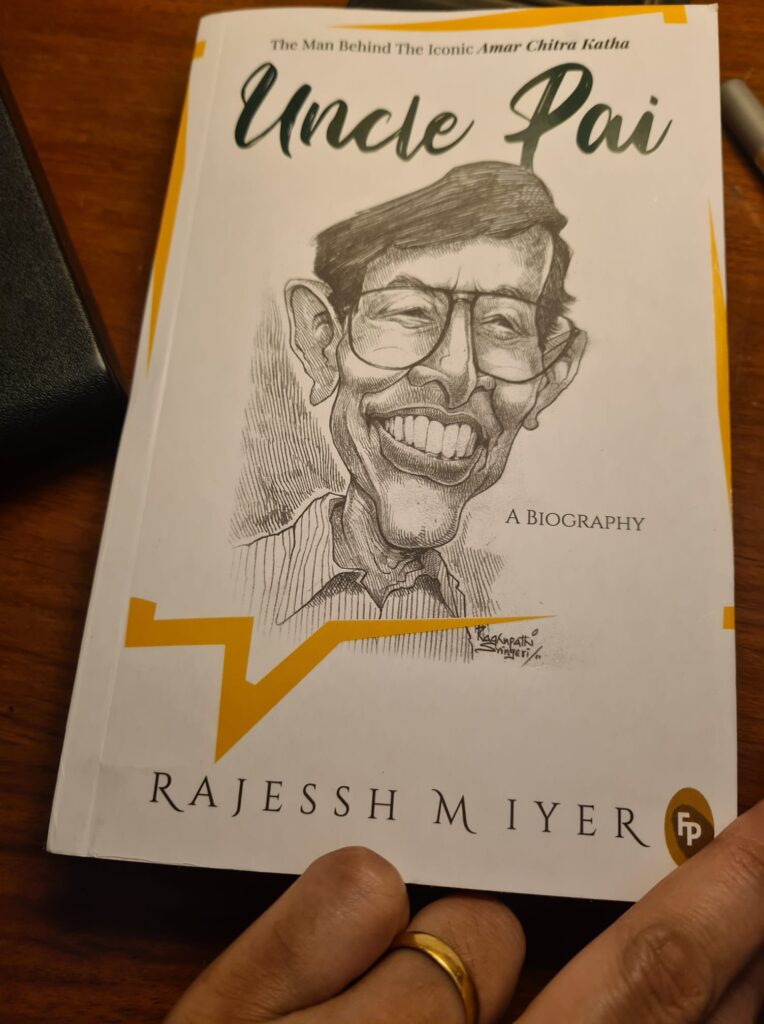
Uncle Pai: The Man Behind the Iconic Amar Chitra Katha by Rajessh M. Iyer— I began reading this biography of Anant Pai with interest (published by . Instead it borders on being a hagiography and capitulating to modern sensibilities. It would have been a tremendous effort if the author had made an attempt to make it a biography with gravitas, researched the period, the genre and the subject of his book a little more diligently. For instance, elaborated upon the debate triggered by well-known historian Sumit Sarkar in 1993 as the comics promoting a Hindu cultural ideology that helped fundamentalist organisations. The author dismisses this as “this couldn’t be farther from the truth”. It is at such points in the book that the reader wishes a little more effort had been made to research the history of ACK and the phenomenal role of Anant Pai. Instead frustratingly, nothing more is forthcoming. Plus, added a bibliography of materials consulted. I am disappointed as I enjoy reading biographies and always hope to learn more about the period of time in which the person lived. With Anant Pai, it is always a pleasure to read about his legendary contribution to India’s publishing history with the creation of the Amar Chitra Katha comics. These are a series of illustrated stories in the comic book form that are synonymous with tales from the Hindu epics but slowly evolved into also sharing folklore, tales from Indian history, Jataka Tales, stories about Akbar & Birbal, Tenali Rama etc. They were known to be simultaneously published in multiple Indian languages using the model of syndication. Some of the earliest artists and writers who were commissioned to create stories were not amused as their copyright was taken away. Whereas Pai himself stood to gain from the sales of the comics as per the deal struck with the owners of IBH. He was offered a monthly payment as well as a percentage of the sales, making him part-stakeholder in ACK. A win-win situation with hindsight but at the time of signing, Pai accepted the deal on pure faith that he had a good idea of making perennial favourite stories available as comics, modelled upon the popular American series “Classics Illustrated”. Unfortunately, I abandoned reading this book when I came upon the chapter on “illustration styles and Anant Pai’s background”. In It, the author, chooses to dwell upon the Hindu cultural sensibility, the influence of Raja Ravi Verma and calendar art as being some of the prime motivations for ACK’s characteristic style of drawing mythological figures. Years ago, I read a comment by Uncle Pai in an essay where he categorically stated that there had been innumerable influences upon his artwork but there was no denying that he also turned to the big names of Hollywood of the day as models for his characters. “Uncle Pai” does not even so much as have a passing reference to the popular cultural references that may have impacted ACK’s sensibilities. The book could easily have soared as a publishing history but it seems to lumber on. Plus, the boxes of information scattered throughout the text make it very cumbersome to read. They are tantamount to throwaway lines that are too laborious to develop as ideas in the main narrative. Ideally the points and comments made in these boxes should have been incorporated as one text. It would have made for a smoother narrative.
Here’s hoping that the second and revised edition of this book is much improved for we could do with a good biography of the legend Uncle Pai.
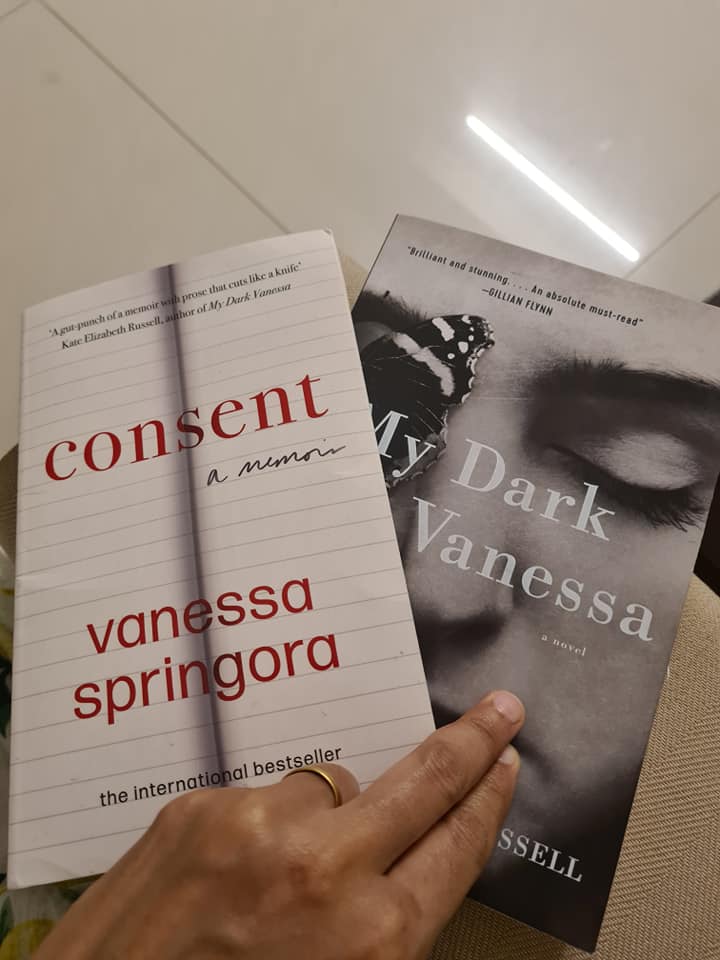
I read two books in quick succession — Consent and My Dark Vanessa ( HarperCollins). Both deal with the same subject. Grooming of a young school girl by a much older man, a writer / school teacher. The difference being that “Consent” is a true account by Vanessa Springora about her being groomed by French literary giant Gabriel Matzneff. It is a horrifying account of a 14-year-old girl groomed by a man who was at the time fifty years old. It is sickening. Springora, the head of the Julliard publishing house, met Matzneff at a dinner with her mother. ( https://www.theguardian.com/…/french-publishing-boss…) She was going through a troubled childhood as her parents were divorcing. Springora began a relationship with Matzneff but despite breaking it off two years later, she was not rid of the man for the next few decades. He pursued her. He stalked her. To the extent he wrote letters to her bosses in the publishing publishing she worked in. Ultimately, the Me Too movement happened, giving her the space to write her account of the events. Consent has been translated by Natasha Lehrer.
It is a memoir that flits between the perspective of the 14yo school girl and the 47yo Springora. It is disturbing. The school girl participates in the relationship with a much older man, but the adult Vanessa questions some of the acts/moments. She is able to see through the sexual exploitation and misogyny of the male writer and the protection he got from his social circle. It is incomprehensible to her. Consent is minimalistic. It does not delve into too many gory details but what the author chooses to share are emotionally shattering. It is inexplicable why this man was protected so well by the French establishment. If anyone had dared to look close enough, the evidence was apparent in the “illustrious” literary career where Matzneff published books that were thinly veiled accounts of his paedophilic acts, letters with his under-age mistresses and his regular visits to the Philippines to sexually exploit boys as young as eleven years old. Yet, Springora too only found the courage to reveal her dark secret after the Me Too movement became popular. She was relieved when she showed her mother this manuscript, who upon reading it said, “Don’t change a thing. This is your story.”
Towards the conclusion of the memoir, she writes:
I spent a long time thinking about the breach or confidentiality, particularly on a legal area that is otherwise strictly controlled, and I could only come up with one explanation. If it is illegal for an adult to have a sexual relationship with a minor who is under the age of fifteen, why is it tolerated when it is perpetrated by a representative of the artistic elite — a photographer, writer, filmmaker, or painter? It seems that an artist is of a separate caste, a being with superior virtues granted the ultimate authorization, in return for which he is required only to create an original and subversive piece of work. A sort of aristocrat in possession of exceptional privileges before whom we, in a state of blind stupefaction, suspend all judgement.
Were any other person to publish on social media a description of having sex with a child in the Philippines or brag about his collection of fourteen-year-old mistresses, he would find himself dealing with the police and be instantly considered a criminal.
Apart from artists, we have witnessed only Catholic priests being bestowed such a level of impunity.
Does literature really excuse everything?
It is a question that the reader is left asking with My Dark Vanessa. Nearly twenty years in the making and endorsed by Stephen King, it too explores the grooming of a young school girl by her English teacher. King calls it is a “hard story to read” and it is. Maybe because Kate Russell’s imagination is very detailed and sometimes gut-wrenching. It is torture to read this story. Initially I stopped reading it after a few pages but then managed to resume reading it after having finished reading Consent.
Somehow My Dark Vanessa comes across as a brilliantly crafted story but it is not as easy to read as Consent. Every despicable encounter/event in “Consent” is meticulously documented but it is shocking to read for the complicity of the French elite in permitting the writer to flourish. Not only did his books sell well, but he was lauded with honours, practically given an expense account by his publishers and the French state. It is astonishing. Whereas My Dark Vanessa reads like fiction although the events described in it are plausible. It is fiction but it sometimes seems to stem from an overactive imagination. The distinction is real. It is unsurprising that My Dark Vanessa has been shortlisted for the Dylan Thomas Prize 2021.
Interestingly Vanessa Springora’s memoir Consent has been endorsed by Kate Elizabeth Russell, My Dark Vanessa, as “A gut-punch of a memoir with prose that cuts like a knife.”
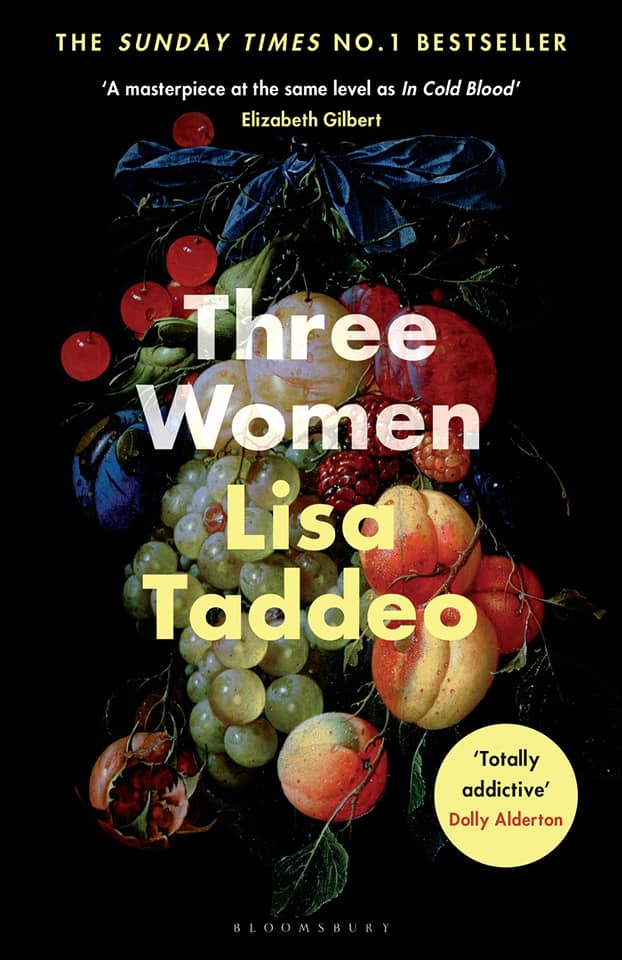
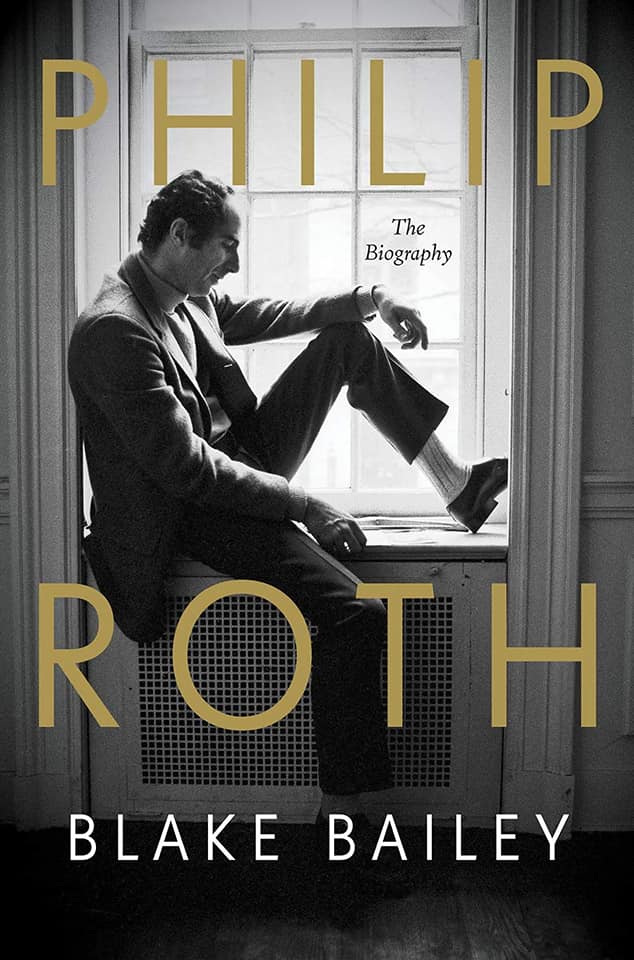
Currently the controversy about Blake Bailey, the biographer of Philip Roth, is raging in the world of Anglo-American publishing. Take for instance this article published in the Slate, called “Mr Bailey’s Class“. It eerily parallels the events described in My Dark Vanessa and Lisa Taddeo’s nonfiction Three Women, where the only girl who agreed to be identified by her real name was Maggie. She spoke about her grooming by her teacher and later taking him to court. It is hard at such moments to distinguish between what is real and what is fiction.
These kinds of stories are not going away in a hurry. There are many, many more. Predatory men and women exist. It is a fact. Children are vulnerable. These books may only focus upon young girls but there is no denying that boys too are victimised.There is no telling how much longer will these stories have to be constantly told for there to be some positive change in the attitude of individuals and society. But for now, read these stories.
The Longest Kiss: The Life and Times of Devika Rani by Kishwar Desai ( Context, Westland Books), is a biography of the famous Bollywood actress, Devika Rani. It is a biography that Kishwar Desai has put together after poring over thousands and thousands of the actress’s personal correspondence. It creates an image of woman who was a strong individual, had an identity of her own, knew her mind and was very sure what she wanted out of the film industry. She was then the only, and perhaps even now, actress/filmmaker/producer and owner of a film studio – Bombay Talkies. She was known internationally in the 1930s, a feat that is hard for many to achieve even today, nearly a century later!
The Longest Kiss is informative and an absorbing read even if one is unfamiliar with the Bollywood landscape of the 1930s to 1940s. Bombay Talkies produced some of the better-known films of its time. It helped launch careers of many actors such as Ashok Kumar and Dilip Kumar. Kishwar Desai captures the tumultousness of setting up a new business, in what was then uncharted waters, but the manner in which Devika Rani supported her first husband and business partner, Himansu Rai is astonishing. There are glimpses of the tough life she had and the balancing act she had to do often especially with Himansu’s failing mental health and irascible temper. Apparently in private he would take it out on Devika Rani, at times leaving her unconscious and yet she persisted in supporting him and working hard to preserve their business. Often she was also the leading lady in the films they produced together. Having said that she ensured that Bombay Talkies ran smoothly, the women actresses hired found it to be a safe haven and a respite from their domestic drudgery, the employees found it to be professionally run and the presence of the German cinematographers were more a blessing than an interference. So much so when the British arrived at the height of World War II to whisk the Germans away to detention camps, Bombay Talkies continued to work smoothly as the Indians had been trained well by the Germans and Devika Rani ensured that there was no break in the production schedules. Of course, Kishwar Desai details a great deal of the financial ups and downs the firm faced and how deftly Devika Rani steered it through. The actress even survived successfully a revolt within her firm and the board and continued to make films that were a critical and a commercial success. It was later that she was introduced by Bharati Sarabhai to the former Russian aristocrat and painter Svetsolav Roerich. They got along famously well and the rest as they say is history. This too is documented fairly well documented by Kishwar Desai except that it forms a very slim portion of the book. Devika Rani died a wealthy woman, a far cry from the days with Himansu when she had to starve herself or hide the fact that she did not have sufficient clothes to wear.
This is a fascinating book that was fifteen years in the making and will forever be referred to by cinema buffs, researchers and historians curious about India’s past, and of course feminists who would be keen to review how a young woman, newly returned from Britain, left her mark on the film industry in this astonishing manner. All this despite the trials and tribuulations she faced at home, Himansu was known to beat her but she hid it from public, he had reduced her to penury and she had pawned her jewels to help him maintain his illusion of a successful man. There are so many wrongs in this and yet so many women readers will recognise the eternal truth of being caught in this bind of being themselves while being “supportive” of their male partners. There is this particular sentiment that wafts through the book that is difficult to pin down. It is a feeling that develops within the reader curious as to why Devika Rani despite all odds chose to stay with an abusive partner like Himansu even if the rationale of sharing a business interest is offered. Of course, the love that Svetsolav and she had for each other was a blessing. Even so, this steadfast loyalty to Himansu is inexplicable.
Kishwar Desai writes ( p.430):
It was ironic that all these years, she had longed to be looked after. In all her relationships, she had wanted a mentor,a father figure to replace the one she had lost so early — but the men in her life would always lean on her, instead. Somewhere, then, did she always feel unfulfilled? Perhaps it was the loneliness. . . .
I had to take a break from this increasingly bewildering feeling about Devika Rani as to why she stuck it out with Himansu and I was not convinced by the argument that it was loneliness. While on a break, I picked up Arshia Sattar’s lucidly written collection of essays about Maryada, or ‘boundary’ and ‘propriety of conduct’. It is a complicated concept especially since the one version that has held supreme is the idea of ‘maryada purshottama’ or the ‘ideal man’ as the defining virtue of Rama in the Ramayana. But in her essays, Arshia Sattar sets out to explore how the Hindu epics are driven by four ‘operators’ — dharma, karma, vidhi ( fate) and daiva (intervention by the gods). How these especially the various kinds of dharma are fulfilled by individuals by the choices they make. In Maryada ( HarperCollins India) Arshia Sattar tries to delineate the various ways in which these can be achieved or even recognise how others apart from Rama practise this concept. In her concluding remarks in the essay on “Ayodhya’s Wives” where she tries to understand Rama’s arguments about love, she writes:
Rama indicates that Dashratha, too, has acted out of love for Kaikeyi, as Rama is about do now for his wife Sita. Acts of love have to be the most subjective, individual choices that anyone can make, for surely no two people love alike. And yet, Rama feels compelled to transform these acts of will, acts located deep within the sweetest and most expansive spaces of the human heart, into choices that lie within the framework of dharma such as the one that controls him and his father, both as kings and as husbands.
Acting within the constraints of dharma, taking on the roles and walking the paths that have been circumscribed for an individual who is a man, a king, a husband, a son, a brother, minimizes the potential these personal choices have for subversion. …Free will has been eliminated from the discourse of right and wrong, and once again, dharma has been instrumental as the basis not only of action, but also of choice.
It may be a bit far-fetched to think that Devika Rani was at some level following the ideals of the faith she had been brought up in and was whether self-consciously or otherwise fulfilling her dharma. Who knows? And we shall certainly never know. But it is this very fundamental concept of choices that a woman makes that is at the core of the third wave of feminism. Perhaps this angle could have been explored further if Kishwar Desai had chosen to exploit her strength as a novelist to create a thinly veiled fictionalised biography based on facts as David Lodge had done in his novel Author, Author that is about American novelist Henry James. For now I have reservations about The Longest Kiss kind of a biography that oscillates between sharing documentary evidence, especially of the financial aspects of running Bombay Talkies, and ever so often delving into the fiction when imagining the romance between Devika Rani and her husbands, does not quite come together seamlessly. The non-fiction narrative is absorbing to read even if it is based on facts that are never footnoted in the text. So why disrupt the flow of reading with romantic episodes that do not sit well in the text? It does not make any sense even if Devika Rani was a romantic at heart.
Having said that Kishwar Desai’s biography of the actress will be considered as a seminal piece of work even if my Eureka moment of attempting to understand who Devika Rani was by reading some of Arshia Sattar’s brilliant essays. But isn’t that what reading is all about? It raises questions reading a book and that may or may not get answered by reading another one?
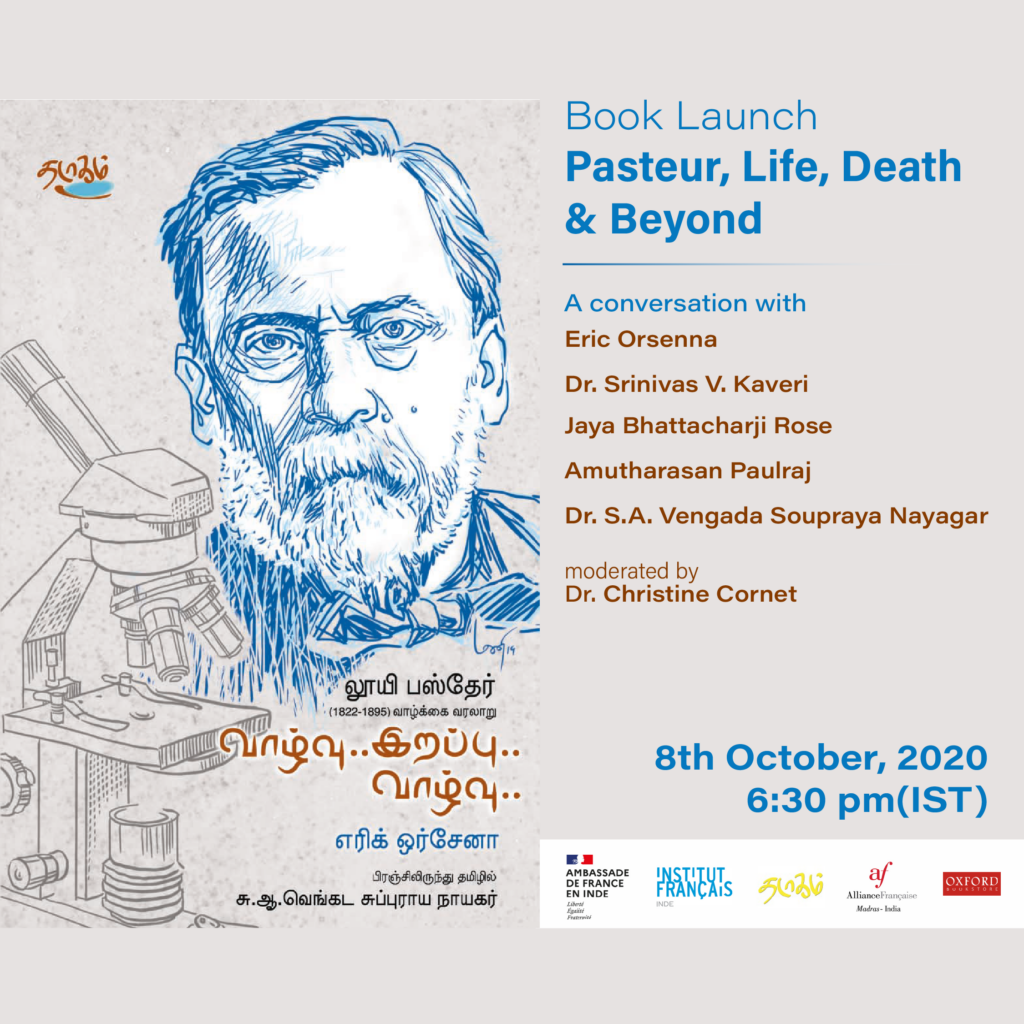
On 8 October 2020, the French Institute of India and the Oxford Bookstores co-hosted a digital book launch. It was for the Tamil edition of noted French politician, academic and award-winning novelist, Erik Orsenna’s biography of Louis Pasteur — Pasteur, Life, Death and Beyond. Erik Orsenna is an award-winning #novelist, member of the very prestigious Académie Française and a French politician. His real name is Eric Arnoult. He has been advisor to many French presidents including President Mitterrand. Erik Orsenna has won the prestigious French literary prize, the Prix Goncourt. He is now an advisor to President Macron. It has been published by Amutharasan Paulraj, Thadagam Publishers. The book was translated from French into Tamil by Dr. S. A. Vengada Soupraya Nayagar. The digital book launch was conducted in three languages — English, French and Tamil.
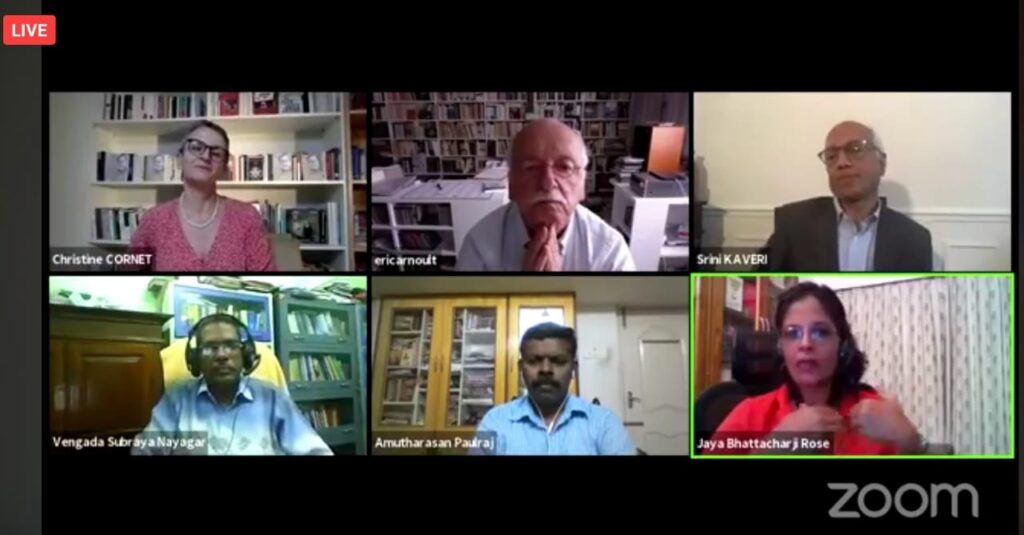
The panel included Erik Orsenna, Dr Christine Cornet, Attachée Débat d’Idées et Livre, Amutharasan Paulraj, Dr. S. A. Vengada Soupraya Nayagar, and Dr Srinivas V. Kaveri, Director, CNRS Office, New Delhi. I moderated the conversation. It was such a fantastically enriching discussion that carried on for nearly one and a half hours!
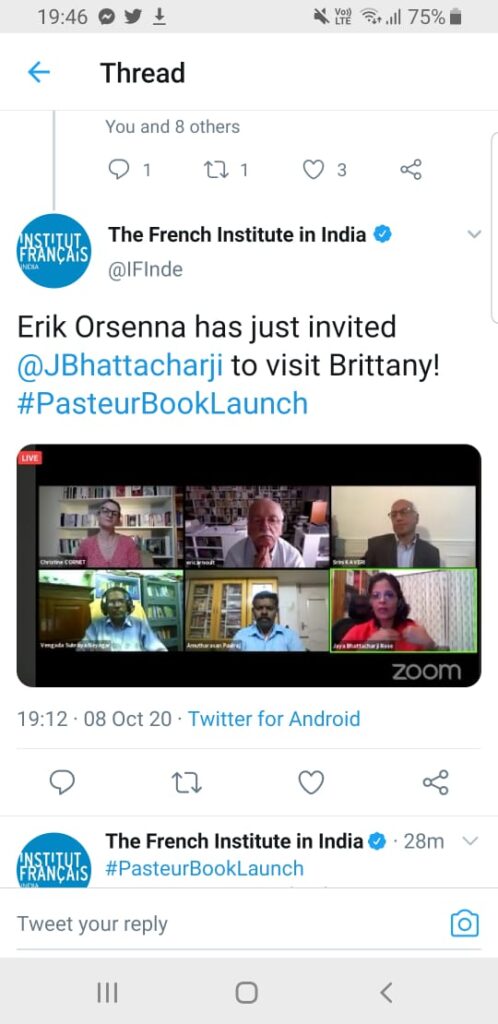
We covered a lot of bases. The conversation moved seamlessly from topic to topic, of which a wide range were covered. From Louis Pasteur, science, looking at disciplines holistically rather than only as areas of specialisation, the Victorian Age, print and ebooks, waterways, sustainable development etc. It was truly an interesting conversation. At one point, Erik Orsenna, extended an invitation to visit Brittany!
Dr Srinivas V. Kaveri and I conducted a Q&A via email. It is a very brief encapsulation of what we discussed during the live conversation. Erik Orsenna replied in French and the document was translated by Akriti Ahluwalia, French Institute in India.
Jaya: How do you define yourself — Scholar, politician, environmentalist, thinker, businessman or writer? Why Pasteur?
I have not changed since childhood. I am a curious person, always obsessed with understanding “how it works”. I am first a professor, happy to learn and happy to pass it on. And for this, I am always looking for new perspectives to cross with the old ones. To be a “specialist” in the field is the least I can do. But this least thing is not enough. The world and life are connected, “religious” in the etymological sense, without relation to a God.
2. Srini: my question is about the intriguing title of your book. Although death ends life, yet it is part of life, let’s say the last part of life. Pasteur points out at the importance of life and death of “living creatures” in several scientific ways, but you say “le domaine de la vie est bien plus large qu’on ne croyait”. if I may translate it as: “the field or subject of life is much vaster than we thought”. You have your own views on the intricate relation between life and death. Could you please tell us the significance of Life, Death, Life (again) in your title?
It is Montaigne who answers: “But you do not die because you are sick, you die because you are alive.” Our civilisation, which refuses death, which would like to prolong existence indefinitely, does not love life. For Pasteur, this title also has another, more intimate meaning: he, the researcher giving all his strength to pierce through the mysteries of Life, saw two of his little daughters, tenderly loved, die at his side.
3. Jaya: What is it that fascinates you about the Victorian period? Do you think that we are now living in a modern version of the Victorian Age where inter-disciplinary studies are again in vogue?
The Victorian Age is that of the explosion of Knowledge. It seems that tens and hundreds of Newtons hatched at the same time because their perspectives crossed. It is the same for the arts. A radical difference with today: TRUST. The future will be better. And then in the future, this suicide of Europe, broke out in 1914.
4. Srini: your book reads like ……if I may say…a “thriller”! You are a great story-teller. Curiously – the research work of a scientist is often referred to as an ‘investigation’ and the scientists are themselves are called “investigators” – and you call Pasteur as ‘Commissaire Maigret’! A hidden passion for thrillers?
I am also a novelist. I like turning the pages. For every disease, you have to find the one responsible, the serial killer. Each time, Pasteur goes out into the field. He investigates. A real investigator!
5. Jaya: Do you think that in the 21C there is a greater need to understand the importance/ relationship of history, language, natural resources/geography, humans & animals? (his last book is Cochons, voyage au pays du vivant/Pigs, journey to the land of the living)(Fayard, September 2020)
Yes! The key notion is that of Unity. Unity of life. There is only ONE HEALTH. If the environment degrades, plants will suffer, then animals, then those members of the animal kingdom who are, let’s not forget, human beings. 95% of our genes are common with the pig (40% with plants, 70% with corals and genetically speaking, we are closer to the gorilla than the gorilla is to the chimpanzee).
6. Srini : “L’arbre n’est pas séparable des fruits qu’il porte” This is such a powerful statement and extremely pertinent – particularly in India. Basic research versus applied research is a never-ending debate. While there is an elitist attitude of scientists working on purely fundamental research, Louis Pasteur showed that it is possible to do basic research which has application and commercialization. How do you yourself see this principle?
Jaya: “I miss scientists who could have explained the phenomenon to me” and “All that week that single word ‘why’ haunted me.” — Is this at the heart of what you believe? The Indies Enterprise
Pasteur is COMPLETE. The whole chain is necessary: from the lab where we discover to the factory that manufactures medicines. Pasteur’s fame allows him to gather funds which help him create the Institute. First in Paris, then in 25 other countries. A scientist has to open up and constantly explain. Especially in a world where suspicion and conspiracy theories are growing.
7. Srini: India is not new to you. Two intriguing Indian concepts: first, reincarnation and Visha Kanya. Looking at the title of your book: La Vie, La Mort and again La Vie… as an Indian, the thought of reincarnation comes to mind. Also the question « Dieu existe-t-il? » Does God exist? A never-ending debate…becomes even more challenging when a scientist is a “croyant – a believer”
I am a “horizontal” believer. For me, everything is connected. But no need for transcendence. Deus sive Natura. God or Nature. I am a religious atheist. I see gods everywhere. I am not very western.
8. Jaya: What is it that you seek in a biography? Do you think a biography should be about the life of a person from birth to death or also beyond — their impact on society/ humanity? (Much of what the Victorians achieved had a long-term impact!) Btw, why isn’t your book on Louis Pasteur translated into English?
I am passionate about the “profession of living”. How do others live? For example, Pasteur: how did he “find” it? Or Beethoven, on whom I am currently working: did he have to wait until he was deaf to create his greatest works?
9. Srini: Self – Non-Self discrimination. As a debutant or a beginner student of immunology, I understand that one of the main pillars on which stands “immunology” is: self versus non-self! The immune system is indeed most potent and aggressive against “non-self” or microbes, but if it exerts a similar violent reaction against self – it can lead to disastrous consequences leading to autoimmunity. Thus, distinction between self and non-self is absolutely crucial. Curiously both in Greek and Hindu mythology, we hear this interesting concept. “Gnothi Seauton” in Greek and “Atma” concept in Hinduism! both c oncepts point at “know thyself” or “know yourself. You have discussed extensively with Patrice Debré – my teacher and colleague in immunology. How and where do you place this idea of Self – Non-Self?
A fundamental question, and the most mysterious! Self / Non self. I am fascinated by the question of grafts. But here, it is me who awaits answers.
10. Jaya: As a writer, researcher and reader, which format do you prefer to access — print or digital or a mix of both? Why did you choose to launch an ebook reader called Cybook in France?
For a simple reason: I hate having to choose between reading (books are heavy) and travelling (always light, almost without luggage). Long live the digital! Why deprive yourself of this modernity.
11. Srini: You say that Pasteur was haunted by the idea that he was not the ‘inventor’ of Stereochemistry, it was Arago and Biot; he was not the initiator of the concept of Fermentation, it was Latour and Cagniard; he was not the ‘pioneer’ of vaccination, it was Jenner. However, you rightly position Pasteur’s greatness that a capacity “to gather all the knowledge and investigating systematically and precisely – leading to a step forward” indeed is a unique and rare quality! Please tell us about the mockery and humiliation that EVEN Pasteur had to endure!
Pasteur invented less than he discovered because he did THE SYNTHESIS of all the knowledge available at his time. And because he was able to gather a very diverse crew of explorers. Truth does not exist. Only Knowledge exists, which is a permanent movement. Pasteur’s enemies were immobile, arrested, rentiers of their status, lazy of certainty.
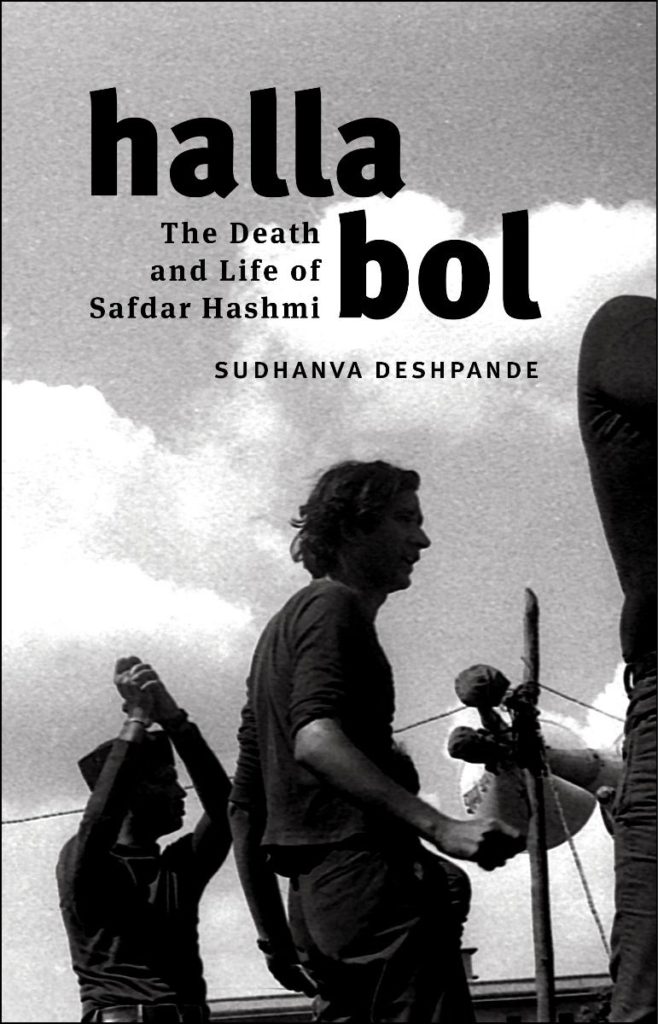
Sudhanva Deshpande’s Halla Bol: The Death and Life of Safdar Hashmi is an account of the left activist Safdar Hashmi who was brutally murdered on 1 Jan 1989 at Jhandapur, Ghaziabad. Safdar Hashmi was 34 years old. Jan Natya Manch was staging a 30-minute play called “Halla Bol” on the road when the actors were interrupted by some politicians who wished to cross. Hashmi requested them to return in a little while. They seemed to listen and turn away except they returned bearing iron rods. They attacked the troupe leaving Safdar Hashmi very badly injured. He had been hit on the head many times. By the time of his death Hashmi had been hugely influential in street theatre with his group called Jan Natya Manch or Janam. He was a member of the CPI ( M).
In Halla Bol Sudhanva Deshpande recalls the earth-shattering events of the day. He was one of those who took the injured Safdar Hashmi to hospital. Working “backwards” from the opening scene of the murder of Hashmi, Sudhanva Deshpande recalls the main highlights of Safdar Hashmi’s life. Both men share similar qualities of being street theatre practitioners and a political activists. So while this book is promoted as a biography, it falls more into the category of a memoir and an unusual one at that — a collective memoir. Through much of the book Deshpande is able to rely upon memory as in many instances he bears witness to the events that occured but for many others he interviewed many people who knew Safdar Hashmi and/or had worked with him. There is a veritable army of people mentioned in the text and acknowledged at the end of the book too. It is a democratic inclusiveness of all those who knew Safdar Hashmi — as a man, a colleague, a relative, a theatreperson, a political activist etc. Deshpande’s account while highlighting that Hashmi used the arts for communicating his politics. As cultural critic Kunal Ray mentioned in his review of the book, “Street theatre is political. It began as a workers’ movement against capitalism. As a medium of performance, it facilitates direct conversation or confrontation with the audience or onlookers defying the restrictions and gentility of a proscenium space. It also undermines the hierarchy of the performer and the audience. Street theatre is democratic and Safdar Hashmi believed in a vision of the arts that is secular and people-oriented. He also believed in an art advocating social justice. It is therefore impossible or perhaps unpardonable to think of Safdar without his politics.” ( Kunal Ray, “Review: Halla Bol – The Death and Life of Safdar Hashmi by Sudhanva Deshpande”, Hindustan Times, 24 April 2020) . Interestingly enough National Street Theatre is 12 April which is also Safdar Hashmi’s birthday.
Nandita Das, Sudhanva Deshpande, Moloyshree Hashmi et al reading out the first two scenes of Halla Bol in Mumbai, March 2020.
Halla Bol is an interesting testimony of a life well lived and rudely cut short by hooligans. It may be considered a biography but is more of a primer on theatre in India with a fascinating account of the evolution of street. More importantly an amalgamation of traditional forms of artistic expression that was combined with drama for a public performance. Today we take this for granted, whether watching a play, reading a book or even watching a film. In the 1980s it was still a brand new concept and had the desired impact upon the audience, mostly workers for Jan Natya Manch performances, and who suddenly did not feel alienated any more from cultural performances as plays like “Halla Bol” used vocabulary, situations, dialogue etc that was familiar — “Just like us”. Safdar Hashmi was undeniably sharp, intelligent, a hugely gifted artist, a visionary and knew how to combine smartly political acts with creative expression. Yet there are moments in the book which make it seem like a hagiography since all those interviewed or reminiscing about Safdar Hashmi continue to miss the man fiercely. In a biography one expects there to be a distancing between the author and his subject offering a perspective to the reader but this does not always happen in Halla Bol. Nevertheless this book is a treasure trove of memories, a people’s history of theatre movement in India, evolution of street theatre, documentation of various attitudes towards performing theatre, empowering future generations of theatrepersons by enabling them to be confident in borrowing elements from traditional forms of theatre/ folk art and making it their own. Within months of its publication the book has been translated into quite a few Indian languages. It is a seminal book on Indian theatre.
Twenty-first century is being touted in publishing as the age of memoirs/biographies. Everyone has a story to tell. People always have. Now with technology making it “easier” for people to share their personal stories, there is a deluge of the “I, me, myself” stories. These shifts in telling narratives are impacting the texture of stories being told. But what continues to stand out are extraordinarily well-researched, brilliantly told, almost meditative narratives that focus upon the particular but persaude the reader to look beyond, to think, to reflect. Two such books that I read recently are: Hallie Rubenhold’s The Five: The Untold Lives of the Women killed by Jack the Ripper and Samanth Subramanian’s A Dominant Character: The Radical Science and Restless Politics of J.B.S. Haldane
Historian Hallie Rubenhold’s The Five: The Untold Lives of the Women killed by Jack the Ripper is a fascinating account of building together biographies of Jack the Ripper’s victims. The canonical five — Mary Jane Kelly, Catherine Eddowes, Mary Ann Nichols, Elizabeth Stride and Annie Clapman. For more than a hundred and fifty years it was firmly believed that these victims were prostitutes. With her impeccable research and marshalling of empirical evidence by scouring police records, newspaper clippings of the time, witness testimonies, reviewing of historical socio-economic and political facts and consistently making it available to the modern reader in an immensely accesible narrative, makes Hallie Rubenhold’s book a dream to read. It is packed with information. Each woman has a section devoted to her, giving a birth-to-death biographical account, neatly interspersed with explanations from contemporary accounts of what could be the rational explanation for the woman’s behaviour or what was a reaction to socio-economic conditions prevailing at the time. More importantly Hallie Rubenhold teases out from history the despicable attitudes towards women that probably contributed to the social downfall of these women, ultimately making them vulnerable to criminals such as Jack the Ripper. Interestingly enough, not once, does she ever give a graphic description of the body disovered at the crime scene or shares details of the autopsy reports. Instead there are a few photographs and illustrations tipped into the book along with a seemingly mundane list of the possessions found upon the women’s bodies. A list that in most cases highlights that these were extremely poor women. Nevertheless these women were careful about appearances as is evident from the list of grooming articles found upon their persons. What is truly remarkable is that The Five is not just a historian delving into the past and putting together bits and pieces of information to create a clear narrative, a short biography of the women victims but it is also an attempt to recover the dignity and respect that these women deserved. The only time Hallie Rubenhold betrays her fury is in the concluding paragraph of the book.
It is only by bringing these women back to life that we can silence the Ripper and what he represents. By permitting them to speak, by attempting to understand their experiences and see their humanity, we can restore to them the respect and compassion to which they are entitled. The victims of Jack the Ripper were never ‘just prostitutes’; they were daughters, wives, mothers, sisters and lovers. They were women. They were human beings, and surely that, in itself, is enough.
Hallie Rubenhold won the 2019 Baillie Gifford Prize for Non-fiction with The Five. It is a prize well deserved for historical research that unearths so many truths that were for so long masked in one-sided, most often imbued with patriarchal perspectives. It is modern day research arguing and bolstering every single observation about the victims by going far back in time and piecing it together meticulously. With The Five Hallie Rubenhold has done a great service not only for the five victims but also created a fresh way of looking at Victorian England and at historical research much in the way that Hobsbawm’s trilogy about the long nineteenth century did. ( Although Rubehold never cites Hobsbawm in her bibliography.) Revisting the past with the tools of the present to investigate and understand and get to the truth by assessing the facts for what they are rather than imposing one’s own modern judgements and reading. Read The Five. An immensely readable history book that reads like an astonishingly well-written nineteenth century novel.
Award-winning writer and journalist Samanth Subramanian’s biography of geneticist H.B.S Haldane has been long awaited. Every fortnight Samanth Subramanian also ran a podcast called The Intersectionthat melds culture, science and history in India. ( Shortly the backlist will be made available on Spotify. Worth listening to!) So it is no surprise that A Dominant Character: The Radical Science and Restless Politics of J.B.S. Haldane melds together cultural and historical contextual references along with Haldane’s scientific temperament. This is a biography that follows the classic definition of a biography of following step-by-step every major development of Haldane. Of course there is a sufficiently long preamble emphasising that Haldane was in many senses the product of the Victorian Age. His curiosity and asking innumerable questions was a trait very similar to that of his father, John Scott Haldane. Haldane Senior a physiologist was known to have gone on madcap experiments in the pursuit of science such as he entered, in the middle of the night, the crowded one-room tenements of slum dwellers where more than six or seven persons lay sleeping in a room holding a vial aloft to collect a sample of the air. Like his father, J.B.S. Haldane was not averse to experimenting upon himself. He had seen his father do it. He had also assisted his father in conducting these experiments such as checking the atmospheric pressure below water wearing a submarine suit. This methodology of self-experimentation became Haldane’s trademark. Some of his more outrageous experiments were to drink hydrocholoric acid or to enclose himself in an airtight space to monitor the effects of carbon dioxide in his blood stream — about which he complained bitterly for it having given him a terrible headache. Haldane was particularly gifted in being able to work with numbers. What comes through very clearly in this biography is that Haldane was known for his irascible temperament and did not suffer fools easily but was quite at peace absorbed in his world, fiddling with mathematical equations. For example Haldane estimated way back that the mutations in the haemophilia gene was equivalent to roughly one mutated nucleotide per 25 million. The full human genome contains roughly 6.4 billion nucleotides. In 2009, a study conducted by the Wellcome Trust Sanger Institute in England using sequencing technology showed that there is one mutated nucleotide per 30 million. Incredibly Haldane with his pen and paper scribbles and before the structure of the DNA had been discovered had come within spitting distance of what is now believed to be the true figure.
Haldane was extremely bright. He learnt to read at the age of three, and at four, after injuring his forehead he famously asked the doctor, “Is this oxyhaemoglobin or carboxyhaemoglobin?” And as is the case with exceptionally gifted children, they keep their adults on their toes. Haldane was no exception. He found his stability at home. His mother particularly was his anchor. Later he had his ups and downs with his educational institutions including Eton College. It was evident that he required understanding and sympathetic adults around him otherwise he would lose his keel. He had cleared the Eton entrance exams easily, topping the list of successful candidates in that year. Yet his grades began to take a sharp dip as he was bullied for what was perceived as arrogant behaviour. Later his circle of acquaintances in Cambridge recognised this rudeness as merely his impatience with those around him as Haldane was constantly needy for stimulating conversationalists. Fascinatingly his circle of friends included Julian Huxley, brother of writer Aldous Huxley. While he was young Haldane could be contained and his excessive amounts of energy were (mostly) constructively channeled. In his adulthood he was more or less a loose canon. Doing as he pleased as long as it enabled him to focus on his passion — his work. It did not make him very popular with many people but he did not really care. Perhaps it was this obstinate trait in him that enabled him to believe wholeheartedly in communism. So much so that Haldane’s blind faith in the ideology clouded his scientific temper to see the merit of biologist and plant breeder Nikolay Vavilov who fell victim to Stalin’s purges. Instead as Subramanian recounts in his splendid biography, Haldane in the battle of the geneticists in Stalinist Russia batted for Lysenko, a Stalin favourite, vs Vavilov, a true scientist. In 1943, Haldane was invited to participate in a BBC symposium on the Lysenko controversy. According to Subramanian, Haldane “delicately” handled Lysenko’s primary claim to fame, “the vernalization of wheat” even though it invalidated Haldane’s own research and went against everything that Vavilov had proven via his experiments.
There are many more details in Haldane’s extraordinary life such as being a possible spy, being followed by the MI5 ( the poor suffering agents had to sit through long lectures on the sex life of extinct fungi or a Science for Peace meeting). In 1956 Haldane left London to take up a job as the head of the biometry unit at the Indian Statistical Institute, Kolkata. This was when renowned mathematician P. C. Mahalanobis was the director. Haldane moved lock, stock and barrel to India believing that the country shared his socialist beliefs. After a run-in with Mahalanobis, Haldane moved to a newly established biometry unit in Orissa. He died due to cancer on 1 December 1964 and as a true scientist he donated his body for medical research and teaching.
Samanth Subramanian takes the art of writing a biography to a new level. Packed with information. Detailed, impeccable research, with plenty of end notes and a select biography which runs into a few pages of fine print. A Dominant Character seems to be the new kind of biography where you delve into data as much as you can to recreate a life on paper, with all the highs and lows of the person being chronicled and with no judgement on the part of the author. It is a presentation of facts. It is an interesting balance to achieve as it could not have been easy to put down on paper. In it there is something for everyone — the lay reader, the scientist, the historian, the geneticist, the science historian, researchers etc. It is a form of resurrection in popular forums that is bound to be influential for years to come. In fact it would be fascinating to hear a conversation between Samanth Subramanian and Dr Siddhartha Mukherjee on the science of writing biographies. Till then read A Dominant Character!
Biographies are a useful access route into a slice of history. Through the lens of the personal they enable readers to get their bearings of historical events. It is a pleasurable learning experience if these texts are authenticated by facts as is the case with these two remarkable books.
Earlier this year I read two brilliant books. Both happened to be biographies. One is the long, detailed biography of Thomas Cromwell: A Life by Diarmaid MacCulloch which took the better part of a decade to put together. In it he has scoured empirical evidence, mostly documents, scattered in different libraries and collections to create a magnificent biography of a man who rose from being the son of a blacksmith in Putney to the chief minister of Henry VIII in London. It is detailed and rich and yet not tedious to read.
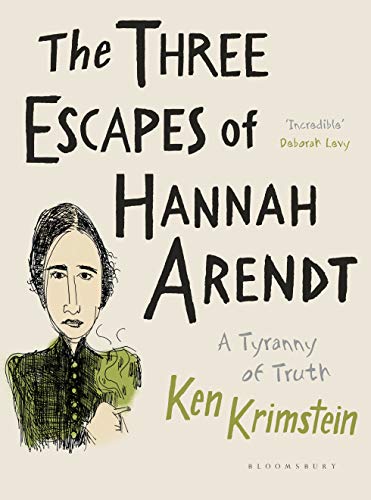
The second one is a graphic novel written and illustrated by New Yorker cartoonist Ken Krimstein. The Three Escapes of Hannah Arendt: A Tyranny of Truth was more than three years in the making but is one of the better introductions to Hannah Arendt that has been ever written. While the images and story frames continue to keep the plot moving in a straightforward narrative style, it is the layout consisting of footnotes and slowly increasing shades of green, till the last frame is soaked in the colour, that makes this a layered and textured reading.
Months after having read these two magnificent biographies, I came across the Guardian podcast where amazingly enough these two authors were speaking in quick succession. Have a listen:
The Women in Translation (#WiT) month is celebrated annually in August. There was a flurry of activity online with a number of gems being unearthed and discussed. It is a really fascinating time to discover new writers, new translators, new publishers etc. Whilst I enjoyed reading the various articles, interviews, profiles and even book extracts that were made available online, I realised there was a deafening silence from the Indian subcontinent.
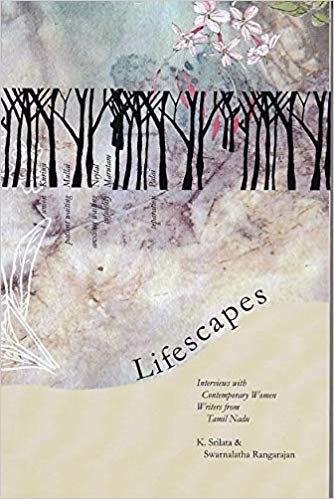
Another fascinating aspect of the Indian publishing industry is that as it grows, the market grows, and so does the interest in the craft of writing. For long writers have written and published their works in various literary magazines, “women’s magazines”, newspapers etc. Of course there are now online literary spaces, discussion forums and sometimes even in the print media where writers are interviewed and their craft discussed. But interviewing writers, especially women, is an art unto itself. Women writers inevitably have to find the time to write amongst the rhythm of many other duties and commitments they need to fulfil. This was more so in the past than now when increasingly there are more and more “professional writers”. Even so, reading about the craft of writing by women writers continus to be an exciting world since irrespective of socio-economic class, many writers share the same concerns and have similar pressures. Women Unlimited, an associate of Kali for Women, has for years published interviews with women writers. Their latest publication is Lifescapes: Interviews with Contemporary Women Writers from Tamil Nadu. The Tamil publishing landscape is not an easy one to understand with many interesting threads running through it, all of which were influential upon the seventeen women writers interviewed by the editors — K. Srilata and Swarnlatha Rangarajan. While the interviews themselves are insightful, it is the structural arrangement of each entry that is fascinating for it has the mandatory biography about the author, a sample of her writing, a head note by the editors introducing the writer and why they chose her specifically to be included in the anthology and finally, the interview. Every detail adds just sufficient information creating an image of the writer that the reader definitely wants to know more about.
Ever since World Literature began to open new publishing horizons in the Anglo-American book market as well as the growth of the desi diaspora as a lucrative readership, did the spotlight on translations from regional languages into English become an attractive proposition for many firms. As a result there is a feast of offerings particularly as the multi-national publishers expand their fare. Be that as it may there are some fabulous publishers such as Women Unlimited, Zubaan, Orient Black Swan, Speaking Tiger, Permanent Black ( on occasion), Aleph Book Company, Yoda Press, Westland/Amazon and Oxford University Press that have been publishing translations for a while. It is impossible to list all but here some of the wonderful titles published recently.
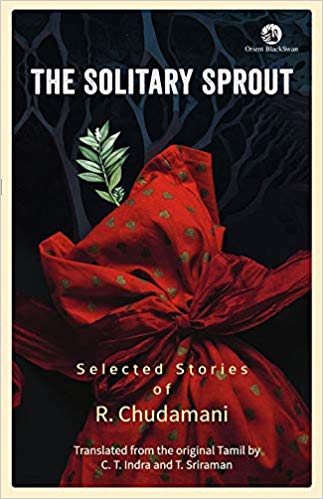
The Solitary Sprout: Selected Stories of R. Chudamani ( translated from Tamil by C.T. Indra and T. Sriraman) is a fabulous collection of short stories. In fact, R. Chudamani (1931-2010) has often been considered as an early feminist among Tamil writers. The Solitary Sprout is a wonderful selection of Chudamani’s short stories with “No fury like a mother’s”, “Herself” and “Not a stepfather” standing out as very modern stories. It is hard to believe that these were written many decades ago. The sharp insight and clear ideas that the writer shares can take one’s breath away even now. For instance, “No fury like a mother’s” is about three mothers of young schoolgirls who are furious at how their daughters are ill-treated by their school teacher. The punishment meted out to the young girls by the teacher is to strip the girls publicly. The three mothers team up and pressurise the teacher to resign otherwise they threaten to mete out the same treatment to her as she did to their daughters. “Herself” is about a mother who once her children are married and settled with families of their own, discovers her trueself and becomes a music teacher as well is a voluntary worker at the Primary Health Centre in her village. Much to her visiting daughter’s dismay who had expected a month’s vacation at her parent’s home free from all responsibilities including babysitting her own son. Instead the daughter discovers she has to pitch in with household chores at her parents home and continue to look after her own son. She is deeply disappointed and upset as her memories of her mother was one who was always free and available for the family. It rattles the daughter. More so as her father supports his wife’s actions and sees no wrong. “Not a stepfather” addresses issues like widow remarriage, single parenting, stepfather etc. It is beautifully told from the perspective of the disgruntled mother of the bride who is not amused that her daugther has remarried and expects the new husband also to take care of her young son. It is complicated but within the first visit of the newly married couple to the mother’s house, the son warms up to his new father and gets the blessings of his mother-in-law too. It is a powerful story as it raises so many questions about gendered and social expectations of a woman and a man. The Solitary Sprout is worth reading, sharing and discussing in more forums. These are stories that need to be told more often.
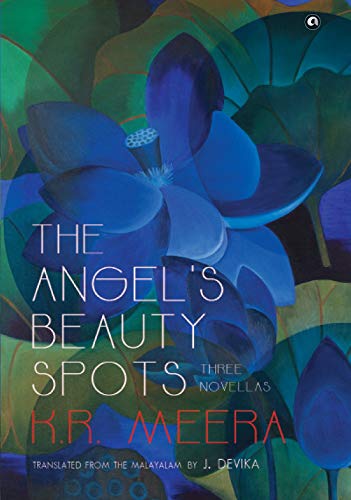
Prolific and powerful writer K. R. Meera has a new collection of three novellas called The Angel’s Beauty Spots. As often is the case with K. R. Meera’s stories, she explores love and its various angles. Sometimes well meaning and powerful love for all intents and purposes can go horribly wrong as in the title novella. K. R. Meera’s stories have this remarkable quality of taking the wind out of the reader’s sails with the horrific and at times inexplicable sequence of events except that some bizarre form of love propelled many of the decisions taken by her characters. Somehow the team of author and translator, K. R. Meera and J. Devika, works well. It is difficult to pinpoint an exact reason but the translation reads smoothly without losing any of the cultural characteristics of sharing a story set in Kerala and written in Malayalam. It just feels perfectly satisfying to read.
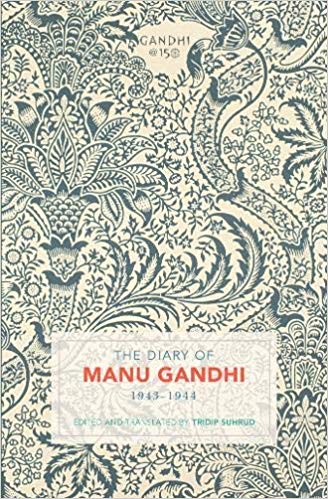
The Diary of Manu Gandhi ( 1943 – 44) are the diaries written by Manubehn ( Mridula) Gandhi, who was the youngest daughter of Mahatma Gandhi’s nephew, Jaisukhlal Amritlal Gandhi and Kasumba. These diaries are preserved in the National Archives of India and for the first time are being translated and edited from Gujarati into English by Tridip Suhrud. Manu Gandhi as a young girl had been encouraged by Mahatma Gandhi to maintain a diary. Manu Gandhi was the one walking beside Mahatma Gandhi at Birla House before his would-be assassin, Nathuram Godse, pushed her aside, so as to be able to shoot his target.
Diary-keeping of Gandhi was an essential duty for all those engaged in pursuit of truth and hence obligatory for Ashramites and satyagrahis. He constantly urged the Ashram community and constructive workers to maintain one. ….A daily diary,he believed, was a mode of self-examination and self-purification; he made it an obligatory observance for all those who walked with him on the Salt march.
While The Diary of Manu Gandhi ( 1943 – 44) is of more academic and historical interest to many readers, it is accompanied by a fine commentary by Gandhian scholar Tridip Suhrud. He offers insights about maintenance of a diary, the translation process, making available critical empirical material such as these diaries which till now many knew of its existence but not many could access. It also documents the growth of a young, under-confident girl to a mature person as evident in the style of her writing, longer sentences, more time spent describing incidents rather than restricting it to scribbles as many of the early entries are. Interestingly, as Tridip Suhrud points out in his introduction, Mahatma Gandhi or Bapu as he was known, would often read and scribble his thoughts in the margins of Manu Gandhi’s diaries. Ideally though it would have been a preferable if in this volume an interview with Tridip Suhrud with a leading gender/oral history expert had been included. It would then give some critical insights in what it means to translate a young girl’s diary many decades later by a highly reputed Gandhian scholar. With due respect even the best academic scholars tend to gloss over certain gender issues that irrespective of how many times they are repeated continue to be important and need to be highilghted. At the same time it would be fascinating to see what emerges from the conversation of a Gandhian expert with a gender expert to see how much Gandhian ways of living influenced the minds and hearts of those in the Ashram or did the basic gendered ways of seeing also get scrubbed away.
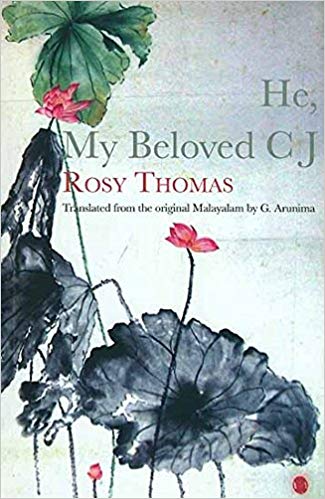
Speaking of memoirs, Rosy Thomas’s He, My Beloved CJ about her life with her husband and well-known Malayalam writer and critic, C. J. Thomas. It has been translated by G. Arunima. C.J. Thomas died young. His wife wrote this memoir much later. While it is a very personal account of her courtship, her marriage and the brief time she spent with her husband during which he opposed her desire to seek employment. Apparently in the Malayalam text, Rosy Thomas often refers to her husband as moorachi ( a colloquial term for conservative). Hence within this context it is quite amazing to read an account of a life that does not necessarily romanticise the couple’s love but is able to subvert the prevalent notions of wifehood. It has descriptions of their homes, their families, their circle of friends and at times some of their discussions on art, creativity and politics. At least in the memoir she comes across at times an equal participant despite his conservative mindset on having a wife who earned a living. Be that as it may, the monotone pitch at which the memoir is written or has been translated in —it is difficult to discern the difference — does not make He, My Beloved CJ easy to read. Of course it is a seminal book and will for a long time be referred to by many scholars interested in knowing more about the literary movement in Kerala or about the legend himself, C. J. Thomas — a man who seems to have acquired mythical proportions in Kerala. How many will access it for being a woman’s witnessing of a fascinating moment in history, only time will tell. Meanwhile the translator’s note is worth reading. G. Arunima writes:
…this biography is as much about C J Thomas and their marriage, as it is about Rosy as a writer. The act of remembrance is also about fashioning her own self and subjectivity, both as a ‘loving’ subject, and as a ‘writer’ and raconteur, observing, weighing, annotating and narrating their life as a text. Rosy Thomas grew up in a literary home; her father, M P Paul, was an intrinsic part of the Progressive Writers’ Movement, the Sahitya Pravarthaka Sahakarna Sangham ( Literary Workers’ Cooperative Society) and had also set up the tutorial college that was named after him. Writers, books and a culture of reading were a central part of her life. Even though these reminiscences do not dwell too much on her own literary or political formation, it is evident that CJ’s world wasn’t alien to her. In her later life she was to become a published writer and translator in her own right; such creativity is obvious even in this text where the nuances of a remembered life are testament to her wit and literary flair.
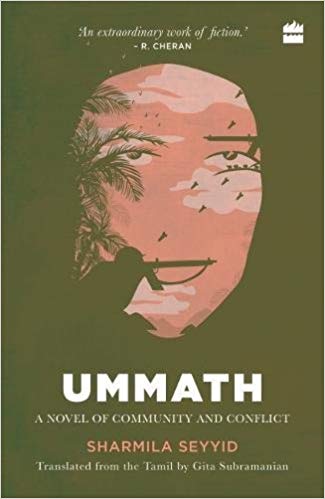
There are many, many more titles that one can discuss such as Sharmila Seyyid’s Ummath: A Novel of Community and Conflict. It is set during the three decades of the Sri Lanka’s civil war. It is told through the lives of three women, Thawakkul, Yoga and Theivanai — one a social activist, the other a Tamil Tiger forced into joining the movement as a child, and the third a disillusioned fighter for the Eelam. The novel has been translated from Tamil by Gita Subramaniam. While it immerses one immediately into the strife torn landscape, it is also puzzling as sometimes the voices of the three main characters seem to acquire the same pitch, making it seem as if the author’s own devastating firsthand experiences of the conflict are making their presence felt throughout the narrative. It is impossible for the English readers to ever solve this puzzle but there is something that comes through in the translation and is not easy to pinpoint. While promoted as fiction, it is easy to see that Ummath with the insights it offers, nature of conversations documented and descriptions of the landscape make this novel a lived experience. This is a challenging story to read but is worth doing so as the conversations about women/gender and conflict are relatively new in public discourse and need to be share more widely.
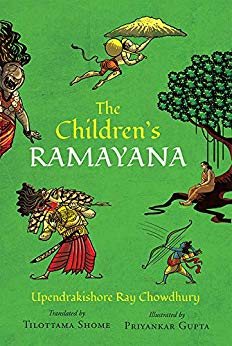
The final book in this roundup is a translation from Bengali of Upendrakishore Ray Chowdhury’s The Children’s Ramayana by first-time translator Tilottama Shome. It is the Ramayana told with its basic story sans the many digressions and minor tales. It is the epic with many of the popular stories retold that many generations of Indians are familiar with. It does not come across as a novice’s attempt at translation. In fact as she says in her translator’s note, “I have tried to retain that delightful quirky tone and the hint of humour told with a straight face that has endeared Upendrakishore Ray Chowdhury’s works to readers for generations” seems to be true. Again it is impossible for English readers to confirm this fact or not but there is something about the zippy pace, ease of reading, a rhythm to the storytelling, making it immensely attractive to read. Perhaps Tilottama Shome being a trained singer ably assisted her in finding the rhythm to this translation. There is something to be said for a trained musical ear and discovering the cadences of a written text making the translation from one language/culture to the next a pleasurable experience!
Supriya Kelkar’s debut YA novel Ahimsais about 10-year-old Anjali who is unexpectedly pulled into the Indian Freedom struggle in 1942 when her mother leaves the family to become a freedom fighter. A brisk pace and an alignment with current social sentiments makes the book particularly apt for our times. It highlights communal tensions, riots, lynchings, prison conditions, the Quit India movement, Gandhi, and the beginnings of Indian nationalist fervour. In the process, it also steps into the vacuum that is literature on the freedom struggle for children.
Supriya Kelkar was born and grew up in the USA, learning Hindi by watching Bollywood films. After college she got a job as a screenwriter for Hindi films. Ahimsa is inspired by her great-grandmother Anasuyabai Kale’s role in the Indian freedom movement. Kelkar spoke to Scroll.in about her book and her writing in general. Excerpts from an email interview:
Why did you choose to write an activist-oriented novel from the perspective of ten-year-old Anjali? I actually first had the idea to write this story as a biopic screenplay of my great-grandmother’s story about fifteen years ago. I tried and the script just wasn’t working and then decided to try it as a fictional story. I realised the more interesting point of view in the story wasn’t that of someone who already believed in the cause. It was of someone who was privileged and not yet ready to confront that privilege.
So I decided to tell the story from the point of view of a ten-year-old girl whose mother joins the freedom movement. I’m really happy with the choice. It allowed Anjali to grow and change so much over the course of the story from a young girl who is happy with the status quo, who loves her fancy clothes, and who doesn’t really understand fully her relationship with her colonisers, to one who is ready to make personal sacrifices, be an ally, and stand up for what is right, strong and confident that her voice can make a difference. It’s a pretty big arc and big awakening for Anjali.
The title, Ahimsa, is synonymous with Gandhi and the Indian freedom struggle. Yet it resonates decades later with the younger generations. What made you think of it The title was one of the first things that came to me when writing this story as a novel, and is one of the few things that has remained from the first draft I wrote back in 2003. Since it was one of the themes of the book, it was an easy choice as a title. But my hope is that the true meaning behind the word really resonates with young readers today, as they realise how powerful their voice is, and how they can make a difference through words and peaceful action and not violence.
What changes did you make in the book over these years? I think other than the very first moment and the last paragraph, everything in the story has changed over the fourteen year-long journey to publication. It took me a long time to be able to figure out what the crux of the plot should be. And that’s the beauty of revision. Once I was able to become detached from my words and hit the backspace key with abandon, I was able to throw out large chunks of the story that weren’t working and figure out what was. I think my characters and their arcs became stronger with each draft, and they definitely became more realistic, as I worked hard to make sure Anjali was flawed and had a chance to grow, and Captain Brent was able to grow and change too. I write on the computer, but will initially brainstorm on paper by hand. But all my outlining and writing is done on the computer.
Navigating historical landscapes at the best of times is tricky and yet you do it with such deftness. How many revisions did this manuscript require? I wrote the first draft of Ahimsa in 2003. It was terrible and I was ready to give up, so I set it aside and went back to working on screenplays. But every year, between screenplays and other novels I was writing, I would remember Ahimsa exists and go back to it, throwing subplots and characters and scenes out and adding new things in. This went on until 2016, when it got a publishing contract. And after those thirteen drafts, I did four more revisions with my editor, so there were seventeen drafts in total.
In her memoir Ants Among Elephants, Sujatha Gidla quotes her uncle, Satyam, remembering an incident soon after India achieved independence. “A short, chubby dark boy…had a strange question for Satyam, one that Satyam had no answer to: ‘Do you think this independence is for people like you and me?’” Do you think this question remains valid even today for Dalits? That is a really powerful quote. While I cannot speak for the Dalit community, I can speak from my experiences growing up and living in America. Here, although equality is a right and on paper everyone should be equal, it is very clear things are not the same for everyone. Systemic racism exists. Discrimination against people based on the colour of their skin or sexual orientation or religion or zip code exists. Hate crimes exist. I think the same can be said in India and in many countries.
Privileged people have to work to confront their privilege and be allies to others. Young readers and older readers alike should be aware that not everyone has the same start in life because of centuries of oppression and discrimination be it based on their skin colour, gender, sexual orientation, last name, etc. When that basic premise is accepted, people can work to address and correct inequality and injustice.
The issues of untouchability, social exclusion and women empowerment are as relevant now as they were in 1942. How did writing historical fiction help you discuss modern instances of these? It really wasn’t until about a decade into revisions that I realised just how relevant historical fiction can be. I was stunned when things I was writing about in 1942 India were being mirrored in 2016 in America. It made me realise we have come a long way and yet we haven’t.
Women are still not considered true equals everywhere, be it in the way girls and women are sometimes treated in India or how women still do not get paid the same amount as men for doing the same job in America. People are still writing narratives for their countries, be it India, America, or anywhere else, and deciding who is included and who is excluded in their nationalism, and who is being centered. And people are still being treated as less-than all over the world. For me, writing historical fiction helps bring light to all these issues, and it is really incredible to see young readers making these connections as they read Ahimsa and see how the story can be applied to their world.
How much research did Ahimsa require? A whole lot! I read many books and went to academic websites for the timeline and historical facts. I used my great-grandmother’s biography, Anasuyabai Ani Me, to help me fill in the gaps for the way some people thought and how they acted at the time. I consulted professors. I spoke to older family members who lived through the time period. And I relied a lot on my parents to help me fill in cultural details. I actually have several of the pictures of the real-life people, places, and things that inspired parts of Ahimsa on my website for educators and readers.
Historical fiction as a genre requires a ton of research. You have to ensure your book works on a narrative level but you also have to make sure the clothing, the food, and the facts are right. And since India is so diverse, what may be true in one part of India for one family may not be true for their relatives in a different part of India. It was part of what made the editing process so challenging. I felt like we were constantly catching mistakes, which is good, because then they could be corrected. The fact-checking was a combination of my own research, my parents and other beta readers pointing things out, and my editor’s questions that helped navigate the fact-checking.
For instance, I had based Anjali’s house on my dad’s childhood house, because much of it was like it had been in the 1940s. But because my memories of that house were from my childhood visits in the 1980s and 1990s, there were mistakes. I had always described people standing to cook in that kitchen in the book. But my dad caught that mistake and told me although the stove was on a counter when I saw the house, back in the 1940s, the cooking was all done on the floor. So I went back and rewrote the kitchen scenes to reflect that.
ADVERTISEMENT
Writing historical fiction in the age of the internet and fake news can also be challenging because you have to make sure the online sources you use are real. It wasn’t until one of the last edits before publication, when I was double and triple checking everything, that I realised that the Gandhi quote I used in the book, “Be the change you wish to see in the world,” was incorrect. There was no proof that he ever said that, but thanks to pop culture, the saying can be found all over America on T-shirts and mugs and written on school walls, attributed to Mahatma Gandhi. I had to research a lot to find a quote that there actually was a record of that could still work in the book.
It is well-documented that atrocities against Dalits persist in India. Ahimsa is not strident, however, leaving it to the judgement of the reader to form an opinion about Dalits. How critical do you think it is as a writer to exercise one’s artistic expression in making stories available that are of utmost social concern to sensitise young readers? I think authors of children’s book authors have a great responsibility in presenting real world issues in an age-appropriate way. As parents, we often want to shield our children from the bad parts of life. But when they are old enough to handle the information, if we continue to shelter them from reality, I think we are doing a disservice to their generation.
In America, there was (and is) a prevailing way of thinking when I was growing up, called being “colour-blind.” We were taught in school that there is no difference between people based on their skin colour and it isn’t polite to talk about race because we shouldn’t see race.
Although that may seem like a really wonderful way to think about the world, studies have shown that teaching kids to be “colour-blind” leads to children who cannot accept that there is systemic racism, or that someone with a different skin colour than them would have a different life experience than them, be treated by the police differently, or be treated by society differently.
I have experienced that first hand, where so many of my classmates walked the same hallways in school as I did but were utterly unaware of racist incidents happening every day in school. And I witnessed those same kids being unable to accept that people who weren’t white got treated differently in America. So it’s actually doing children a disservice to not talk about race and how the colour of your skin in America does affect how you are treated and the opportunities you have.
That’s why I think it is really important for children’s book authors to not gloss over real-life issues. Young readers are smart and shaping their world view at the middle-grade reader level, so it is absolutely critical that we don’t talk down to them or ignore issues of social justice, and other important issues, in books for them.
What has the response of students been like? Have the reactions varied depending upon the audience? For instance, do Americans have a different response to that of Indians or the Indian diaspora? Or do all young readers respond to the book in similar ways? I’ve actually found that readers in America, both from the diaspora and not, and readers in India have all been able to deeply connect to the story. Not only that, so many of them have been able to apply the themes of social justice in the book to the real world, regardless of where they live. I’ve had young readers in America tell me they have been inspired to speak up because of Anjali, that they have decided to get more involved in a cause they believe in because of her, and that the story has opened their eyes to injustice around them. And I have had young readers in India tell me they know they can use their voice to change the world because of Ahimsa.
One reader in Delhi told me that she had never really paid attention to how privileged she was until she read Ahimsa. She was chauffeured to school and often tuned out any suffering she saw outside her car window because she was so used to seeing it her whole life. She told me that, thanks to the book, she will no longer ignore others’ suffering and wants to make a difference and knows she will. So although the issues children in different parts of the world (or often the same country) can relate back to Ahimsa may be different, I have found they can all find a way to connect to the story.
Ahimsa moves at a crisp pace while being packed with details, many of which are noticed on a second reading. How did you develop a love for storytelling? Who are the storytellers who have influenced you? Thank you very much. I developed a love for storytelling thanks to the hundreds of books I read as a child, and thanks to Hindi movies. With each book I read and movie I watched, I was learning about plot and pacing and what works in a story and what doesn’t. Being surrounded by books and movies as a child, I couldn’t think of doing anything else in life but telling stories.
There were several authors whose stories I loved and learned from, like Holly Keller and Beverly Cleary. But the first storyteller who influenced me in person was my dad. He is an engineer but also wrote a lot on the side and was always introducing me to the power of words through the plays he acted in and directed for the Indian-American community we lived in. When I was growing up I saw him writing a script weekly for his Indian radio programme which airs in America and now thanks to the internet worldwide. He also wrote stories and even wrote a couple of screenplays for Hindi movies decades ago.
The other storytellers who have influenced me are people I consider myself so lucky to have got the chance to learn from. I had the great fortune of being taught screenwriting at the University of Michigan by Jim Burnstein. He is a Hollywood screenwriter and incredible teacher who taught me everything I know about structure and outlining and making sure there is logic in your writing.
I had the privilege of working for Vinod Chopra Films right out of college. Vidhu Vinod Chopra taught me so much about making sure your stories are entertaining while saying something. It was through working with him that I learned to really be ruthless in revisions, and go from an impatient novice to a writer who knows the value of revising, even if it takes years to get things right. Abhijat Joshi taught me how to shape a story, and how to really dig deep to get to the crux of a scene and make sure it hits emotionally. And I learned from Rajkumar Hirani how to fill my writing with heart and do justice to each character’s arc, while always keeping the theme in mind.
Did writing for Bollywood films inform the very visual narrative of Ahimsa, or do writing styles vary? Do you find writing for young readers is vastly different to writing scripts for movies? I actually had to unlearn some of my screenwriting training to write novels. In screenwriting you don’t waste time describing the way someone dresses or the way a room looks or the physical way a character responds unless it is absolutely vital to the plot. That’s because the screenplay isn’t the final product.
A costume designer will decide what clothes characters wear, a set designer will decide how rooms should look, and a director and the actor will decide how they physically react to moments. Because of this, through many drafts of the book, I did not describe how my characters interact with their world to show their emotions other than in basic ways like their shoulders slumping or their smile turning down. It was only in the later edits, when my editor pointed this out, that I was able to momentarily let go of the screenwriter in me and really describe what a character was doing physically.
Other than that, I don’t find writing children’s books that different from writing screenplays. I still use a three-act screenwriting structure in all my novels, and find that the basics of plot and character are really the same in both forms of writing.
Was it challenging to find a publisher, or was it an easier process with the “We Need More Diverse Books” movement? It was challenging. I had tried for over a decade to get an agent in the publishing world for Ahimsa and other books but I just kept getting rejection after rejection, despite my screenwriting credits. Growing up never seeing myself in a book, I never really thought a children’s book set in India could get published in America. Other than Ahimsa, for almost fifteen years, I only wrote stories featuring white families because I thought that was all that could sell.
As an adult, I saw a couple of children’s books set in India being published and it gave me hope. I’m so grateful to We Need Diverse Books and everyone involved in speaking out for the importance of diverse stories. I was lucky Ahimsa was published by Tu Books, an imprint of Lee & Low Books, the largest multicultural publisher in America. And I’m lucky it’s been published in India by Scholastic. But there is still much work to be done to make sure every child gets to see their story reflected in a book.
How did the striking cover design come about? Unusually, both the American and Indian editions have used the same design. Did you have a say in it? Yes! I love the gorgeous cover so much. It is by a UK-based artist named Kate Forrester. I love the way she uses intricate design and symbolism and hand-lettering in her book covers. I believe I mentioned that peacock feathers would be nice in the design because of their symbolism in the book and I just adore the way Kate worked them in. I also love Baba’s clenched fist, Ma holding the flag, the spinning wheel, and the plants and the reference to the garden and growth throughout the cover.
Supriya Kelkar Ahimsa Scholastic India, Gurgaon, India, 2018. Hb. pp. 308 Rs 295