Bloomsbury India Posts

TOI Bookmark with Nayanima Basu

Journalist Nayanima Basu had a ringside view of the total collapse of the republic of Afghanistan at the hands of the Taliban. From 8 to 17 August 2021, based in Kabul but travelling outside and talking to Afghans across the political spectrum, she sent despatches of the Taliban sweeping through the country, with provinces falling one after another. Covering a hostile war zone, a woman all alone, she saw the fall of Kabul in real time and managed to get out on the last flight by negotiating with Taliban bosses. Basu transports us to the heart of the action with her vivid narration and precise descriptions of what was happening in Afghanistan at large and Kabul in particular. Through her astonishing account of how she did her reporting – from asking gun-toting civilians for help to find her way back to her hotel and being chided by the hotel employees to stay safe in an iron room to being the only Indian journalist to ever interview the ‘Butcher of Kabul’ – Basu tells the story of not just the wreckage of the country’s present but also of the contentious past that lead to it.

Nayanima Basu has penned a truly gripping first person account of the dramatic fall of Afghanistan to the Taliban in August 2021. It reflects her indomitable courage in the face of acute and ever-present danger and her unfailing commitment to professionalism as a journalist. This is outstanding reporting but within a frame of deep political and historical familiarity with a truly complex country.- Shyam Saran, former Foreign Secretary of India

Nayanima Basu has given us a lively and informed account of her stay in Afghanistan at a pivotal moment, just as the Taliban took over the country in 2021. More than a diary of travel in a dangerous, exciting and exotic place, this book is an explanation of a phenomenon, the return of the Taliban, with which the world has yet to come to terms. Its consequences are still playing out, making this a valuable contribution to understanding the increasingly complex geopolitics of India’s periphery.- Shivshankar Menon, Former National Security Advisor and Foreign Secretary of India

An honest and poignant account of what unfolded in August 2021 in Afghanistan, which the world is still grappling with…What makes this book distinctive is the simple narration of an extremely difficult period that once again brought the Taliban back in power.- A.S. Dulat, former Head of Research and Analysis Wing and Special Director, Intelligence Bureau

Nayanima Basu is a New Delhi–based journalist covering foreign policy and strategic and security affairs with nearly two decades of experience. A major in history from the University of Delhi, Nayanima has been professionally associated with several media organisations such as the IANS, Business Standard, The Hindu Group, ThePrint and ABP Network. She has covered stories such as the assassination of former Pakistan prime minister Benazir Bhutto, India’s crucial years at the World Trade Organization (WTO), the global financial recession, India’s evolving ties with its difficult neighbours like Pakistan and China, and bilateral and multilateral summits. In the course of her reportage, she has also interviewed several key Indian and international political and military figures.

I wrote earlier about her book on my blog.

Then, I had the privilege of speaking with her on TOI Bookmark. Here is the Spotify link:

“The Lion of Naushera” by Ziya Us Salam and Anand Mishra

Within weeks of India gaining independence, Kashmir resembled a battlefield because of Pakistan’s repeated incursions to capture the Muslim-dominated princely state. Towering among the soldiers who fought with grit and gumption to foil Pakistan’s designs was Brigadier Mohammed Usman, who chose to remain in pluralist India. Sadly, he lost his life twelve days shy of his thirty-sixth birthday, fighting Pakistani forces. The newly born nation saluted the fearless warrior conferring on him the sobriquet ‘the Lion of Naushera’ for his bravery.

While some heroes have been duly and gratefully feted, others have not always got their due. The Lion of Naushera is an attempt to clear some of the debts we owe to Brigadier Usman. Not only does it tell the story of the brave soldier, it also presents a multifaceted narrative of India – of how people of all faiths, castes and regions fought for the independence of the country and protected its borders.

Read an extract from the book on Moneycontrol. It has been published by Bloomsbury India.

Ziya Us Salam is an eminent journalist and a widely published author. A literary and social commentator, Salam has examined critical subjects through his books Women in Masjid: A Quest for Justice (Bloomsbury 2019), Nikah Halala: Sleeping with a Stranger (Bloomsbury 2020) and Being Muslim in Hindu India: A Critical View (HarperCollins 2024). His other books include Of Saffron Flags and Skullcaps: Hindutva, Muslim Identity and the Idea of India (Sage 2018), which deals with challenges to the idea of India, and Lynch Files: The Forgotten Saga of Victims of Hate Crime (Sage 2019), which focuses on the victims of hate and violence.

Anand Mishra is currently a political editor. As a senior journalist who has travelled across north India to cover key political developments and elections, tracking the evolution of political parties across the spectrum — left, right and centre — in the national capital and the states in the Hindi speaking belt.

Hailing from Gaya in Bihar, Mishra is an English literature graduate. His poems have been published in national and international publications.

“Telling Me My Stories: Fragments of a Himalayan Childhood” by Kunzang Choden

My first introduction to Kunzang Choden was when her manuscript The Circle of Karma was placed on my desk. It was one of the first novels that I edited and thoroughly enjoyed doing so as well. It was also the first book that was placed on the Penguin/Zubaan joint imprint. It was a project that we poured our heart and soul into. We even created a micro-author website for Kunzang to promote her and the book. It was delightful. It was experimental and unheard of. This was in 2004 or so, when the internet was still in its nascent stages and we were using dialup modems to connect to the world wide web. Later, when I organised the book launch at the British Council, New Delhi, it was an incredible experience. The auditorium was packed. Some of us were left standing outside in the foyer. It is then that I noticed a quiet young man standing near the front door, flanked by a bunch of smartly dressed men. It was the then prince and now King of Bhutan, Jigme Khesar Namgyel Wangchuck. He had just finished or was about to finish studying at the University of Oxford. It was extraordinary to see him at the event. But if you read Kunzang’s latest book, Telling Me My Stories ( published by Bloomsbury India), her association with the royal family is explained. Kunzang’s mother was related to the royal family.

I interviewed Kunzang Choden for TOI Bookmark. Here is the Spotify link:

Telling Me My Stories is a stunning memoir that truly exemplifies the title of the book. It is almost as if Kunzang has taken these fragments of stories that she heard, or were passed down generation to generation, and has tried to create a coherent narrative about her family. She was orphaned at a very young age — her father passed away when she was 9 and her mother a couple of years later. Over the years, Kunzang heard stories about them, or was handed pieces of their belongings by various relatives that made her want to patch together their stories. She has done a fine job in this book.

Her skill as a storyteller and as a collector of forgotten Bhutanese folktales and retelling them has become an important art form. Probably in many ways it enabled and empowered her to share the history of her family in the way she has done so. She focussed on herself and her ancestors, shared their stories pleasantly, gleaning facts from bits and pieces of oral testimonies and memories shared by those who knew her family in the past. The conversion of oral tales into the written word, providing a coherent narrative to the story is not as easy as it looks when read. It requires patience, persistence, and plenty of research to connect the dots and produce a chronological narrative. This is what Kunzang has achieved in Telling Me My Stories.

While weaving together her ancestral history particularly that of her parents, she also achieves a remarkable feat of documenting the change in Bhutan: from a closed nation, relying on a barter economy to becoming the modern country it is today. She refers to the various social reforms that the government instituted, including sponsoring Bhutanese children to be educated in India. Kunzang was one of those who benefitted from this scheme even though it entailed a 15-day trek from Bhumthang to Kalimpong. Quite an introduction to a new life when you are merely a nine-year-old girl, leaving home for the first time.

I truly enjoyed reading Telling Me My Stories.

Listen to our conversation on TOI Bookmark. It is available on Spotify.
Here is a snippet:

I mention somewhere that the death of our parents came to us in such a blasé way and we never really had the time and the opportunity to absorb it, to mourn it, to understand it, and it stayed with me. You are right, it is kind of like a healing process for me to write about it, talking to myself about it, and going through the whole process. The time we learned about the deaths and how we had nobody to really help us or guide us. Even to help us to mourn, to cry, to hold us or explain things to us. We sort of just developed, my brothers and I, developed our own coping strategies and that sort of stays embedded in my psyche.

29 August 2025

“The Kargil War Surgeon’s Testimony” by Arup Ratan Basu 

A human story of war as experienced by a doctor who was the only surgeon at the Kargil field hospital

Arup Ratan Basu’s first posting as a young surgeon in the Indian Army Medical Corps was at a field hospital in the Kashmir valley. He was frustrated at being sent to a place that was not even equipped with a functional operation theatre while his classmates were taking up postings at established hospitals in major cities.

Little does the rookie surgeon know that he will soon be deputed to a small town that was turning into a dangerous theatre of war. Between 19 May 1999 and 24 July 1999, as the sole army surgeon at the field hospital in Kargil, he ended up performing two hundred and fifty surgeries, including on an enemy soldier.

Curious and sympathetic, the young surgeon engaged with his patients and colleagues and recorded his impressions in a notebook purchased at the town bazaar. He does not venture into the technical, logistic and strategic aspects of war; instead he remains resolutely focused on the people and the extraordinary price they pay. The result is a one-of-a-kind testimony, invaluable and enthralling.

Read an extract from the book on Moneycontrol.

The book is published by Bloomsbury India.

Shashi Tharoor, MP, endorsed the book saying:

As the first military surgeon on call at Kargil in the summer of 1999-when Pakistani troops, disguised as goatherds, crossed over the Line of Control and besieged critical Indian peaks-Lt. Col. (Dr.) Arup Ratan Basu toiled to rescue nearly 350 of our valiant soldiers from the jaws of death. One can only imagine how helpless he, trained to be a lifesaver, must have felt seeing a steadfast stream of young men marching to their deaths at those inhospitable heights-that too in a war not of their nation’s making.

In Basu’s view, it’s not so much about the futility of war as its untold human cost, which gets muffled beneath the nationalist pomp and clamour of any war effort-even one like Kargil, undertaken in self-defence. Yet for the parents who lose their sons, wives their husbands, and children their fathers, this is the only real consequence of war. And perhaps on no one’s conscience do these deaths weigh more heavily than on a doctor’s-who, for no fault of his own, could not prevent them.

A military doctor with a poet’s sensitivity and talent for lyrical expression, Arup Ratan Basu has composed a haunting elegy to the lives lost and blood spilt at Kargil. And as a powerful, poignant, and heart-wrenching indictment of the debilitating cost of war, 
The Kargil War Surgeon’s Testimony ought to be read-and remembered.

Interestingly, this endorsement was received the Monday of the week when Operation Sindoor happened. Later, when Shashi Tharoor spoke and was sent on the foreign mission to garner support via diplomatic channels, he echoed these very same words. It was prescient of him to have sent it when he did. Also, a curious way to connect these two incidents at the Indo-Pak border, more than twenty-five years apart.

Arup Ratan Basu received an MBBS degree from the Armed Forces Medical College, Pune. He joined the Army Medical Corps in 1989 and completed a master’s in surgery and post-doctoral fellowship in gastro-intestinal surgery. During the Kargil conflict of 1999, he was deputed as a general surgeon to the field hospital in Kargil, and he received the Yuddh Seva Medal for his services there. In 2001 he was deputed to Kabul, Afghanistan, immediately after the collapse of the first Taliban regime. He served there for ten months and was awarded a certificate of appreciation by the government of Afghanistan. Later, he served in various command hospitals of the Army Medical Corps and settled down in his hometown, Jamshedpur, in 2013.

Basu has written three books in Bengali. This is his first book in English.

20 July 2025

TOI Bookmark: Murzban Shroff

Murzban Shroff is a Mumbai-based writer. He has published his fiction with over 75 literary journals in the U.S. and UK. His stories have appeared in innumerable literary journals such as The Gettysburg ReviewThe Minnesota ReviewThe Saturday Evening PostChicago TribuneLitMagManoa, and World Literature Today. He is the recipient of the John Gilgun Fiction Award and the Bacopa Review Fiction Award. He holds seven Pushcart Prize nominations, among the most honoured short story prizes in the U.S.

His story collection, Breathless in Bombay, was shortlisted for the Commonwealth Writers’ Prize in the best debut category from Europe and South Asia, and rated by the Guardian as among the ten best Mumbai books. His novel, Waiting for Jonathan Koshy, was a finalist for the Horatio Nelson Fiction Prize and has been published in India, China, and the U.S. His India collection, Third Eye Rising, featured on the Esquire list of Best Books of 2021.

Shroff’s latest book, Muses Over Mumbai, a collection of 17 full-length stories, has received glowing endorsements from male writers such as Salman Rushdie, Jonathan Franzen, Robert Olen Butler, Ben Fountain, Amit Chaudhuri, and Jeet Thayil. It is published by Bloomsbury India.

I interviewed him on TOI Bookmark. Here is a snippet from the conversation:

I reserve the short story form for my issue-based fiction because I feel that when I am covering a territory like Mumbai, it is very difficult to have an overarching theme and weave it into a single piece of work. I feel Mumbai works best as a polyphony of class and cultures. There are multiple issues working at multiple levels; how do you best represent the diversity. Let me expand a bit on that, Jaya. If you look at Muses of Mumbai it has seventeen stories, out of which two are almost novellas, which means that they are about 15-17,000 words. Now each story is completely different from the other, not only in terms of subject matter and characters but also socio-economics and in terms of writing styles. Some I have used elements like memoir writing, used elements like essay, like whimsy. So the styles themselves represent the diversity and that is why I think the short story form works marvellously because short story is a marvellously promiscuous form of writing.

Listen to it on Spotify:

TOI Bookmark is a weekly podcast on literature and publishing. TOI is an acronym for the Times of India (TOI) which is the world’s largest newspaper and India’s No. 1 digital news platform with over 3 billion page views per month. The TOI website is one of the most visited news sites in the world with 200 million unique monthly visitors and about 1.6 billion monthly page views. TOI is the world’s largest English newspaper with a daily circulation of more than 4 million copies, across many editions, and is read daily by approximately 13.5 million readers. The podcasts are promoted across all TOI platforms. Till date, I have recorded more than 138+ sessions with Jnanpith, Padma Bhushan, and Padma Shree awardees, International Booker Prize winners, Booker Prize winners, Women’s Prize for Fiction and Non-fiction, Nobel Laureates, Pulitzer Prize, Stella Prize, AutHer Awards, Erasmus Prize, BAFTA etc. Sometimes the podcast interviews are carried across all editions of the print paper with a QR code embedded in it.

Some of the authors who have been interviewed are: Banu Mushtaq, Deepa Bhashti, Samantha Harvey, Jenny Erpenbeck, Michael Hoffman, Paul Murray, V. V. Ganeshananthan, Hisham Matar, Anita Desai, Amitava Kumar, Hari Kunzro, Venki Ramakishnan, Siddhartha Deb, Elaine Feeney, Manjula Padmanabhan, NYRB Classics editor and founder Edwin Frank, Jonathan Escoffery, Joya Chatterji, Arati Kumar-Rao, Paul Lynch, Dr Kathryn Mannix, Cat Bohannon, Sebastian Barry, Shabnam Minwalla, Paul Harding, Ayobami Adebayo, Pradeep Sebastian, G N Devy, Angela Saini, Manav Kaul, Amitav Ghosh, Damodar Mauzo, Boria Majumdar, Geetanjali Mishra, Viet Thanh Nguyen, William Dalrymple, Abdulrazak Gurnah, and Annie Ernaux.

7 July 2025

“The Fall of Kabul: Despatches from Chaos” Nayanima Basu

On Thursday, 15 May 2025, the Indian Foreign Minister, Mr. S. Jaishankar tweeted that he had spoken to the Acting Afghan Foreign Minister Mawlawi Amir Khan Muttaqi. As NDTV reported, by speaking with the Taliban foreign minister, Jaishankar had scripted history.

One of the responses to this conversation that stood out was that of journalist and author Nayanima Basu. She posted a long post on Facebook on Friday, 16 May 2025. I am reproducing the text here:

Four years can significantly affect public memory. When the Taliban returned to power in Kabul on 15 August 2021, global reactions were largely negative, including from India, which promptly shut down its embassy in Kabul and revoked valid visas for Afghans, including those traveling to India for higher studies under ICCR scholarships and medical treatment.

The Indian government, despite multiple requests from former Afghan diplomats and ministers, did not provide temporary refuge to these individuals. Consequently, Afghan students and patients were left in a difficult situation as India prioritized security and viewed the Taliban as an adversary.

I was in Kabul and also in other key cities of Afghanistan in August 2021. Reporting from ground zero I witnessed first-hand how the situation was rapidly evolving as the U.S. withdrawal concluded in the most chaotic manner, marking the end of their longest war. I reported that many Afghans, excluding the elite in Kabul, were preparing to adjust to the Taliban’s return. But they knew India will remain their steadfast friend, no matter what.

Subsequently, I wrote several analyses discussing and advocating the importance of India reassessing its stance towards the Taliban, highlighting that significant global changes have occurred since the Taliban’s previous rule in the 1990s. I also wrote in my book (The Fall Of Kabul : Despatches From Chaos) why India needs to engage with the Taliban, including addressing issues such as women’s education and the implications of regional dynamics, particularly regarding Pakistan.

Read one of my pieces from August 2023 that explores the potential benefits of re-establishing people-to-people ties with Afghanistan in light of these challenges. For further insight, read my book (Available both online and in bookstores globally).

I endorse her book too. It is very well written. It won the debut writer’s prize at AutHer Awards 2025. (Read more here and here.)

As the Literary Director, AutHer Awards, I was pleased that a new voice had been discovered and recognised. I hope Nayanima Basu will write more reportage and publish books regularly. We need balanced and nuanced voices to write about moments in history as we live through them. It is easy to be swayed by popular sentiment, but Nayanima Basu’s commentaries are worth reading in real time. They have gravitas.

Good luck to Nayanima!

16 May 2025

Books on advice for women

Three books of advice for women spread across more than a century is a great way of mapping the enormous strides women have made over the decades. Don’ts for Wives by Blanche Ebbutt ( 1913) is a list of instructions to women advising them on how to survive, particularly on how to manage their husbands. Tucked away in it are some gems like this:

Don’t forget that you have a right to some money to spend as you like; you earn it as wife, and mother, and housekeeper. Very likely you will spend it on the house or the children when you get it; but that doesn’t matter — it is yours to spend as you like. 

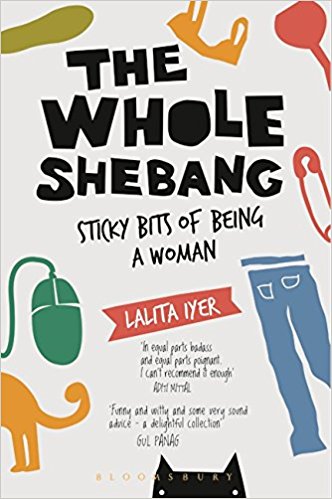
Published in 2017 are Little Black Book by Otegha Uwagba ( HarperCollins)  and The Whole Shebang: Sticky Bits of Being a Woman  by Lalita Iyer ( Bloomsbury India) are two handybooks on what it takes to be a professional woman while juggling a million other responsibilities. There is plenty of sound advice offered by Otegha Uwagba whereas Lalita Iyer imparts similar nuggets of information but in a more personal way through anecdotes. There are many, many more books of a similar nature being published and of late there is practically a deluge of these books since the women reader market is burgeoning. Suddenly from a niche area it has become a mainstream market so there is a range of information available. All said and done all the books advise that women need to focus on self-preservation, maintaining their sanity, identity and self-respect and not necessarily capitulating to all that is expected of them. Sharing stories is one way of being able to get through to other women.

16 August 2017 

Who will win the DSC Prize for South Asian Literature? (13 January 2015)

DSC shortlistAccording to the vision statement, the DSC Prize for South Asian Literature celebrates the rich and varied world of literature of the South Asian region. Authors could belong to this region through birth or be of any ethnicity but the writing should pertain to the South Asian region in terms of content and theme. The prize brings South Asian writing to a new global audience through a celebration of the achievements of South Asian writers, and aims to raise awareness of South Asian culture around the world. This year the award will be announced on 22 January 2015, at the Jaipur Literature Festival, Diggi Palace, Jaipur.

The DSC Prize for South Asian Shortlist 2015 consists of:

1. Bilal Tanweer: The Scatter Here is Too Great (Vintage Books/Random House, India)
2 Jhumpa Lahiri: The Lowland (Vintage Books/Random House, India)
3. Kamila Shamsie: A God in Every Stone (Bloomsbury, India)
4. Romesh Gunesekera: Noontide Toll (Hamish Hamilton/Penguin, India)
5. Shamsur Rahman Faruqi: The Mirror of Beauty (Penguin Books, India)

( http://dscprize.com/global/updates/five-novels-make-shortlist-dsc-prize-2015.html )

The jury consists of Keki Daruwala (Chairperson), John Freeman, Maithree Wickramasinghe, Michael Worton and Razi Ahmed.

All the novels shortlisted for the award are unique. They put the spotlight on South Asian writing talent. From debut novelist ( Bilal Tanweer) to seasoned writers ( Jhumpa Lahiri, Romesh Gunesekera and Kamila Shamsie) and one in translation – Shamsur Rahman Faruqui, the shortlist is a good representation of the spectrum of contemporary South Asian literature in English. Three of the five novelists– Jhumpa Lahiri, Romesh Gunesekera and Kamila Shamsie–reside abroad, representing South Asian diaspora yet infusing their stories with a “foreign perspective”, a fascinating aspect of this shortlist. It probably hails the arrival of South Asian fiction on an international literary map. The three novels — The Lowland, Noontide Toll and A God in Every Stone are firmly set in South Asia but with the style and sophistication evident in international fiction, i.e. detailing a story in a very specific region and time, culturally distinct, yet making it familiar to the contemporary reader by dwelling upon subjects that are of immediate socio-political concern. For instance, The Lowland is ostensibly about the Naxalite movement in West Bengal, India and the displacement it causes in families; A God in Every Stone is about an archaeological dig in Peshawar in the period around World War I and Noontide Toll is about the violent civil unrest between the Sinhala and Tamils in Sri Lanka. Yet all three novels are infused with the writers’ preoccupation with war, the immediate impact it has on a society and the transformation it brings about over time. The literary techniques they use to discuss the ideas that dominate such conversations — a straightforward novel (The Lowland), a bunch of interlinked short stories narrated by a driver ( who is at ease in the Tamil and Sinhala quarters, although his identity is never revealed) and the yoking of historical fiction with creation of a myth as evident in Kamila Shamsie’s A God in Every Stone. All three novelists wear their research lightly, yet these novels fall into the category of eminently readable fiction, where every time the story is read something new is discovered.

Bilal Tanweer who won the Shakti Bhatt First Book Prize 2014 for his wonderful novel, The Scatter Here is Too Great. Set in Karachi, it is about the violence faced on a daily basis. (Obviously there is much more to the story too!) Whereas Shamsur Rahman Faruqi’s novel The Mirror of Beauty, translated by him from Urdu into English is primarily about Begum Wazir Khanam with many other scrumptious details about lifestyles, craftspeople, and different parts of India. It is written in a slow, meandering style of old-fashioned historical fiction. The writer has tried to translocate the Urdu style of writing into the English version and he even “transcreated” the story for his English readers—all fascinating experiments in literary technique, so worth being mentioned on a prestigious literary prize shortlist.

Of all the five novels shortlisted for this award, my bet is on Kamila Shamsie winning the prize. Her novel has set the story in Peshawar in the early twentieth century. The preoccupations of the story are also those of present day AfPak, the commemoration of World War I, but also with the status of Muslims, the idea of war, with accurate historical details such as the presence of Indian soldiers in the Brighton hospital, the non-violent struggle for freedom in Peshawar and the massacre at Qissa Khwani Bazaar. But the true coup de grace is the original creation of Myth of Scylax — to be original in creating a myth, but placing it so effectively in the region to make it seem as if it is an age-old myth, passed on from generation to generation.

13 January 2015

 

Web Analytics Made Easy -
StatCounter