
“Mother of Invention: How Good Ideas get Ignored in an Economy built for Men” by Katrine Marcal, translated from the Swedish by Alex Fleming
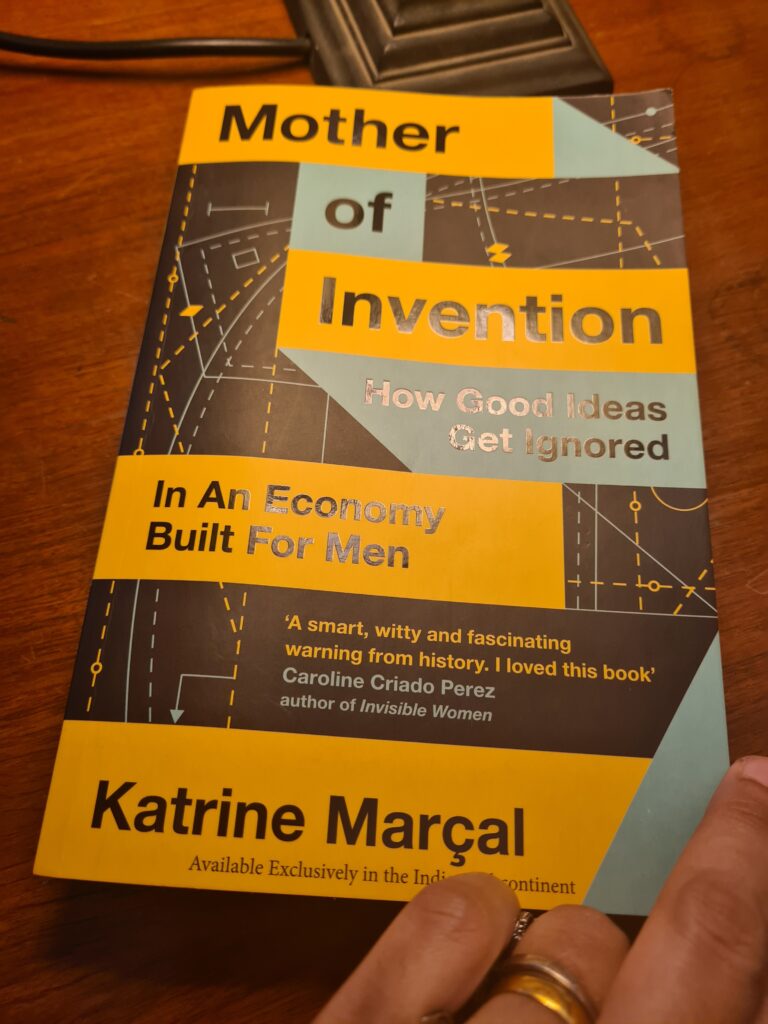
Bestselling author Katrine Marcal’s latest offering, Mother of Invention: How Good Ideas get Ignored in an Economy built for Men ( William Collins, HarperCollins India) is very clearly about the importance of women in contributing to specific economic systems that have gone on to transform social behaviour/history. It has been a sexist understanding, recording and reading of histories that have credited men with the success of certain innovations, whereas Katrine proves with her detailed readings of some of the historic global events has been that the contribution of women was undeniable. Unfortunately, it was not understood sufficiently, recorded or interpreted by men who designed, controlled and managed systems. Take for instance, the absurd case of the seamstresses and Nasa’s inability to approve the space suit, even though they could see that it was far superior to the rest. Their internal assessment recorded that no other suit even came a close second. Yet, because there were no engineers on the job, recording the designs that the women were creating using 4,000 pieces of cloth and using a single-hole sewing machine to ensure precision of their lines, NASA rejected the space suit. It was only after the manufacturing company chose to hire a team of engineers to “translate” a perfectly understable sewing job into gobbledygook, that the NASA top brass was satisfied and gave their approval to the space suit which was eventually worn by Neil Armstrong and Buzz Aldrin when they walked on the moon! Meanwhile the seamstresses themselves scoffed at the pages and pages of material and said they did not have the time to wade through it. The point the author makes is that because sewing was considered a “soft” skill, irrespective of the fact that it had existed for as long as civilization, but was mostly perceived as a woman’s expertise, it was dismissed. It did not have the masculine touch of being presented in technical jargon and thereby making it seem worthwhile. I was reading about Benz and his invention of a horseless carriage and how he was stupid about exploiting it commercially. It required the brilliance of his wife, who sneaked out the car from their garage with her teenage sons, and then drove it to visit her mother, 90 miles away. They drove at the top speed of 16 miles/hour, with many breakdowns along the way. One of them requiring her hat pin to fix. In another when the brakes were heating up, she stopped at a cobbler and asked for a leather strap to be put around the brakes. She reached her mother’s home triumphantly 15 hours later. Many of her innovations of that day are still used in cars. And also thanks to her proving that the horseless carriage could be driven and was safe, the machine became a commercial success. But no one remembers her name, they only remember her husband, who soon became the second half of “Mercedes Benz”.
Her name? Bertha.
How is that for a gendered perspective on an age-old story?!
There are many more such stories in the book. Also a fascinating overview of recent theories about economies from a gendered and a non-gendered perspective. Katrine Marcal dissects these popular statements/books by male “thought leaders” such as Yuval Noah Harari, Jordan Peterson, Nassim Taleb et al. She concludes that it is imperative to include women in narratives because the moment it is done, the ground beneath us shifts and a new and a truer history emerges.
Katrine has a nuanced reading of the importance of women in history. She has really done a fine job of rescuing women and done them a massive service. She has balanced the accounts as it were to show how integral they are part of any economy. They are equal contributors in making society successful and businesses successful, thereby being essential contributors to the economy. There is a wonderful account in this book on the history of venture capitalism and whalers of the nineteenth century and how many of those concepts have been transplanted decades later to modern businesses. Sadly though, in more cases than one would like, these venture capitalists continue to igmore the contribution made by women to various economies. This is a gender balanced reading of economic history. By this narrative, Katrine is trying to upend the sexist narrative of economy that has been passed through generations and conveyed as the absolute truth.
It is a good book. Much along the lines of what Angela Saini has done for science, Katrine Marcal has done for women and innovation.
1 August 2021