
Eve Ensler Posts

Interview with Sonora Jha on “Intemperance: A Novel”

For Moneycontrol, I interviewed Sonora Jha on latest publication Intemperance: A Novel. It is published by Penguin Random House India.

Here is the interview:

Sonora Jha is the author of the novels The Laughter and Foreign, and the memoir How to Raise a Feminist Son. She won the AutHer Award for Fiction 2024 for The Laughter.  After a career as a journalist covering crime, politics, and culture in India and Singapore, she moved to the United States to earn a PhD in media and public affairs. Sonora and her work have been featured in the New York Times and literary anthologies, on the BBC, and elsewhere. She is a Loyola Endowed Professor at Seattle University and lives in Seattle.

Her latest novel, Intemperance, is a love story. It is about a middle-aged, twice-divorced, Seattle-based professor, who decides to hold a swayamvar for herself as a fifty-fifth birthday celebration. She decides to lean upon her Hindu roots and resurrect a matrimonial tradition that is no longer practiced but remembered. It is an event held by the bride-to-be’s family where prospective male suitors are invited. Either the suitors line up for the bride to view. The person she likes, she garlands as her betrothed. Alternatively, the assembled suitors have to perform a series of tasks to prove themselves. These could be in the form of one challenging task or multiple rounds. The winner gets the hand of the bride.

The woman, a renowned and respected intellectual in an American town who had once declared she was “past such petty matters as love,” knows she is now setting herself up for widespread societal ridicule. To her surprise, a cast of characters shows up to support her call―a wedding planner looking for the next enchanting thing, a disability rights activist making a documentary film, and even, begrudgingly, her own young adult son. The Men’s Rights Movement protests her project, angry at her objectification of men. She must also reckon with a brutal love story in her ancestry that was endangered by the caste system―a story that placed a generational curse on those in the family who show an intemperance of spirit. As her whole plan spirals into a spectacle, the woman embarks on a journey to decide what feat her suitor must perform to be worthy of her wrinkling hand. What feat will define a newer, better masculinity? What feat will it take for her to trust in the tenderness of love?

Intemperance is at once a satirical feminist folktale and a meditation on how we might reach past all sense and still find love. It is published by Penguin Random House India.

The following interview with Sonora Jha was conducted via email.

  1. What was the genesis of Intemperance? 

    After my last book, The Laughter, which was a dark satire, I found myself longing to write a love story. I started to toy with the idea of a protagonist who plans a swayamvar in middle age, and then I read bell hooks’ brilliant philosophy on love and marriage in Communion: The Female Search for Love. It all came together for me as I crafted a protagonist who makes the search for love a fiendishly playful act.

    2. Why did you choose the title Intemperance? Why not How to live like a Feminist: A Memoir and a Manifesto, echoing your book How to Raise a Feminist Son: A Memoir and Manifesto (2021)? 

    Well, that was a memoir, and this is fiction. And this is not a manifesto either. The word “Intemperance” fit perfectly the practice of living unabashedly as a woman, living past the cautions of moderation and temperance.

    3. For a writer, what is the difference between memoir, autofiction and literary fiction? 

    I believe there’s a bit of one’s own lived experience in every writer’s work, even if the writer is writing fiction from thin air. The norms of memoir dictate, though, that you hew close to fact. With autofiction, you can use your own life as a diving board and make leaps into fiction. This novel of mine is more fiction than autofiction.

    4. When does the authorial narrative and the protagonist’s “I” merge, if at all? 

    It varies for every writer and every work. Kazuo Ishiguro’s The Remains of the Day uses the first-person “I,” but it’s clearly not Ishiguro writing about himself (he’s writing in the first-person voice of Stevens, an English Butler). In my novel, the “I” is the voice of an unnamed narrator, and I let some of my own ideas and interiority swim into hers even though the plot and characters in the story are not from my own life.

    5. Transplanting an ancient Hindu wedding practice like a swayamvar into modern times is a way of testing your feminist ideas, is it not? Although conducting a swayamvar is like reality television today. 

    Yes, I decided to sharpen the concept of the swayamvar from a contemporary lens of power and agency. I decided to play with it. The protagonist encounters goddesses and princesses from Hindu mythology (as well as one character from Homer’s Odyssey) in the form of present-day people who either warn her against having a swayamvar or cheer her on. The book, however, becomes less about the spectacle and more about the journey, both inward and outward.

    6. With every edit of the manuscript, does your feminism become stronger and sharper or does it have to be turned down a notch or two so as to be heard by a vast audience? 

    I didn’t set out to write a “feminist novel.” I set out to write a novel about a woman looking for love. The search for a true and beautiful love for a cis-gender, heterosexual woman today seems to me and several others to require a feminist way of loving, for her as well as for the man she seeks. I believe a vast audience exists for novels about love and novels with feminist stories. Men, women, non-binary people, everyone is aching for love and for fresh love stories with intemperate characters.

    7. On p.167 you ask if “reclusiveness is allowed for women”? So, is it? 

    The protagonist wonders about this. I don’t. I believe healthy doses of solitude and reclusiveness should be everyone’s right to have. I claim these for myself. If more women claim time for themselves, we will have more delicious, richer partnerships.

    8. Your novel has the classic structure of a novel and yet it has many elements of folklore and oral narratives with the interspersing of many micro-stories. Although, the presence of Alokendra and Heera’s story is much more than that. Please comment. 

    Thank you for appreciating that. I wanted to populate the novel with friends, found family, and community. People of all genders and sexuality. Gods and mortals. Sinners and saints. The fearful and the intemperate. I wanted to also show that the protagonist has a tradition in her ancestry where people loved passionately against all rules and against all odds. Placing a queer, inter-caste love story in the litchi orchards of 1895 Bihar gave me much joy as a writer. The protagonist is who she is today because of all the love that came before.

    9. A love story involving an elaborate wedding is the perfect formula for a successful book. So how many conversations and backstories did it take to create this incredibly perceptive feminist commentary to the swayamvar, in itself on the threshold of a very patriarchal institution —matrimony? 

    Subverting the idea of a swayamvar, stealing it away from the patriarchs and their collaborations (kings marrying off their daughters to other kings), making contemporary men in Seattle perform feats for the hand of an aging, twice-divorced women in her sexual prime…all this just spilled out of me. But yes, I am an academic with a journalistic background, so of course I did a lot of research into these practices and also into caste and disability and more. One of the continued conversations that was invaluable to me was with author and journalist Yashica Dutt, who wrote Coming Out as Dalit.

    10. Will you ever consider dramatising this for theatre, say along the lines of Eve Ensler’s The Vagina Monologues

      I hadn’t considered that, but that’s a wonderful idea.

      31 Oct 2025

      “Strongmen” by Eve Ensler, Danish Husain, Vijay Prashad
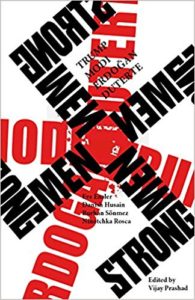
      Strongmen is a slim book, a collection of fables about strong men. As the book blurb says “Eve Ensler, the American playwright (The Vagina Monologues), goes beneath the skin – or should we say orange hair – of US President Donald Trump. Danish Husain, the Indian storyteller and actor, finds himself telling us the story not only of Indian Prime Minister Narendra Modi but also of the ascension of the extremism of the Sangh Parivar. Burhan Sönmez, the Turkish novelist, ferrets about amidst the bewildering career of the Turkish President Recep Tayyip Erdoğan. Ninotchka Rosca, the Filipina feminist novelist, unravels the macho world of Rodrigo Duterte. Their essays do not presume to be neutral. They are partisan thinkers, magical writers, people who see not only the monsters but also a future beyond the ghouls. A future that is necessary. The present is too painful.”

      With the permission of the publisher here is an extract from Eve Ensler’s essay:

      This is the story of what happened in the late time, right before the end time, that later got interrupted and became the new time. In those days there arrived in the land of violent amnesia and rapacious dreams – a virus. It first became discernible in an oafish, chubby man with orange hair. Some say it was the virus that turned his hair orange. Others claimed his hair was actually the virus. The oafish, chubby man with orange hair goes on to become the most powerful man in the world.

      It was highly debated whether the intensity of the infection was the cause of his rise, but it has since become clear that the virus was a very contagious one and that much of the populace had a dormant strain of it lodged in their beings which was activated by the orange man during his toxic campaign.

      Those infected the most deeply were those with unexamined wounds and openings from childhood, repressed fear, insecurities that were ripe for othering and rage, predisposition towards racism and sexism and insatiable daddy hunger. These tendencies were exacerbated and catalyzed by the way the portly, thuggish leader injected the virus into the unsuspecting crowds through angry white-hate filled spittle, slimy superlatives, sham filled promises, and toxic red caps which allowed the virus to seep in through the hair follicles and head. Bald men were most susceptible.

      This, fortunately, was not true of all segments of the population because some appeared to have built-in immunity. Most of those were the ones who lived on the various edges, which was ironic, as it was the ones most foreign and exiled from the culture who would eventually find a cure. We will come to that later.

      It was also highly debated whether the man with orange hair was the origin of the virus or simply the manifestation of it. Some said it didn’t matter, but I believe it matters a lot. For if the chubby man were the originator of the virus, then it would have simply been one sick individual contaminating the public and if and when he was eliminated, the virus, would, in theory, be gone as well. But we know this didn’t happen. So the question then evolved: why was the oafish, portly man with orange hair the major host of the virus?

      And again, the theories abound.

      One classic theory is that the thuggish man had become what no one had yet become in the time of late date consumption and greed. He had evolved or devolved (depending on your perspective) into what the psychologists later came to define as a genocidal narcissist – a person willing and able to destroy everyone and everything on the planet as long as it makes him feel momentarily better. That extreme and total endgame narcissism made the oafish man a perfect super host for the virus. For it has since been discovered that the virus can only fester in an environment where the host has developed no antibodies to tolerate others, or indeed criticism, difference, curiosity, questions, doubt, ambiguity, the truth, mystery, waiting, thinking, reading, reflecting, questioning, wondering, caring, feeling, listening, or studying. It is where the healing properties of humour and irony have been killed off and self-obsession, revenge and self-adulation have taken their place.

      Noted symptoms of the virus are: hysteria, mania, illogical thinking, impulse disorder, bullying, a distorted belief that the group and gender you belong is superior, vile and show-offy compulsive grabbing, molesting behaviour towards women, compulsive lying, increased paranoia, loss of ability to distinguish between good and evil (for example equating Nazi and white supremacist with people fighting for their constitutional rights) and shifting and constantly evolving enemies, because the infection needs a target to energize its effective components. One day it was Mexicans, the next day blonde women reporters, the next a Puerto Rican mayor, the next Black football players. It was actually irrelevant to the virus who the enemy was as long as it kept shifting and escalating as the pathogen craved and fed off this antagonistic energy. But it has been conclusively determined that the virus would first seek already existing weaknesses in the DNA of the culture.

      Also read an interview with Eve Ensler with Vinutha Mallya, published in Pune Mirror.

      14 August 2018 

      Web Analytics Made Easy -
StatCounter