
Fitzcarraldo Editions Posts

The Booker Prize 2025 longlist

The full Booker Prize 2025 longlist, including author nationality, is:

– Love Forms (Faber) by Claire Adam (Trinidadian)

– The South (4th Estate) by Tash Aw (Malaysian)

– Universality (Faber) by Natasha Brown (British)

– One Boat (Fitzcarraldo Editions) by Jonathan Buckley (British)

– Flashlight (Jonathan Cape) by Susan Choi (American)

– The Loneliness of Sonia and Sunny (Hamish Hamilton) by Kiran Desai (Indian)

– Audition (Fern Press) by Katie Kitamura (American)

– The Rest of Our Lives (Faber) by Ben Markovits (American)

– The Land in Winter (Sceptre) by Andrew Miller (British)

– Endling (Virago) by Maria Reva (Canadian-Ukrainian)

– Flesh (Jonathan Cape) by David Szalay (Hungarian-British)

– Seascraper (Viking) by Benjamin Wood (British)

– Misinterpretation (Daunt Books Originals) by Ledia Xhoga (Albanian-American)

Discover the full list: https://thebookerprizes.com/bp2025

The longlist has been selected by the 2025 judging panel, chaired by critically acclaimed writer and 1993 Booker Prize winner Roddy Doyle

Doyle, who is the first Booker Prize winner to chair the panel, is joined by Booker Prize-longlisted novelist Ayọ̀bámi Adébáyọ̀; award-winning actor, producer and publisher Sarah Jessica Parker; writer, broadcaster and literary critic Chris Power; and New York Times bestselling and Booker Prize-longlisted author Kiley Reid

This year’s selection, which was chosen from 153 submissions, celebrates the best works of long-form fiction by writers of any nationality, written in English and published in the UK and/or Ireland between 1 October 2024 and 30 September 2025.

For the first time, the shortlist of six books will be announced at a public event, to be held at Southbank Centre’s Royal Festival Hall in London on Tuesday, 23 September 2025. The six shortlisted authors will each receive £2,500 and a specially bound edition of their book. The announcement of the winning book  will take place on Monday, 10 November 2025 at a ceremony at Old Billingsgate in London. The announcement will be livestreamed on the Booker Prizes’ channels. The winner receives £50,000.

The ‘Booker Dozen’ features five British authors, while also encapsulating a vast range of global experiences. The 13 novels transport readers to a farm in southern Malaysia, a Hungarian housing estate and a small coastal town in Greece. They shine a light on the lives of Koreans in postcolonial Japan, a homesick Indian in snowy Vermont, a Kosovar torture survivor living in New York, a shrimp fisherman in the north of England, a mother’s search for a child given up for adoption in Venezuela and even endangered snails in contemporary Ukraine. They reimagine the great American road trip as a slow-burning mid-life crisis and take us into the heart of the UK’s coldest winter. 

The judges’ selection features: 

  • Authors representing nine nationalities across four continents, with UK authors securing the highest number of nominations  
  • Kiran Desai, who is nominated 19 years after her previous book won the Booker Prize 
  • Tash Aw, longlisted for a third time, who could become the first Malaysian winner 
  • Past shortlistees Andrew Miller and David Szalay  
  • Two debut novelists among nine authors who appear on the Booker Prize longlist for the first time 
  • The first novel from an opera librettist and the 12th from a former professional basketball player 
  • A book that first garnered acclaim as a short story, and one that is the first in a proposed quartet 
  • Three titles from independent publisher Faber and a first Booker longlisting for Fitzcarraldo Editions, to add to its 16 International Booker Prize nominations  
  • Novels that are ‘alive with great characters and narrative surprises’ which ‘examine the past and poke at our shaky present’, according to Roddy Doyle, Chair of the 2025 judges  

This is a fabulous longlist with so much to discover. I am truly delighted at the coincidence that last week I had interviewed Andrew Miller on his fabulous book The Land in Winter for TOI Bookmark.

29 July 2025

“The Years”, Annie Ernaux
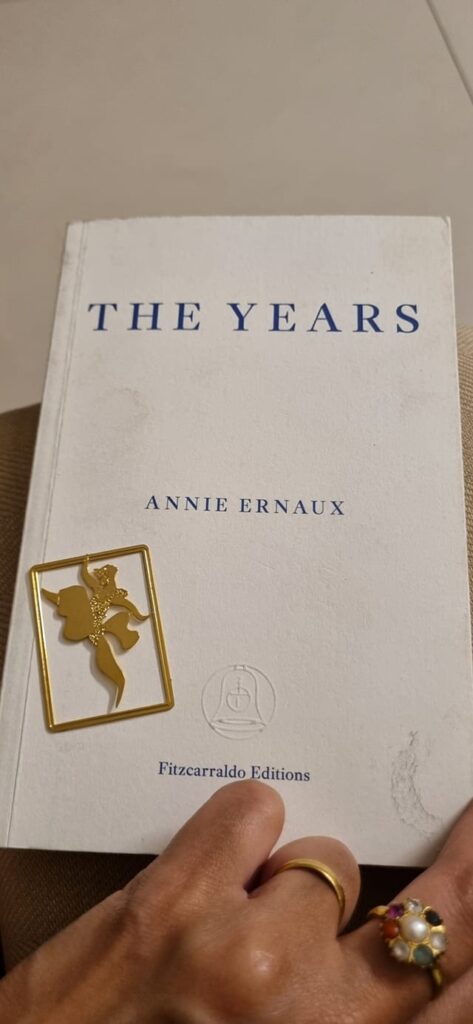
We reflected on our lives as women. We realized that We’d missed our share of freedom — sexual, creative, or any other kind enjoyed by men. We were as shattrteded by the suicide of Gabrielle Russier as by that of a long lost sister, and were enraged by the guile of Pompidou, who quoted a verse by Eluard that nobody understood to avoid saying what he really thought of the case. The Women’s Liberation Movement had arrived in the provinces. “La Torchon Brule” was on the newsstands. We read “The Female Eunuch” by Germaine Greer, “Sexual Politics” by Kate Millet, “Stifled Creation” by Suzanne Horer and Jeanne Socquet with the mkngled excitement and powerlessness one feels on discovering a truth about oneself in a book. Awakened from conjugal torpor, we sat on the ground beneath a poster that read “A woman without a man is like fish without a bicycle” and went back over our lives. We felt capable of cutting ourselves loose from husband and kids, and writing crudely. Once we were home again, our determination faded. Guilt welled up. We could no longer see how to liberate ourselves, how to go about it, or why we should. We convinced ourselves that our man was neither a phallocrat nor a macho. We were torn between discourses, between those that advocated equal rights for the sexes and attacked patriarchy, and those that promoted everything feminjne: periods, breast-feeding, and the making of leek soup. But for the first time, we envisaged our lives as a march towards freedom, which changes a great many things. A feeling common to women was in its way out, that of natural inferiority.

The Years by Annie Ernaux, translated by Tanya Leslie ( Fitzcarraldo Editions)

24 Feb 2023
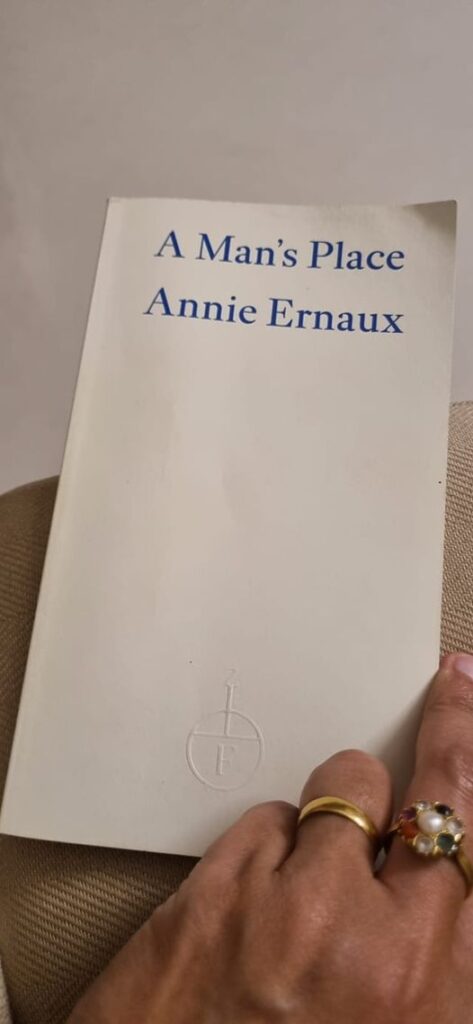
“A Man’s Place” Annie Ernaux

One Sunday after church, when I was twelve years old, my father and I walked up the sweeping staircase inside the town hall. We were looking for the public library. I was terribly excited, we’d never been there before. We couldn’t hear anything on the other side of the door. All the same my father pushed it open. It was completely quiet in the room, quieter even than in church. The floorboards creaked and there was a strange, musty smell in the air. Perched behind a high desk barring access to the shelves, two men watched us approach. My father let me say: ‘We’d like to borrow some books.’ One of them immediately asked: ‘What books do you want?’ At home it hadn’t occurred to us that we had to prepare a list and reel of titles as easily as if they had been brands of biscuits. They chose the books for us: “Colomba” for me and a “light” novel by Maupassant for my father. We never went back to the library. My mother must have returned the books, maybe when they were overdue.

A Man’s Place Annie Ernaux , Translator is Tanya Leslie

( I posted this on Facebook on 22 Feb 2023. It resulted in a fascinating conversation with Miguel M. Abrahão. )

24 Feb 2023

Web Analytics Made Easy -
StatCounter