
“The Jamun Tree” by Krishan Chander
Or listen to Yasmeen Rashidi, The Wire, narrate it: https://thewire.in/books/watch-icse-drops-krishan-chanders-1960s-story-which-questions-centralised-governance
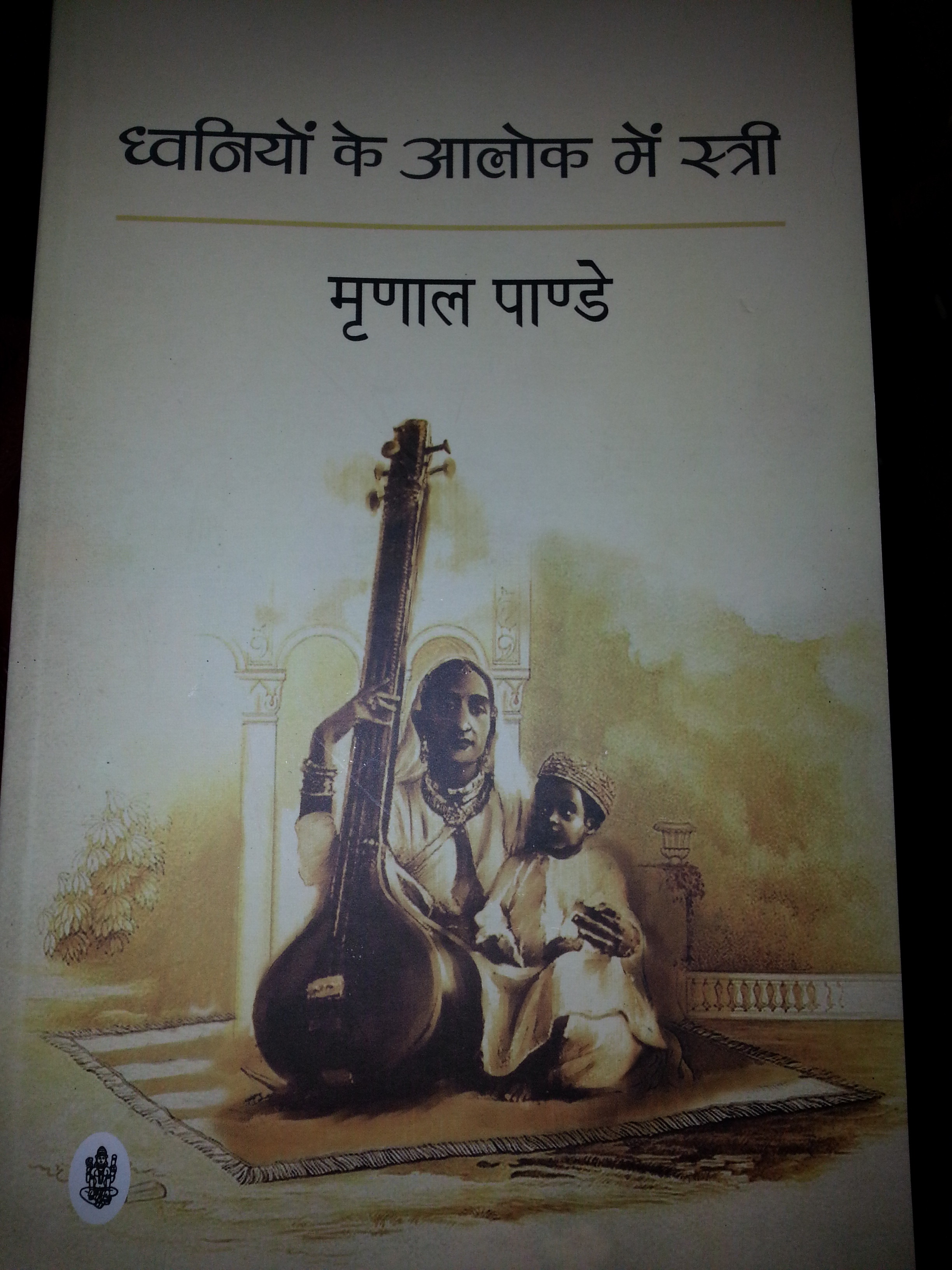 On Monday, 4 January 2016, I attended Hindi publisher Rajkamal Prakashan’s book launch for noted journalist and writer, Mrinal Pande’s Dhvaniyon ke aalok mein stree . Mrinal Pande has written a nonfiction book about the vast contribution of professional women musicians (largely tawaifs or courtesans till the mid 20thC) to Hindustani classical and semi-classical music in post-1857 India. Most of whom went unmentioned even by famous musicians and Ustads, whom they had lovingly and selflessly tutored and mentored through their early days of penury. The panel includes journalist Yatendra Mishra, singer Shubha
 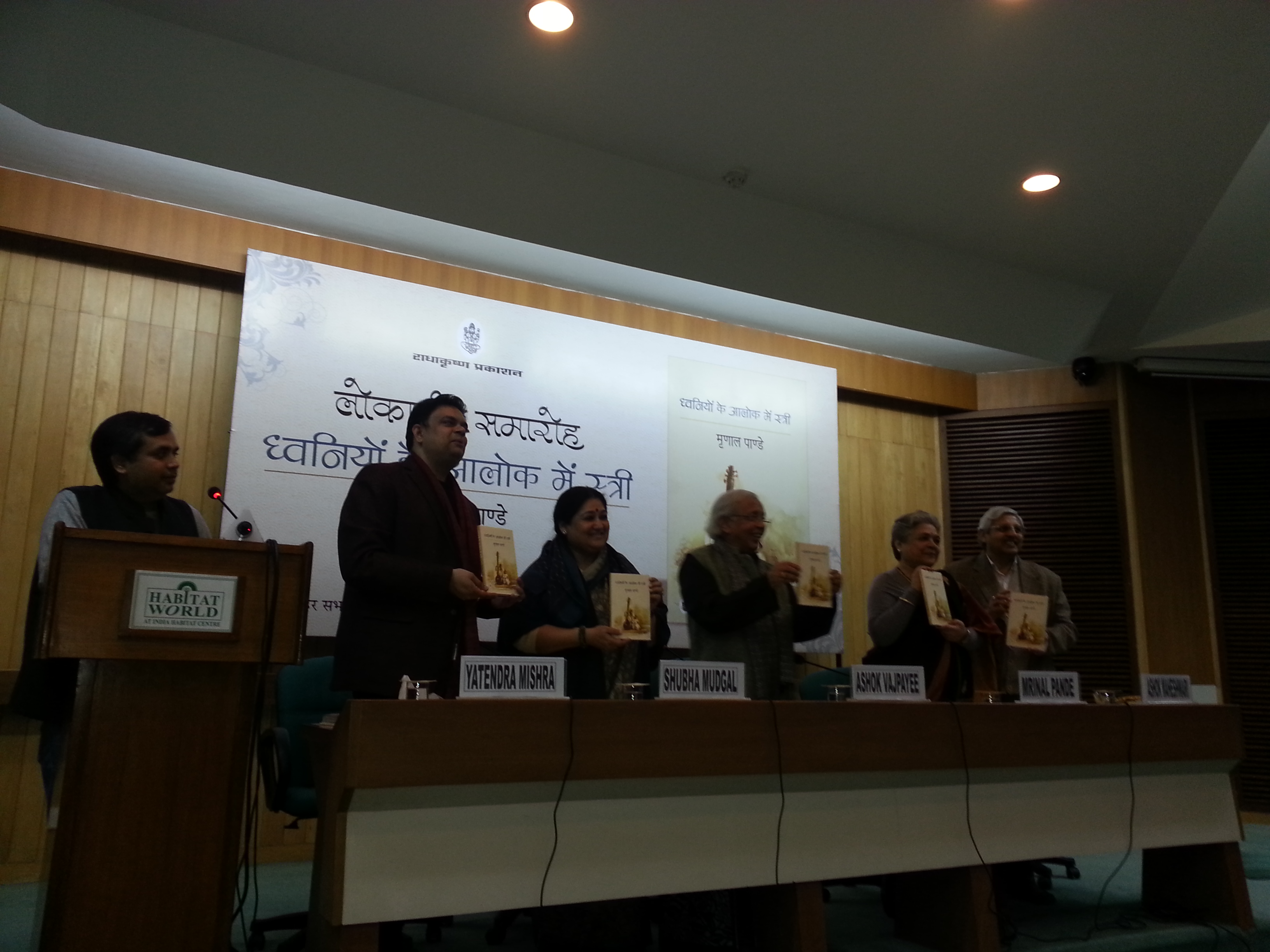 Mudgal, poet Ashok Vajpeyi, Mrinal Pande and publisher Ashok Maheshwari. The event was introduced by editor Satyanand Nirupam.
I enjoyed the event immensely. Two hours went by so swiftly. I could have heard the conversations some more.
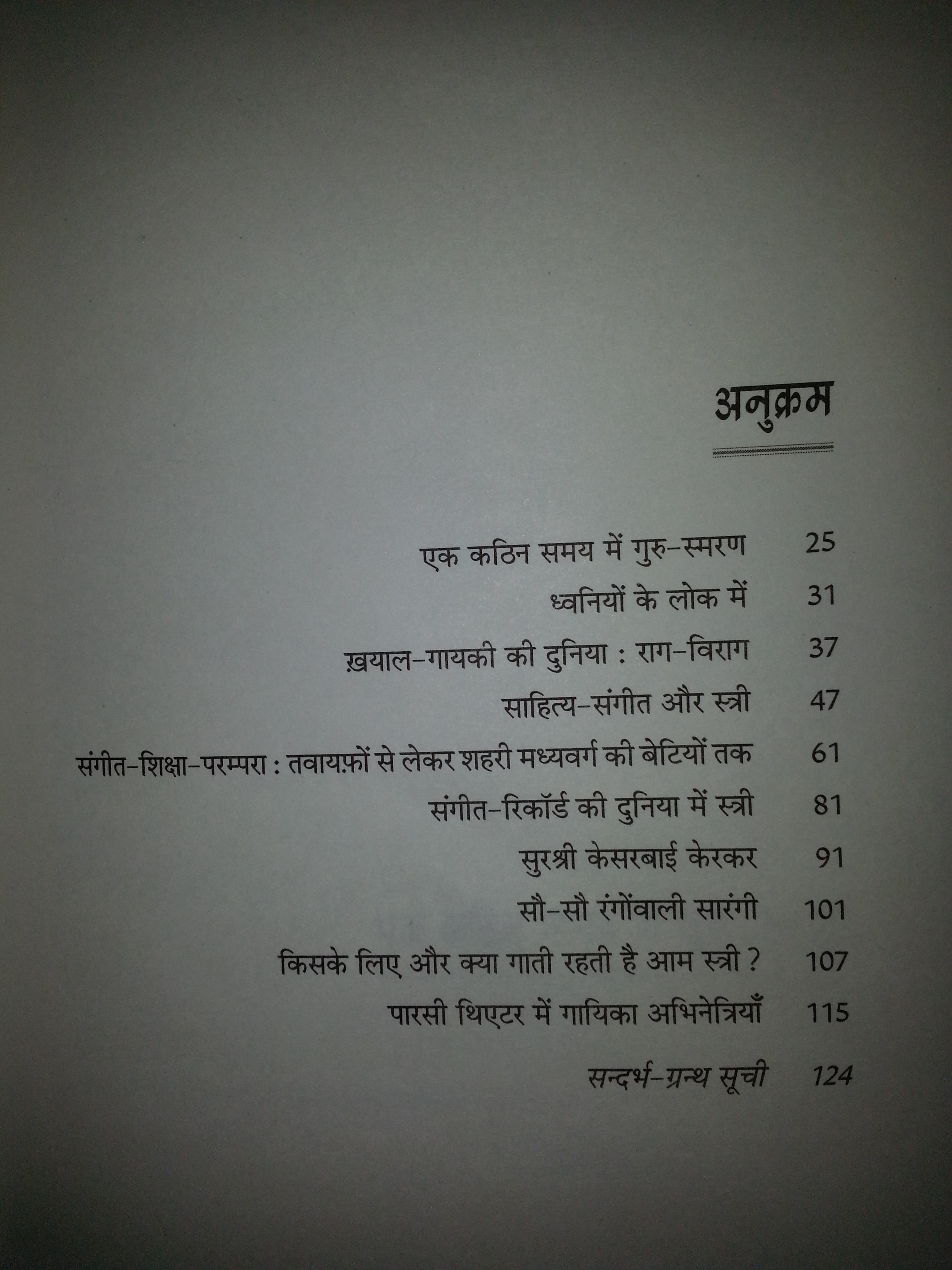 I liked the narrative which emerged from the evening’s chat. Women musicians were a phenomenal influence and in many cases taught men who were to later earn quite a name for themselves. But the focus was not necessarily on the women musicians who have been profiled in the book but many like Shubha Mudgal’s Nani ( maternal grandmother) who yearned to learn music but was not allowed by her father. Instead he insisted she learn the piano. To fulfil her desire of learning Hindustani music Nani had herself photographed holding various Indian musical instruments in the garden. (I am curious though how did the Nani get access to those musical instruments with which she was photographed in the garden?) Or the many rich wives of Bombay boxwallahs or the corporates who were taught music to while their time. It served another purpose too – the male musicians social ambitions of being seeing in the right circles. But the true preservers, inheritors and practitioners of music, were the Hindu and Muslim tawaifs, who kept Hindustani musical traditions alive by performing every night gave music a lease of life. Equally significantly they kept local languages and dialects or “bolis” alive in the Hindi that was commonly known and spoken. They were not averse to borrowing, blending, improvising and creating fresh interpretations as long as music was heard. This for Mrinal Pande is a crucial aspect of the womens musicians contribution to language and musical traditions. Her analysis of Hindi being kept alive since it had not as yet been politicised and hijacked depriving it of its backbone, ie the various bolis some of which were integral to the gharanas. So these remained in
 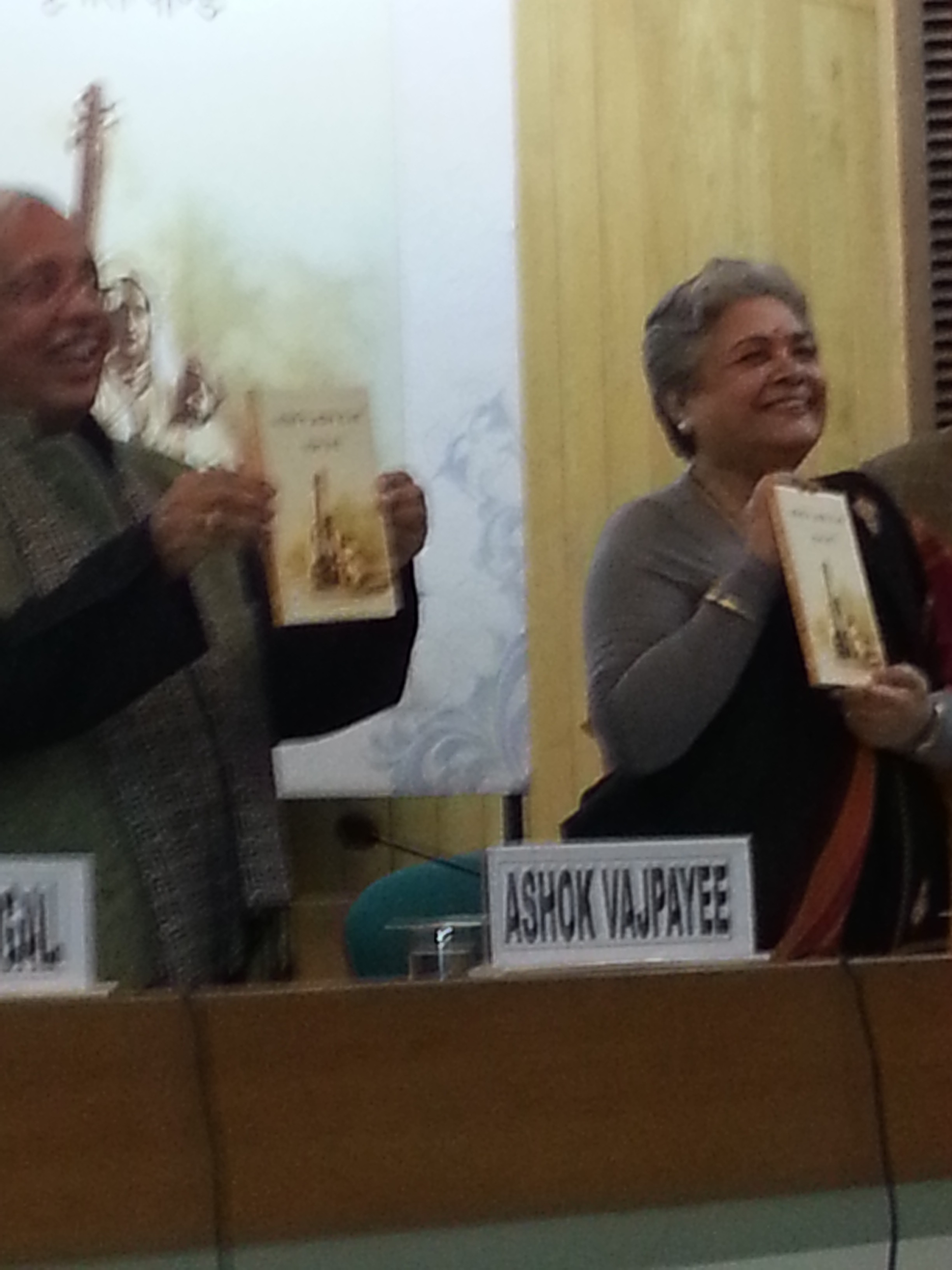 the social consciousness. I found this gem fascinating.
Another one was that of women singers graduating from anonymity to establishing their name to a recording. The idea that after the 3.5 minutes of 78 rpm had been cut by the German engineers the women to ensure the correct singer was given due credit said her name at the tail end of the song. It is incredible what technology and different kinds of publishing can do for the identity and self-worth of an individual.
The Union Home Ministry note issued in 1946 when Govind Vallabh Pant who was a minister in the provisional government debarring women singers who had a pesha or were tawaifs from singing. Later Mr Keskar, Minister for Information and Broadcasting, post independence, nullified the government note banning,”women whose personal lives are a public scandal”, in 1952. Suddenly it all made sense to my mind…once again the notion of identity of the women along with the patriarchal tyranny which was implicit in the 1946 order. But when Mr Keskar overturned the order he insisted the religion of singer be evident. All muslim singers were to add the prefix “Begum” and hindu singers had to add the suffix, “Devi”. Now that too is a curious move…identification along religious lines. Not unheard of. It could be considered at par with the star all Jews had to stitch on their coats in Nazi Germany.
I liked the story about Mrinal Pande’s mother, the popular Hindi novelist, “Shivani”, taking her husband’s permission to write and then adopting a pen name. Ironically it is Shivani who now remains alive in people’s minds. I enjoyed Shubha Mudgal’s response about her son being cared for by the extended clan while she was on tour and the astonishment expressed by the Indian diaspora who could not fathom how this was possible — “Had she taken permission from her husband to do so?” Having said that I know these women continue to be rare examples and not necessarily the norm.
Even Yatindra Mishra’s tale about his Dadi (paternal grandmother) not being permitted to sing since it would be frowned upon by society especially now that the family had lost their princely status. Given the context that women musicians were mostly tawaifs this would have really complicated matters for the family. So her father did not allow her to sing saying, “What will people say? They will think we have fallen on such hard times that now the daughter of the house is singing to earn!” Funny how far Indian society has now come with children being encouraged to sing and perform publicly in the hope they can become professional singers, preferably in Bollywood.
I liked how gracefully and tactfully Shubha Mudgal and Mrinal Pande dealt with the comment about “deterioration” of Indian classical musicians performing mobile ring tones and snatches of popular Hollywood musicals. It was fascinating to observe the arguments playing out between the purists and those who were arguing for the evolution of musical traditions such as the examples noted by Ashok Vajpayee. He said sometimes he can identify bits of Gwalior or Bhopal gharanas in modern renditions. Interesting.
Dhvaniyon ke aalok mein stree has been published by Rajkamal Prakashan. It is available in hardback and paperback.
6 January 2016

( I invited Rohini Chowdhury to talk about her experience in translating Bosky’s Panchatantra for Red Turtle. She translated Gulzar’s verse rendition of Panchatantra.
She is a widely published children’s writer, and an established literary translator. As a children’s writer, she has more than twenty books and several short stories to her credit. Her published writing is in Hindi and English, and covers a wide spectrum of literary genres including translations, novels, short fiction, comics, and non-fiction.
Rohini’s primary languages as a literary translator are pre-modern (Braj Bhasha and Avadhi) and modern (Khari Boli) Hindi, and English. She has translated the seventeenth century Braj Bhasha text Ardhakathanak, into modern Hindi and into English; both translations were published by Penguin India. Ardhakathanak is the autobiography of the poet, merchant and philosopher, Banarasidas; written in 1641, it is widely regarded as the first autobiography in an Indian language. Her translations include the Hindi novel Tyagpatra [The Resignation] by Jainendra, one of the leading Hindi novelists of the modern period, into English, also published by Penguin India.
Rohini was born and educated in India, and was a management professional before moving to London in 1997. She is widely travelled and brings in the nuances of the cultures of Asia, Africa and the West in her writings.
 Gulzar Bosky’s Panchatantra Translated by Rohini Chowdhury, illustrated by Rajiv Eipe. Rupa Publications (2013) Pb. Rs. 195
When I was first asked to translate Gulzar’s verse renditions of stories from the Panchatantra, I was both excited and curious. Excited because I would be translating Gulzar, and curious because these were familiar tales, that I had grown up listening to; also, I had earlier translated several of these stories from the original Sanskrit Panchatantram. Moreover, these stories had been told and retold a hundred times before, in varying forms and formats, by writers and translators of all colours, and I wondered what new twist or angle Gulzar could possibly have given them. The excitement and curiosity were soon replaced by apprehension: Would I be able to do justice to the tales, or would my own familiarity with them stand in the way of my translation? And then, it was Gulzar that I was translating, and translating the work of a living poet of his stature brought its own demands— the quality of my translation had to match the greatness of his reputation, and please the poet as well! As if these doubts were not enough, the tales were meant for children, and children, as anyone who has had anything to do with them will tell you, are far more demanding and discerning than adults. So there I was, faced with a trio of unprecedented challenges— an overly familiar subject, the text written by a famous and much-revered poet, and meant for children!
But I need not have worried, not about the ‘overly familiar’ at least! As I worked through the tales, I was drawn into their magic once more, and this time the magic came with the added sparkle of Gulzar’s wit and lively humour. Gulzar’s gentle imagination had fleshed out the original tales with dialogue and descriptions, and added events and happenings the way one does when telling a well-loved story to a child several times. The humour and the detail made these stories uniquely Gulzar’s, familiar yes, but new as well!
Gulzar Sahib approved my translation of the first story, and I breathed a sigh of relief. So the second worry was gone too! I could now focus on what, in any case, is any translator’s primary concern— to transmit the original in as accurate and as interesting a manner as possible to her audience, which, in my case, would be made up mainly of children.
Gulzar’s Panchatantra stories are in Hindustani, that inimitable mix of Hindi and Urdu that is so rarely heard these days, the tales related as he would have related them to his daughter, Bosky, when she was little. My main challenge now became to transmit the tones and nuances of his sparkling, softly flowing, idiomatic Hindustani into the much staider, crisper English.
Each language brings with it its own context, social, historical, cultural, so that when we move from one language into another, we also move worlds. Translation therefore becomes a negotiation between languages and cultures, and the translator, as mediator, must address the issues that arise in such a negotiation: How accurately must the translation follow the original? Which words may be kept, which must be discarded? How best may an idea that is intrinsic to the original culture but alien to the other be transmitted? Can it be transmitted at all? I, too, asked these questions as I sat down to translate Gulzar’s stories.
Gulzar’s use of idiom makes the stories easy to read, but difficult to translate without taking some liberties with the original. Take, for example, the Hindi phrase, ‘jhoot ke pair nahin hote’ which translates literally into ‘falsehood has no feet’. In Hindi the phrase makes perfect sense, in English, not so much, not without further explanation of some sort. We finally settled upon ‘A lie never goes very far/For it has no feet at all’.
Certain cultural and social norms which are easily conveyed in Hindi, are almost impossible to convey in English, and compromises are inevitable. Consider the Hindu practice whereby a woman may not address her husband by name. This is conveyed perfectly in Hindi but in English translation, the cultural context is by and large lost. Take the tale of Manram Swaroop, the Brahmin. Though he had a wonderful name, no one ever used it: the entire village called him ‘Panditji’, and his wife, of course, would never address him by name:
His wife would call him
‘Hey, sir!’
‘Ho, sir!’
‘Do you hear me?’
That’s how she would address him…
Though technically correct and adequate for the purpose of telling the story, the translation does not and cannot in itself capture the social and cultural implications that are implicit in this tradition, unless it be accompanied by further explanation, either in the main text itself or in footnotes. But any such explanation would have made the text heavier, and given that my translation was not a scholarly exercise but aimed at young readers, I decided to skip the explanation.
Puns and double meanings are ever the translator’s bane and Gulzar’s gentle and clever play on words throughout the text presented another challenge in translation. Unfortunately, in some instances, this was inevitably lost in translation, though sometimes English actually enhanced the humour of the original. In the tale of the singing donkey, for example, English gave me the facility of playing with two words ‘donkey’ and ‘ass’ to convey the two meanings (the animal, and a fool) of the single Hindi word ‘gadha’.
Gulzar’s stories are in free verse, and therefore, to stay as close to the spirit of the original as possible, I wanted my translation to be in free verse as well. Translating into verse constrains the translator even further for verse demands economy in the use of words, so that the translator must use words not only effectively, but both efficiently as well. I found myself writing and rewriting, cutting and pruning and editing, till the lines fell into place just so. An arduous exercise, but worth the effort.
Of course, as I worked, every decision I made— the words I used, the phrases I chose to explain or leave to the readers’ understanding, the ideas I chose to convey or glossed over briefly – was influenced by the fact that this work was meant for children.
One might ask, and I asked myself this: why should a translation aimed at children require more care from the translator than a translation aimed at adults? The answer, I realized, lay in the responsibility I feel when writing for children. Children are demanding readers, they absorb and observe, criticize and comment with a great deal more engagement and involvement than do most adults. They are also our future, and therefore, whether it is an original novel or story, or a translated work, children deserve the best that I can give.
London, 11 Sept 2013
(C) Rohini Chowdhury
Email: [email protected]