
ICS Posts

An excerpt from Mr. N. K. Mukarji’s oral history

My maternal grandfather was the last ICS officer. He belonged to the Punjab cadre. I recall his telling us accounts of him as a young officer overseeing the partition of Punjab once Independence had been announced. He recorded his oral history at the Teen Murti Library. It is the longest oral history recorded so far. Given that today is 14 Aug 2025, I am posting a snippet from it, where he talks about being Under Secretary (Political) in undivided India in Lahore from 3 January 1947 to 14 August 1947. He continued as Under Secretary (Political) with the East Punjab Government in Simla from 15 August 1947 to 19 September 1947. He was then promoted to a senior scale post, Governor’s secretary, with effect from 19 September 1947. He became Governor of Punjab in 1989.

In the 1990s, I remember driving him to the Teen Murti library for these recording sessions. I would wait outside the recording room while he was being interviewed. It took nearly two years to record. It was a slow and methodical process. The research team would ask my grandfather detailed questions. He would usually prepare in advance, knowing the topic that they were going to talk about. But much before the recordings began, he had discussed with them the narrative that he would share. They would then share the rough transcripts of every recording which he would later edit. It was the final version that he had passed that was finally put on the shelves of the library.

Nirmal Kumar Mukarji (ICS)

Here he is in his own words (Part 1, Vol 1, pp. 275 onwards). Manchanda was his interlocutor on behalf of Nehru Memorial Museum and Library, Oral History.

Mukarji: I took over as Governor’s Secretary on the 20th September 1947 and stayed in that post up to the 19th December 1948. At the time that I took over, the East Punjab’s Government’s temporary headquarters was at Jullundur. The Governor was also there. He had taken up residence in a sort of bagicha building of a rayees on the Grand Trunk Road, north of Jullundur going towards Amritsar, about five miles out of Jullundur. I was the second person to be Governor’s Secretary.

When I went back as the Governor of Punjab much later, I found that there was a board in the room of the Governor’s Secretary listing all the names of the previous Secretaries and, sure enough, my name was there at Number 2. I suppose I am one of the few, if not the only, Governor’s Secretary who has gone on to become Governor of the same State.

My spell as Governor’s Secretary can be divided into two parts. The first one was during the period that East Punjab Government was locaed in Jullundur. This was, you might call, an emergency period. When the emergency period was over, the East Punjab Government went back to its regular headquarters at Simla and thereafter you might say the conditions were normal. The emergency conditions under which I served as Governor’s Secretary stretched from the 20th September when I took over to about the end of February or beginning of March 1948. I cannot recall the exact date. The East Punjab Government felt that by then all was reasonably under control and they could go back to their regular headquarters.

I shall now talk about this emergency period. The Governor, as I said, was Sir Chandulal Trivedi. He was a Gujarati, a former ICS man from the Central Provinces and Berar cadre. He had been Secretary in an important Ministry of the Government of India. After that, during the British period, he ahd been elevated to the post of Governor of Orissa. It was from there that he came to take over as Governor of East Punjab. He was an experienced man, very able, thoroughly honest and a solid worker. I do not think he was brilliant in any sense, nor did he possess the faculty of being a visionary. He was very down-to-earth.

Manchanda: Pragmatic, you mean.

Mukarji: No. I mean a practical, nuts-and-bolts administrator, which I suppose was what East Punjab needed at that time. He seemed to us, Punjab civilians, somewhat overanxious to prove that although he was from a backwater province like C.P. and Berar and had been Governor of an even more backwater province like Orissa, he was as good if not better than all of us put together. I think there was a psychological factor involved here. This, coupled with the strain and stress of having to be responsible for a province in such a high state of chaotic turbulence, probably accounted for his gruff and generally aggressive style of functioning. In his own way my predecessor my old friend, Saroop Krishen, warned me about this at the time of taking over. … .

Now I have spoken of the Governor as having been responsible for the province. But was he? Considering that there was a ministry. I would like to mention four reasons for the special role which the Governor was required to play in the early months of this emergency period. Firstly, the aura of Governorship under the British especially in Punjab continued for some time even after the British left. Everybody, whether they were Ministers of civil servants or even in the people, tended in those early months to view Trivedi as some kind of reincarnation of Jenkins. Secondly, Trivedie had been hand-picked by the national leadership, maybe on Mountbatten’s advice, because East Punjab was obviously going to be a difficult province to be governed and would therefore need an experienced administrator. All concerned showed him due deference because they saw him as the Centre’s man, one who enjoyed the confidence of the then power structure at the Centre, comprising Mountbatten, Jawaharlal Nehru and Vallabhai Patel. Thirdly, following the pattern adopted at the Centre for handling the prevailing emergency in the country as a while, and at the instance of the Centre, East Punjab also set up an Emergency Committee which was headed by the Governor, just as at the Centre it was headed by Mountbatten. For all practical purposes this became the supreme decision-making body. So long as it lasted, the Cabinet functioned in a shadowy manner handling only routine issues. Fourthly, no constitution had yet come into being. The role of the Cabinet vis-a-vis the Governor in the changed conditions of freedome was thus undefined. In this vacuum, the Rules of Business carried over from the British days tended to persist and, under those rules, the Governor continued to have a special position. For all these reasons, the Governor of East Punjab was indeed responsible for the good governance of his province. Maybe, he was uniquely so in the whole country. He himself saw his role in that way. I believe the Centre also held his responsible. After all, as I said, he had been hand-picked by the Central leadership.

The Governor’s role as the de facto ruler in those early emergency days inevitably affected the role of the Governor’s Secretary. Although he had less than three years service — four years if you count the probabtionary year also — he found himself, that is to say I found myself, pitch-forked into a fairly key role. During this emergency period, there were two aspects to my work. There was work relating to the Emergency Committee and other work …

Manchanda: … other usual work which was assigned to the Secretary.

Mukarji: Nothing was usual at that time.

Manchanda: I mean which was given by the Governor.

Mukarji: No, I will come to that.

Again following the central pattern, Governor’s Secretary was appointed the Secretary of the Emergency Committee, because at the Centre Mountbatten had insisted that his own secretary should be the Secretary of the Emergency Committee there. So the same pattern was followed here. The Emergency Committee — I am talking from memory — consisted of the Governor as the Chairman, and the Chief Minister, Gopichand Bhargava, the Home Minister, Swaran Singh, and two or three selected Ministers as members. One of them was the newly-appointed Transport Minister, none other than Saradar Partap Singh Kairon. The Committee also had senior officials, the Chief Secretary, the Home Secretary, the Inspector-General of Police and the Financial Commissioner for Relief and Rehabilitation. These were regular members. Other Secretaries or Heads of Departments attended when required for an agenda item covering them. The General Officer Commanding in Jullundur, who was none other than Major General Thimayya, or his representative also used to attend when required.

In the early days the Committee met every single day in the late afternoon. No notice went out. It was understood that everybody would come at that time. It was understood that everybody must come at that time. The Committee broadly attended to three things: It took stock of the latest information, from the districts as also from Pakistan, in regard to law and order and the movement of refugees both to and from East Punjab. Secondly, it reviewed the action taken on the previous days decisions. Thirdly, it took decisions on points arising indicating the nature of action to be taken. The discussions were not always in the sequence that I have mentioned.

Manchanda: Was the third point not about relief and rehabilitation?

Mukarji: Yes.

Manchanda: What you are saying was movement of refugees to and from East Punjab. But what about the setting up of camps, providing them shelter, etc.?

Mukarji: This was connected with the movement of refugees. We were constantly in touch with West Punjab. Whenever we heard that some kafila was being attacked or had been attacked on that side, we had to be on guard to prevent or contain retaliation on our side, because we were responsible for the Muslim kafilas going from this side to the other. The agenda thus changed according to the circumstances. The discussions were not always orderly or in any kind of sequence, as I have mentioned. Whatever was hot on anybody’s mind was brought up. Maybe a letter from Jawaharlal Nehru or a reported massacre in Lahore or a huge refugee caravan moving from point X to point Y, whether in East or West Punjab.

Manchanda: That means there was no fixed agenda.

Mukarji: There was this broad agenda always.

Manchanda: I mean on a particular day, there was no fixed agenda . . . .

Mukarji: . . . unless someboady wanted to discuss a special subject. There was no time to issue agenda notices anyway. The atmosphere was such that these discussions were, though fairly tightly controlled by the experienced Trivedi, inevitably somewhat chaotic. It was left to the Governor’s Secretary to distill coherence and sense out of what was discussed in the shape of action points. Immediately after each meeting I was required to dictate crisp minutes, setting out action points. This was important as each minute indicated who was to take action on what and by when. The minutes were dispatched that very evening to all concerned who had to take action so that they could initiate action without delay. Of course, in most cases action was initiated by the concerned persons without waiting for the minutes to arrive. That was just as well because the situation demanded that. For a young officer like myself it was a unique opportunity to learn what crisis management was all about. The writing of minutes, which I did, was solely my responsibility. There was no question of obtaining the Governor’s approval before sending the minutes out. There was never time for it anyway.

Mukarji: Just the action points.

Manchanda: But you would write something in the minutes . . . .

Mukarji: . . . if there was something that required explanation. That would be mentioned.

Manchanda: Generally, how many pages did a single days’s minutes contain?

Mukarji: Anything up to half a dozen pages.

Manchanda: That’s right.

Mukarji: It was a treat to see the next day how promptly and efficiently all action had been attended to. The East Punjab Government was still finding its feet, but even so it was dealt with this wholly unprecedented crisis, I would say, rather well.

The following is a sample of the issues that were attended by the Emergency Committee: (1) Monitoring the movement of refugee kafila from and into East Punjab, (2) Providing protection to outgoing Muslim kafilas, (3) Directing incoming kafilas to refugess camps, (4) Setting up refugee camps and seeing to the required logistics and the organisation. Setting up these camps involved enormous problems, getting tents, making food arrangements, seeing to the layout of camps, selecting camp officers, defining the precise responsibilities of the Deputy Comissioners and his officers, making health and sanitary arrangements, and ensuring special attention to widows and children, (5) Initiating action for rehabilitation as distinct from relief. It was the first time anybody was addressing this kind of action agenda.

Manchanda: This was unprecedented thing in the history of India.

Mukarji: These were the kinds of issues that used to come up and they were dealt with regularly. On the whole the Emergency Committee worked with smooth efficiency.

I recall an occassion when this smooth functioning was rather rudely interrupted. This was when the Director of Health Services, a very eminent medical man, highly respected by everybody, by the name of Colonel B. S. Nat, was invited specially to attend a particular meeting because health arrangements in the camps were being discussed. There had been complaints of inadequacies here and there. Before Colonel Nat could speak a word, Governor Trivedi jumped on him, as it were, and was very rough in what he said to him. I remember Colonel Nat was almost reduced to tears. After the meeting the Chief Secretary M. R. Sachdev asked me whether I would like to have a lift back to where I was staying.

He took Colonel Nat and me in his station wagon. The Chief Secretary and I tried to pour oil on troubled waters on this return journey. The Chief Secretary said that the Governor’s outburst should be seen in the light of the heavy strain on him. He reassured Colonel Nat that he would still be highly regarded by all of us as before. Sachdev told him: You have to deal with the new Governor only once like this. Look at young Mukarji here, he has to face him everyday and yet carry on! In other words he said that the times were such that we all had to go on doing our best for East Punjab and the country. Colonel Nat of course responded accordingly, being the great and good man that he was.

The most terrible aspect of the emergency period was the mass killings and also other killings. The Emergency Committee was at its wits’ end about how to control this because normal law and order methods or even extra-normal law and order methods were just not good enough. The mood of anger, resentment, revenge was so great: the temperature was so high that there was nothing that could be done. This most terrible aspect came to a full stop through what I can only think of as divine intervention. This came in the form of the heaviest downpour of rain that I have personally witnessed in Punjab in all the years that I was there. It rained heavily, non-stop, for four to five days. It started raining at night on the 27th September. Every river and stream was in flood. All communications were broke down. There were two streams called the East and West Beins. They lie on either side of Jullundur on the Grand Trunk Road. They both became swollen and overflowed, so the East Punjab Government and its officers, all of us, were imprisoned between the two Beins. We could not move out. The points at which these two crossed the Grand Trunk Road were about ten to twelve miles apart. At each crossing point there was a Muslim kafila lying encamped, each other ten to fifteen thousand in numbers. When the rains started these thousands of fleeing Muslims were encamped on the banks of the two Beins. I should explain that these kafilas were spaced out at ten to twelve miles distance from each other. This was done so as not to allow one kafila to telescope into the kafila ahead. When the two Beins were suddenly flooded, the two camps, each in the lowlands adjoining the streams, anything up to 20,000 people plus tens of thousands of cattle, were simply drowned or washed away. Any attempt by these people to escape was futile. The lowlands stretched from the streams to the bluffs from where the highlands started. Along the periphery of the highlands roamed armed Sikh peasants ready to kill or loot anyone trying to escape.

After the rains stopped, J. M. Shrinagesh who was the Commissioner, Jullundur Division asked me if I would like to visit one one of these camp sites. I said: Yes. We went by jeep to the East Bein site. There were corpses of humans and animals bloated and rotting. It was difficult to breathe. The stink was nauseating. It was easily the worst disaster I have personally seen.

Now all this rain meant that agricultural lands became ready for the Rabi crop. It has to be borne in mind that East Punjab was largely barani, that means rainfed. The bounty of Bhakra waters was far off. So the peasantry laid down their arms and picked up their ploughs. It was thus that the killings came to a sudden stop. Even otherwise, a feeling had probably come about that enough was enough.

14 August 2025

My great-grandmother / Badi Dadi

My mother, Shobhana Bhattacharji, posted this on Facebook yesterday (5 Aug 2025). It is about my great-grandmother or Badi Dadi as we called her.

Shobhana Bhattacharji :

My paternal grandmother Mary Chandulal Mukarji (1889-1984), in her home in Dalhousie. She was married to Satyanand Mukarji who was principal, St. Stephen’s College, Delhi. A feisty lady. Great singer. Great cook. Great housekeeper. Phenomenal grandmother. Career woman when she was widowed in her 50s. She had no daughters to whom she could pass on her considerable knowledge but never daunted by circumstances, she taught her five sons – all of whom except my 5’11 & 3/4“ dad ( Nirmal Kumar Mukarji, ICS) were over 6’ tall – lo cook, embroider, knit, pack crockery etc while encouraging their cricket and studies.

5 Aug 2025

“Moth” by Melody Razak
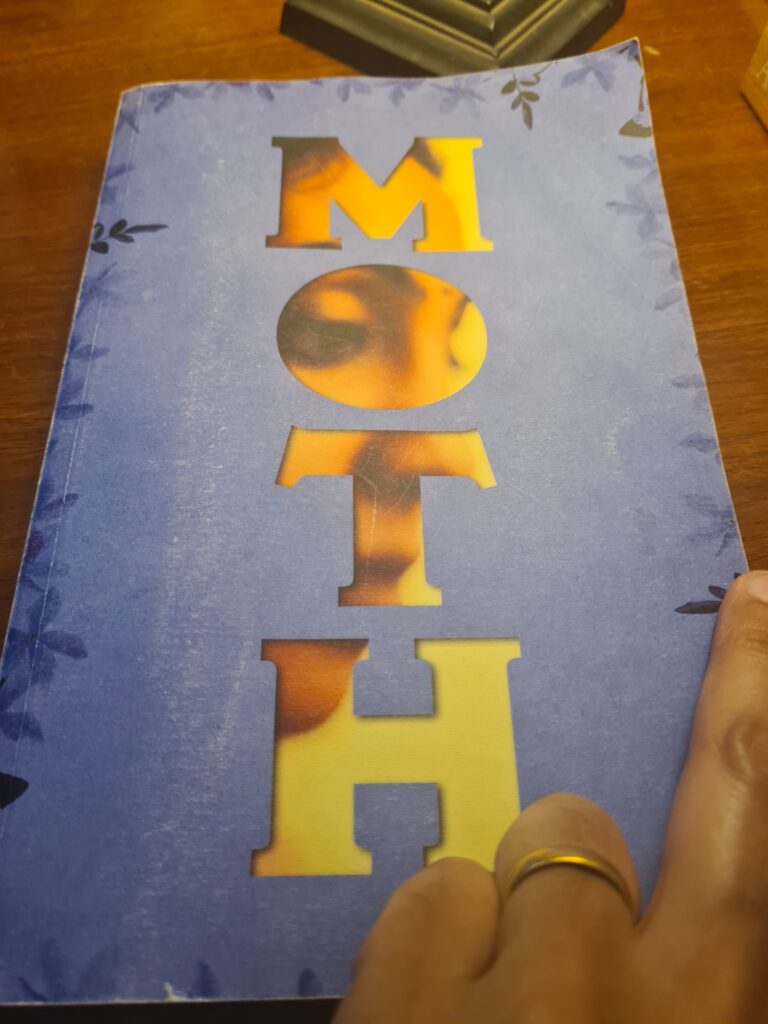
Delhi, 1946

Ma and Bappu are liberal intellectuals teaching at the local university. Their fourteen-year-old daughter — precocious, headstrong Alma — is soon to be married: Alma is mostly interested in the wedding shoes and in spinning wild stories for her beloved younger sister Roop, a restless child obsessed with death.

Times are bad for girls in India. The long-awaited independence from British rule is heralding a new era of hope, but also of anger and distrust. Political unrest is brewing, threatening to unravel the rich tapestry of Delhi – a city where different cultures, religions and traditions have co-existed for centuries.

When Partition happens and the British Raj is fractured overnight, this wonderful family is violently torn apart, and its members are forced to find increasingly desperate ways to survive.

Moth by debut author, Melody Razak ( Orion Books), has been a surprisingly slow read for me. Usually, I manage to zip through fiction pretty quickly. More so when it is historical fiction as I have a soft spot for this genre. But this one was slow for many reasons. These ranged from false starts in attempting to read it to the many times my mind wandered after reading a section of the story. Let me explain. 

Melody Razak credits Urvashi Butalia’s seminal book The Other Side of Silence for having inspired her debut novel. I can absolutely understand and recognise that sentiment. I worked with Urvashi for many years. I joined her team the day she split from Kali for Women to establish Zubaan. So, I was privy to a lot of Urvashi Butalia’s work for many years and also helped brand Zubaan. I, like Melody, and many others, had been in awe of Urvashi Butalia’s work for years. She did something fundamentally new. Of capturing the oral histories of women and families after the British left India in 1947. We gained our Independence but the people from the newly created nations suffered tremendously. 

Urvashi wrote this book after she volunteered to help the riot victims of 1984. It was a watershed year for many of us living in Delhi at the time. The Indian prime minister, Mrs Indira Gandhi, had been assassinated by her bodyguards while she was en route to meet filmmaker and actor, Peter Ustinov. It unleashed the most horrific communal violence we had witnessed at that time in newly Independent India. We were still a young nation at that time. (Now, communalism seems to be a way of life.) Many, many folks were horrified at what had occurred in the capital city. It was unheard of. We had curfew imposed. The army conducted flag marches. The silence was unbearable. No one should ever have to experience the silence of living in violent times. It is very still and still very disturbing. In the far distance, we could hear mobs. We could hear sounds. We would see smoke spires in the sky. And one of the most frightening memories was to see the ashes of paper flutter down on our terraces. When my twin brother and I returned to school after those two terrible two weeks, we noticed kids in our bus who were looking dishevelled and reduced to a cloth bag carrying a few books. They had been affected by the riots for being Sikhs and had lost property and family. It was earth shattering. But we were young. It was our first experience of such violence. But for my maternal grandfather it brought back a flood of memories. Stuff we had not realised he had kept suppressed for decades. 

My grandfather, N. K. Mukarji, was the last ICS officer in India. The Indian Civil Service was the administrative service established by the British. He joined as a very young man and was allocated the Punjab cadre. This was before 1947, so as a government servant he was posted in and around the then undivided Punjab. He later recalled that as a young man, he would sit with the other officers, many of whom were British, dividing the assets of the Punjab state between India and Pakistan. Many times, the lists drawn seemed arbitrary but he would meticulously minute the meetings. I am sure somewhere documents exist with his neat signature. He also used to tell us about the migrant camps that were set up. For many years, the refugees of 1947 were considered to be the largest mass migration ever recorded in human history. It was unprecedented. There were no rules or policies governing or guiding the officers on how to manage this massive influx of people. He used to tell us of how his signature was forged and converted into stamps. These forgeries were then used to stamp documents of the refugees so that they could use them as valid papers to migrate. Some left overseas too. My grandfather was well aware of these forgeries but the administration was so overwhelmed by the number of people that needed looking after that he turned a blind eye. And if you ever knew him, he was such an upright officer that this act upon his part was so unlike him. He and his colleagues worried about the spread of disease. Cholera and typhoid that still plague large refugee settlements were the bane of their existence even in the 1940s. The only difference being that there were no UN forces or other humanitarian aid organisations to help manage the healthcare of the refugees. There was no organised camp. So, the relief of the onset of the monsoon, literally washed the camp, is something that I still recollect in Nana’s voice. He has been gone for more than two decades but his relief, as if it was a God sent gesture, is something I will never forget. So, the descriptions of the refugee camps in Moth brought back memories of these stories. I could not help but think that the perception of the refugee camps of today that are to a fair degree “organised” because of the aid agencies, was not the case at that time. And this was one of the depictions in Moth that bothered me, the pell mell in the settlement. Instead, the description seems to suggest that it is fairly orderly. It was as if the image had been created from the modern images of refugee camps. 

Just as these memories came flooding back for my grandfather, so did it happen with many victims of the 1984 riots. The victims were Sikhs. The community to whom the PM’s assassins belonged. Urvashi too is a Sikh. She too had family in Lahore and in India. In fact, when I went to Lahore in Nov 2003, I went in search of the house that belonged to Urvashi’s family and discovered that it was in the process of being pulled down. So, I brought back pictures of it for her. 

There were many, many reasons why Urvashi was affected by the 1984 riots. But working in the refugee camps of Delhi, listening to stories, being a feminist, she realised the importance of recording these stories. Oral history testimonies were being done in our country even then but not necessarily by individuals at this level. Urvashi’s work is pioneering for many reasons. She explored her family’s history and unearthed many more stories in the process. It has had a huge impact on the way Partition stories are read. 

Melody Razak picks on a few of the stories such as the women jumping into the well, the abduction of girls/women and taking them away to the other side (since then established as a regular form of persecution of women at times of conflict), the problems of documentation etc. I found it particularly interesting that while Melody Razak has been deeply moved by the incidents recounted in The Other Side of Silence and of course, for this novel, may have done some independent research, Melody has been unable to describe the traumatic incidents. I found that curious as that it is often noticed in the victims that they are unable to recount the actual event. There are mechanisms by which they protect themselves, one of them is to talk about the act in the third person or distance themselves in the plot. Melody does exactly that — distancing herself. It indicates how deeply moved she has been by the testimonies/stories of the events of 1947. 

By the way, the assassin of Mahatma Gandhi whom Melody mentions, Nathuram Godse, was sentenced to death a few years later by Justice G. D. Khosla. Again, another upright officer who opted to join the judiciary once India became an independent nation. He wrote about the trial of Godse. It is freely available as a booklet online. I met Justice Khosla. He was a friend of my grandfather’s. But by these acts, I feel as if I have been close to history. (Does that statement even make any sense?) 

Melody Razak gets the grief at the assassination of Mahatma Gandhi very well. I recall meeting people who remembered that day very clearly. This and later, Jawaharlal Nehru’s death. Everyone could recall what they were doing at the precise moment that the news broke about these deaths. The collective grief that was felt at Mahatma Gandhi’s death has been brilliantly captured by Melody. 

But the reason why I had so many false starts to the book were because of the tiny historical inaccuracies in the opening pages. I can only recall one at the moment. She refers to Amul chocolates. Well, they did not exist till many decades after Independence. Amul is a dairy cooperative that was set up by Nehru under his modern India plans under the leadership of Mr Verghese Kurien (again, someone whom I have met). The chocolates came much, much later. So, this fact could have been checked. There were also spelling errors that annoyed me such as getting the name of All India Radio wrong and hyphenating “All India” or referring to the hot winds that blow in summer as “Lu” instead of as “loo”. (It is a hot wind similar to khamsin.) 

I can see why Melody Razak has been showered with praise in the media and has been recognised as one of the debut novelists of 2021 by The Observer. She has a great sense of storytelling. Her pace is fantastic. She knows when to slow down her writing tempo or speed it up as per the requirements of the plot. Her characters are so alive. She is able to move freely between the Muslims and the Hindus and describes them well. Alma’s grandmother is particularly vile. To create evil in a person who is mostly ignored by the family, is quite a creative achievement. But alas, she is also so familiar. We have all come across such characters at some point in our lives. Melody also manages to share only that much of the back story of the characters as is relevant to the main plot. Again, an admirable quality as many debut novelists tend to get hijacked by their characters and create unnecessary tangents to the story. Whereas in this case, whether it is the stories of Dilchain, Fatima Begum, Ma, Bappa or even Cookie Aunty/Lakshmi, Melody shares enough to make them rounded rather than flat characters. There is no need to know more about them. 

I had reservations about the extremely feminist angle to the storytelling. It was sort of unbelievable that these narratives could possibly have existed in 1947/8. It seems as if a very modern structure of feeling has been superimposed upon the past. It does not sit well. But then it brings me to the crux of literary fiction. At what point as Salman Rushdie calls it, does fiction “lift off” from the truth and begin a story of its own? Somewhere the writer has to be given the leeway to let their imagination fly. The reader too has to go easy on the writer for letting them tell the story in their own way. Perhaps I found it uncomfortable, even though I more than heartily agree with the feminist sentiments, because of the amount I know about the events of 1947. But the moment I sort of let myself go and just read the story for what it is, I realised it was the only way to “get into” it and enjoy it. Also, having read a lot of historical fiction recently has been doing this — of revisiting past events and imbuing the women characters with a strength and a personality with a very modern touch. It works for modern readers. And if historical fiction is being redefined today as historical events providing only a backdrop to the storytelling, then I suppose we have to make our peace with it. It is fine. 

As for the sisters, Alma and Roop, they are incredibly well-created. Although making Roop cut off her hair, roam around naked and wear her father’s trousers whenever she needed to step out seemed a bit farfetched for a five-year-old. But then who are we to argue with the bizarreness of life under conflict. Or for that matter now, during the pandemic. That was another thing that I found so eerily parallel to Moth — our reality of rationing food given the lockdowns and irregular supply of provisions, not sure when to step out (in Moth for fear of communal riots and today, for fear of getting infected by the Covid-19 virus), creating community kitchens (in the novel for refugees and in modern life for migrants who are going home), etc.   

As is fairly evident, Moth has triggered many memories as well as made me respond to the book in a manner that I did not think it would do. So there in itself lies the answer of a good emerging novelist. Moth is an extraordinary immersive experience and I am glad I read the novel. 

3 July 2021

Web Analytics Made Easy -
StatCounter