
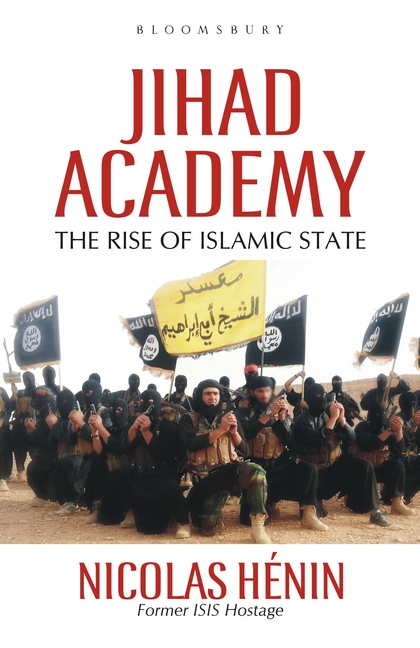
Nicolas Henin “Jihad Academy: The Rise of Islamic State”
 To prevent radicalisation, rather than putting imams on Arab dictators’s payrolls, we could seek to channel the goodwill of all those (Muslims and others) who are shocked by crimes committed in Syria and who simply wonder: ‘How can I help?’ We could devise some sort of ‘legal jihad’ to stop more young people ending up in the clutches of terrorists. We could promote humanitarian, social and other types of engagement. As far as I know, no such programme exists.
In addition, such an initiative would allow Muslims to reclaim the term ‘jihad’, which has been corrupted by extremists and hijacked by the Western media. Jihad– and this is something that we tend to forget–was initially one of Islam’s most beautiful concepts. It is the effort, exerted on and for oneself, with the aim of becoming better, improving one’s life and striving for a fairer world.
Our young people, whom we often describe as lacking values, of being individualistic and materialistic, deserve opportunities to commit themselves to something better than criminal gangs. ( p.135)
Frenchman Nicolas Henin is a former ISIS hostage. He was captured in June 2013 and spent ten months in captivity with James Foley and others who were beheaded soon after Henin was released. His book Jihad Academy: The Rise of Islamic State is a slim, hard-hitting and alarming account of the rise of ISIS. It documents the systematic rise of terror, the rise of Islamic State and how “the radicalisation of the revolution has proceeded in tandem with the hardening of Bashar al-Assad’s personality” ( p.41)
Here is a man who was an ISIS captive. He has not succumbed to the Stockholm Syndrome. Nicolas Henin is a thorough professional journalist. He is very familiar with the Middle East having worked in the region as a freelance journalist for more than a decade. Like the Jesuit priest, Paolo Dall’Oglio, who negotiated his freedom Nicolas Henin too has ‘Syria in his heart’. It is hard to even begin to imagine what Henin is going through mentally more so with the knowledge that Paolo Dall’Oglio has been abducted by the Islamic State and is still missing. Yet he has had the presence of mind to write this clear account — Jihad Academy.
After the horrendous attacks in Paris on 13 November 2015 when more than a 100 people were gunned down, Nicolas Henin wrote this scathing essay in The Guardian: “I was held hostage by Isis. They fear our unity more than our airstrikes” ( 16 November 2015. http://www.theguardian.com/commentisfree/2015/nov/16/isis-bombs-hostage-syria-islamic-state-paris-attacks )
What is even more terrifying than reading Jihad Academy is the realisation that this is not the first time such terror has been unleashed. The lessons learned from the past are that man-made monsters can easily be created but once in existence these human monsters can unleash an unimaginable horror on their own race.
Jihad Academy has to be read. It is a memoir with a difference. A firsthand account with a sharp and acute understanding of the Islamic State.
Nicolas Henin ( Former ISIS Hostage) Jihad Academy: The Rise of Islamic State Translated from French by Martin Makinson. Bloomsbury, London, 2015. Hb. pp. 150 Rs 399