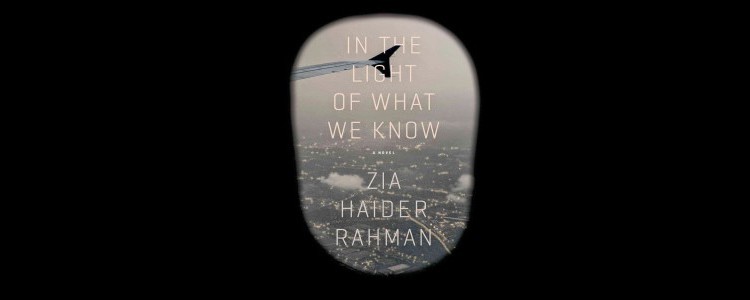
On 20 July 2014, The Hindu Literary Review carried an interview I had done with Zia Haider Rahman. A shortened version was published in print, a slightly longer version on the newspaper’s website ( http://www.thehindu.com/features/magazine/writing-is-really-an-interruption-of-reading/article6228449.ece ) and I reproduce below the complete and unedited version of the interview that the author sent and approved. The book is available in India with Picador India, PanMacmillan India. ISBN: 9789382616245
 Zia Haider Rahman’s novel, In the Light of What we Know, is a forceful debut. It is about two male friends, an unnamed narrator and Zafar, who first meet as students at Oxford. The book consists of a long, meandering conversation with the men exchanging notes about their past, their careers, their families and their experiences since they last met in New York, when they were colleagues with bright futures at a financial firm. This meeting takes place in London, September 2008.
Zia was born in rural Bangladesh but migrated to the United Kingdom before his sixth birthday and was raised in a derelict squat before moving to state housing. His father was a waiter; his mother a seamstress. Zia won a scholarship to read mathematics at Balliol College, Oxford, and completed graduate studies at Cambridge, Munich and Yale universities. After working as an investment banker for Goldman Sachs on Wall Street, he turned to practising as an international financial lawyer before moving to human rights work.
1. What was the gestation period for this manuscript? How long was the first draft? How much time did it take from manuscript to printed book?
Many of the ideas and images in this novel have been percolating for rather a long time; some of the governing themes have grown out of preoccupations that have been with me for the whole of my life. I imagine this must be true of many authors and must hold for even books subsequent to their first.
The first draft was about the same in length as the final one, as I recall. Before I began revising anything, my editor made some helpful suggestions conceding that those comments might actually increase the length of the novel by ten or so per cent. In the end, I decided to make a few small cuts here and there and so the word count did not change much between the first draft and what is there now in the printed book. I find that certain writing is not improved by tinkering or revising, particularly passages or scenes of strongly emotional content: the rawness is a vital part of the energy.
From final manuscript to printed book, it took about three to four months. I made life a little difficult for myself by choosing to keep the British English version and the American English version distinct; the punctuation as well as vocabulary, of course, is different. The US version, for instance, has adopted the serial comma, which most non-American readers would find inhibitive to fluent reading.
2. How many notebooks did you maintain to create this novel or was it written directly on the computer? When and where was the research done? Does it ever cease?
As a matter of routine, I have always kept notebooks, jotting down ideas and things of interest. I used to try to keep track of them. Once I’m through a dozen or so, I sit down and take a few hours to type them up. This refreshes my memory but also allows me to discard ultimately uninteresting material. But the real reason I do it is that an electronic document is easy to search through.
While writing the novel, my note-taking activity increased hugely. I was quite itinerant at the time, so it was vital to have something to hand in which to record thoughts as they arose, if I was waiting for a train or plane, or if I woke up with a thought that I wanted to record. But when I was properly drafting any text for the novel, I did this on the computer. I type very much faster than I write long hand.
The research was done in various places. Some of it was done on the internet, although the internet is really only helpful as a starting point and also to confirm some fact or other. At one point, I used the internet to watch what felt like every US congressional hearing on the financial crisis, which was considerably more than was necessary for the novel, but I found them inherently fascinating and full of drama. The libraries I used were principally the British Library in London, the New York Public Library and the library of a small town in upstate New York, near Yaddo (a foundation for writers, artists and composers, where I wrote most of the novel). The last library is actually plugged into the wider library system of upstate New York and has very swift access to the many books within the system. It’s quite extraordinary, actually, with large sunlit rooms and many shelves of books, as libraries used to have, and has not been overrun by technology, multimedia and so on.
It’s no doubt possible to do more research than necessary. But if the activity of research is in itself rewarding then one is not so much doing research as merely indulging oneself in the pleasure of reading.
3. Who are the authors and writing styles/ traditions that have influenced you?
Everything I read leaves something and I can no more identify my literary influences than I can point to particular meals I’ve had that have been exceptionally nourishing. Over the years, many, many books and authors have had an emotional impact on me, although whether and how they might have influenced my writing is, in most cases, harder to see. To name a few that spring to mind: Dostoyevsky’s The Brothers Karamazov, Marquez’s Hundred Years of Solitude, Dorothy Allison’s Bastard out of Carolina, Thomas Mann’s Doctor Faustus, David Adams Richards’ Mercy Among the Children, Salman Rushdie’s Midnight’s Children, Sylvia Plath’s The Bell Jar, Sebald’s Austerlitz, many of Philip Roth’s novels and Coetzee’s, James Baldwin’s, and the list goes on and on, as one might expect of any author, because writing is really an interruption of reading and vice-versa.
4. You have a lot of epigraphs in the novel but they seem to be used in an unusual way. What is their purpose?
You’re right. There is something unusual about them. Ordinarily in novels, epigraphs are evidence of the writer peeking in from behind the curtain; here, the narrator has actively included them after retrieving them—or most of them—from Zafar’s notebooks, as he himself explains. There is also the fact that near the end of the book the epigraphs of a particular chapter are the venue for a disclosure: the epigraphs actually do a job of storytelling. Described in this way here—and not encountered in the course of reading—it might seem like the assignment of epigraphs to and by the narrator is a breach of a convention of the novel. After all, epigraphs typically stand above, aside, aloof. I have no aversion to breaches of convention, provided they are effective, but I’m not sure there is a breach here in any event. All that is happening is that the narrator is laying claim to real estate on the page ordinarily owned by the author.
5. At a time when it is easy to Google for information why did you introduce extensive footnotes in the text?
As you know, the narrator himself does precisely that—go to internet search engines in order to look things up. The narrator uses footnotes where he wants to elucidate something that Zafar says, without interrupting the flow of Zafar’s account. Having said that, there are also a couple of rather long footnotes, notably one likening map projections in cartography to the translation of poetry and another relating to the war of 1971, where one has the sense that the narrator simply doesn’t want to omit something that Zafar said or wrote and yet cannot justify to himself the inclusion of the material in the main body of text. The narrator, as one quickly gathers, is to a certain degree rather unreliable: he thinks he is smarter than he actually is, he has a rather undeveloped attitude to women, and, of course, he is fundamentally compromised by a certain set of circumstances which we cannot go into without issuing a spoiler warning. The footnotes—their presence, form and the kind of material they include—are an example of what emerges from the first person perspective here. In a third person narration, they might not have emerged in a necessary way.
6. How did your training in mathematics impact your manuscript drafts and plot structure?
Mathematics is fundamental to my outlook on very many things and in ways that I cannot easily measure. In my formative years it was everything to me, the single place of beauty in my life, and of breathtaking beauty at that. I still believe that pure mathematics is the most creative thing that our species does, though I am no longer a part of the mathematical project.
The mathematical tilt remains basic to my epistemological perspective, my insistence on reasons for a claim—reasons that that are capable of yielding to interrogation. Mathematics gave me that. Other experiences might have left me with the same outlook, as I expect other things do to other people. But my debt is to mathematics. Nothing in life can be relied upon in the way that a mathematical proof can. Nothing anyone ever says or does or tastes or feels will so much as perturb the trust we have in a mathematical truth. And though elsewhere in life we cannot achieve the same conviction, the presence of this standard in one realm ought to be regarded as a beacon illuminating the dark poverty in the quality of reasoning we seem to settle for in other aspects of our lives, in the political and social especially.
I am unsure how to begin to answer your question—or even if I can—since thinking mathematically, day-in and day-out for a long time and at a formative age means that its effects are marbled into my foundations.
7. The analogy between cartography and translation is a fascinating concept on the art of representation via illustrations and word. How do you view your novel in the light of this theory?
In the novel, the narrator relates Zafar’s observations on one underlying similarity between map projections and the translation of poetry. There are many ways to represent the curved surface of the planet on a piece of paper. And there are many ways to go about translating a poem in one language into another. In cartography, for instance, you might choose to preserve relative areas or relative subtended angles. In poetry, you might choose to preserve rhyme or meter. The list of things to consider is actually quite long in both cases. Both involve choices about what to preserve and what to let go. Moreover—and this is crucial—in both cases a decision to preserve one thing limits or even destroys the freedom to preserve others. In both cases, also, the underlying need that drives the enterprise is that without either a map or a translation nothing would be knowable; after all, you cannot give someone a miniature globe with all the details of the earth’s surface along with a powerful magnifying glass and tell her to use these to navigate her journey across New York, London or Delhi, any more than you can give her a poem by a Hungarian poet along with textbooks to learn Hungarian and expect her to be moved to tears—assuming she’s not a native Hungarian speaker, of course!
The similarity of the two enterprises speaks to the pervasiveness of an underlying point: in order to gain access to the world, we undertake an activity of representing it that necessarily involves destruction. We are forced to abandon any hope of seeing some things in order to see anything at all. Zafar’s perspective is bleak, on one level, but on another it could be read as epistemic humility, an acknowledgement of one of the kinds of constraints on our perception of the world and on our access to knowledge. There are several themes in the novel but its backbone is to do with the status and nature and limits of knowledge.
8. There are so many identities that you mention in your novel whether defined by religion, nationality or language. Even within one religion there are many sub-categories such as Wahhabi and Sunni Muslims; Coptic, Arabic and Pakistani Christians, Anglicans and Catholics. Would you say that In the Light of What we Know is exploring the concept of a “global or an immigrant” novel?
I remember walking into a famous independent bookshop in New York a few years ago and discovering that under fiction they had an “Asian writers” section, as well as other ethnically or regionally defined categories. This sort of arrangement is not uncommon. But it is impossible to criticize the bookshops themselves; the industry of bricks and mortar booksellers is under enormous strain, with outlets folding by the day, not to mention whole chains of stores. Bookshops are simply responding to customer demands and preferences; in an environment in which margins are being squeezed, there is little room to do anything but organize books in a way that caters to customer tastes and maximizes sales. Some are throwing in the towel and have transformed into cafés or gift shops in all but name; if they can flog you a book on your way out, that’s a bonus.
The geographic and cultural categories into which novels are placed, often by people, other than the author, assigning her an identity, is driven by a market that has become habituated to conceiving of literature in terms of these categories. The root of the problem is a word: novel. The novel is such an expansive menagerie, holding such varied beasts, that a taxonomy is inevitable because it is useful. But the expansiveness of the idea of a novel gives rise to all manner of problems. For instance, it means that two novels might be compared that are fundamentally incommensurable. The label novel is misleading. But the publishing industry needs it in order to widen the market for every book it promotes: You like novels? Well, here’s a novel. I suspect that your question has more to do with aspects of my own particular novel. But I think that the question is related to the business of book-selling. The publishing industry is slightly schizophrenic in a certain respect. Discussions about lofty ‘literature’ rarely include matters of publishing industry realities. I understand this—in fact, a little part of me dies when I hear talk about the art of novels and the business of publishing in the same breath. But—to bring us to your question—it seems to me that the current taxonomies are not responsive to the changing world and our changing understanding of the world. What happens twelve time zones away has as much impact on us as something happening on our doorstep. The geographic, economic, and social scope of the particular world each of us inhabits is widening, the perceptual field broadening. To return to the taxonomy analogy, even biologists have been introducing new taxonomies of living things that reflect better understandings of relationships between organisms.
9. Post-9/11 there have been a number of novels tackling the issues of identity, cultural politics, and new geo-political orientations, with literary conversations dissecting the rise of the Muslim novelists. Yet In the Light of What we Know focuses on “conflicts” happening along various fault lines—in the world of finance, within marriages or on real battlefields. The frightening truth to emerge in your story is the sense of wrongs and injustices of history being repeated over and over again, going against the popular theory of one particular community being responsible for terrorism. Please comment.
Every general election anywhere seems to mark a turning point, we’re told. Or something is a landmark event. Every military surge is a new initiative that will turn back the tide. The consumption of news would fizzle out if it did not bear the sense that what is happening is new in the sense that it is bringing in change, is going to alter the way things are. We all like to plan—we can plan like no other animal—but our ability to plan goes hand in hand with an appetite to learn what’s new, what’s news, what might affect our plans. News media feeds this appetite endlessly and would do itself out of a living if its reports ran along the lines of, say: Such and such happened today and it’s terribly similar to what happened ten years ago and also to what happened forty years ago and everybody thought then that it was going to change everything but it didn’t.
There is hubris in regarding ours as the pivotal moment in history—a shocking hubris given that every age has thought this way—but it is vital to the sale of news to maintain this pretence. To see the repeated patterns may not actually make it easier to resolve the problems we now face—after all, the most common repeated pattern is one of failure—but I have wondered whether it would lead to a feeling of familiarity, which would have a calming effect, a sense that we are not at the edge of a precipice without parallel. Of course, this is a nightmare to those who rely on us feeling frightened all the time.
10. During the Global Summit to end Sexual Violence in Conflict, London (June 2014) the birangonas stories were not shared in the official programme; a silence that was marked by protests. Whereas in your novel there are many epigraphs drawing the reader’s attention to the Bangladeshi women raped during conflict. Please comment.
What is there to say that hasn’t been said already? Tahmima Anam, the distinguished Bangladeshi novelist, has written evocatively about the plight of the Birangonas. But one finds oneself still asking: who is listening? Every aspect of the suffering that these women have been through at the hands of Pakistani soldiers and Bangladeshi collaborators is stomach-churning. But it galls me to think that after rape and violence during the war many of them returned to communities that turned their backs on them.
11. How would you define yourself? By the country of origin or domicile or a bit of both like Zafar who is perceived as “Anglo-Bangla”?
I am often asked where I’m from—in Europe, mainly because of my skin color, and in the US, mainly because of my British accent. I know that this is the case because in the US when I say that I was born in Bangladesh, nine times out of ten, an American probes further to get an explanation of the accent. But if, instead, I tell Americans that I grew up in the UK, there seem to be no further questions. I’m explaining this because nobody ever actually asks me to define myself; the question is invariably “Where are you from?” and behind that question there is a desire to have something specific resolved—why the skin color or accent? Nor do I myself ever stand in the mirror and ask: Zia, how do you define your identity? Identity, per se, has not been an issue I have felt a need to resolve. Does a lion need to know that it is called a lion?
That said, I have long sought a sense of belonging to a place, something lacking in my psyche. The insufficiency is not without its advantages, of course. I think it keeps one a little removed from things, which is a helpful vantage from which to observe. And this slight dislocation can make for interesting personal experiences. But the cost is brutal. Human beings need roots, perhaps not all humans, but I rather suspect it is the norm to attach to a piece of land, to the ground that will one day take us back.
12. You are represented by the legendary literary agent Andrew Wylie, a dream beginning for a debut author. How did this come to pass?
I was introduced to the agency by a mutual acquaintance. I have been lucky in many ways over the years beginning with the enormous good fortune of having access to healthcare and schooling and libraries and, at least after the first few years, to a decent meal every day, all the way through to the sheer luck of living in a place where university education did not require me or my family to bring resources of our own. If humanity cared enough about fairness, then luck of this kind would have no place in determining the fate of a child.
22 July 2014