
Russia Posts

Interview with historian and editor Chandana Dey

For Moneycontrol, I interviewed Chandana Dey on publishing her Russian/Lithuanian Jewish grandmother’s memoir — Kotia to Ketaki: At Home Away from Home. It is published by Writers Workshop.

Interview with historian and editor Chandana Dey

Chandana Dey studied Modern Indian History at the Jawaharlal Nehru University, Delhi and
International Affairs at the School of International Studies (SAIS), Washington D.C. She has recently published her Russian/Lithuanian Jewish grandmother’s memoir — Kotia to Ketaki: At Home Away from Home. It is published by Writers Workshop India. In fact, Chandana Dey more or less, co-authored the publication by adding a substantial afterword to the original memoir entitled My Life. Ketaki Sarkar was born Kotia Jonas to a middle-class family in Moscow in 1907. She lived through the Russian Revolution, famine and the civil war. The family moved to Switzerland in 1921. Kotya met her husband, Nitai De Sarkar, a medical student. They married in 1930 and came to India in 1934. Kotia learnt Bengali, always wore a sari and made India her home. On one of their visits to Santiniketan, Rabindranath Tagore bestowed the name, Ketaki, on Kotia Jonas. This is the name she retained for the rest of her life. Ketaki made Santiniketan her home and died at the age of ninety-one.  Kotia to Ketaki is a slim book but packed with detail – by both grandmother and granddaughter, stretching across time. Truly worth reading!

Here is the interview conducted with Chandana Dey conducted via email.

  1. When and why did your grandmother, Ketaki Sarkar nee Kotia Jonas write this Memoir? Was it all from memory or did she consult any living relatives at the time?

My grandmother has dated the memoir as 1972. My mother typed the manuscript on her portable typewriter. I would imagine that my Dida got the time for reflection and thought after 1971. She retired from the Alliance Francaise and came to live in Santiniketan, in her home, ‘Akanda’ permanently. Before this, she used to visit Santiniketan only on holidays or occasional weekends. My family members who had heard stories of her childhood in Russia kept urging Dida to write her memoir. I don’t think she consulted any family members, although she was in regular touch with her sister, Tina. When I started the research for the book, no one in the extended family knew that such a document existed. The only people who had read the memoir were people in Santiniketan whom my grandmother was close to — among these were Kshitis Ray, (Teacher of English in Patha Bhavan and Tagore researcher), Rani Chanda (artist and Freedom Fighter) and Uma Das Gupta (foremost scholar of the history of Santiniketan and Sriniketan). Part of the reason for not passing around the Memoir much was partly my grandmother’s own diffidence and the fact that the Jonas family members were not comfortable in English. This discomfort with English also affected many potential readers in Santiniketan in my grandmother’s circle.

  • The memoir reads swimmingly well for a modern reader, even if a little sparse on the historical details. Did you print it in its entirety or is this an abridged version?

It has recently come to my attention that there may have been an original version of the memoir that was written in French. I have never seen such a document. From the 1970s, family members heard of the memoir and each family member was given a typed copy of My Life. This is the entire text that I was given by my mother. I put it and the photographs my mother gave me in a small black suitcase. I think the genesis of Kotia to Ketaki was in my mind for the past 40 years. However, as all precious things are stored away, so was the black bag! When I went to retrieve the contents, I found the black bag empty. My late aunt came to my rescue. As my cousin and I went through her things, we found the copy of My Life. I immediately scanned the single copy and sent a copy to each living family member.

Unfortunately, the memoir ends in 1946. I think we did not pester my grandmother sufficiently to compel her to write about her remaining life history. It was a fascinating one. She was the sole breadwinner of the family. She worked in multiple jobs and made enough money to send my mother to Europe for her higher studies. She also built three houses. I really regret not recording her life and bringing out a companion volume. I also regret not asking her about the memoir in sufficient detail.

  • Your grandmother was a Lithuanian Jew who had been born and brought up in Russia before and after the Russian Revolution and in parts in Switzerland and France. Her memoir observes a smoothish transition for her to living in British India, especially in Shantiniketan; to the extent she learned Bengali so as to speak to family members. How did she assimilate in the Bengali Bhadra society? Did she have to forego her Judaism?

My grandmother spoke Bangla fluently. She did not manage to learn the language to be able to read or write in Bangla. But she used to listen to poetry, would attend all the functions in the Ashrama. Both my uncle and mother studied in Patha Bhavan and Bengali was spoken at home. My grandparents, however, spoke in French with each other. Perhaps it was my grandfather’s support that enabled such a smooth transition into Bengali society. The story goes thus: once they were settled in Calcutta, Dadu said to Dida, ‘Come, let me take you somewhere you will feel at home’- and this was Santiniketan — where there were many Bengalis married to foreigners. Besides, Rabindranth Tagore was almost singlehandedly responsible for trying to turn Santiniketan into a cosmopolitan place, while retaining its fundamentally Bengali ethos. Yet, it continues to be a mystery as to how Dida adjusted so well to Dadu’s family — a joint family that was extremely hierarchical and patriarchal. My grandmother’s mother-in-law was known to be a stern figure and extremely harsh with her daughters in law. My grandmother became her favourite daughter-in-law — and was given privileges, unheard of at that time. This remains a mystery to me and to everyone else.

A word on the Judaism is required here: my grandmother never had any Jewish artefacts in her home. Not even a menorah. The first menorah was one that my mother’s Jewish friend presented to her during their stay in the US. Nor did my grandmother ever step into a synagogue. Yet, the idea of Israel was very important to her since she felt that the Jews deserved a homeland after the Holocaust. This was a reason for perpetual strife in the family since my late brother was a vehement supporter of the Palestinian cause. The ‘Russianness’ revealed itself through a love of literature, music, language. She never taught Russian but never forgot the language. It was a great help to me when I started learning languages. I think I chose French and Russian so as to be able to speak to Dida.

  • Depending on the audience they are addressing, women tend to bifurcate their narratives for private or public consumption. You knew Ketaki Sarkar. Do you think her memoir is true to her personality, the person you knew, or did she skip information in writing that she may have told you verbally.

Interesting question. The memoir was written originally for her children — Maya and Nandan. In fact the memoir is addressed to them. Once written, my uncle and my mother persuaded my grandmother that it should be published. Initially reluctant, my grandmother acceded to their wishes. Dida was always very conscious of the lack of educational foundation in her growing years. She felt that she was self-taught to a large degree. In Santiniketan, she was surrounded by literati. But I think she held her own even in these circles. ‘Kotia Mashi’ was much sought after and she remained close to her friends and their children and grandchildren. Santiniketan is still a very small place where most people know each other. It would be natural therefore for Dida to eschew anything critical about the people she met. When she wrote the memoir, the characters in the narrative were all living. Besides, the memoir is a narrative where she looks back forty years. (She is writing in 1970 about what happened in 1930.). She is taking a look at her previous self.  

  • Why did your grandmother’s family move to Switzerland? Were conditions conducive for a Russian/Lithuanian Jewish family to relocate to the fairly newly established country, Switzerland (established 1874)? Did the internal passport issued by the Lithuanian authorities play a key role or was it linked to the Bolshevik Revolution and the ‘threat of communism’?

My great grandfather, David Jonas, had purchased a piece of land in a place called Richielien, near the Lac Leman. Doctors in Moscow had suggested he go and take rest somewhere and since the family traveled widely, he chose Switzerland. This was around 1912. By 1914, the Swiss doctors gave David a clean bill of health and the family returned to Moscow. After the Russian Revolution, famine and civil war, David was keen to leave Russia. This was only possible because of the internal passport, issued by the Ober-Ost government. A large part of Lithuania was then under German rule.  If David had been born in Moscow, it would have been impossible for the family to leave Russia after the Revolution. David’s sister, Sonya,  lived in Lithuania. Sonya and her husband, Dr Frumkin, helped David get the Lithuanian passports. During my research, a Lithuanian researcher, Elena Borik, found proof of my grandmother’s family’s passports in the Lithuanian archives. My grandmother has written about the large Russian émigré community in Switzerland at the time the Jonas family lived there.

  • What was your Bengali grandfather doing in Geneva when he met Ketaki at a student dance before they moved to Orsieres as a married couple? Or to put it another way, was Geneva a regular landing spot for Indian/Bengali students going overseas to study and work?

My grandfather was studying medicine at the University of Geneva. He had first tried his luck in Paris (where there were more Indian students) and then moved to Geneva. He studied French and even wrote his thesis in French. Some Swiss friends located his thesis in the University of Geneva archives. This Swiss degree was not really recognized as a proper degree when my grandfather returned to India. He struggled to land a proper job and did not manage to have a very successful practice either. My grandfather came from the Amrita Bazar family. The family consisted of staunch nationalists. My grandfather did not want to go and study in a colonial setting. He therefore chose France, then Switzerland. There were many Indian students in Britain. This was the most popular choice and there was no need to learn a foreign language here.

  • Your grandmother and you make references to the Yonas family being related to Eliezer Ben Yehuda (ne Perlman), the founder of the modern Hebrew language. How did you verify your grandmother’s account?

My grandmother spoke often of Eliezer Ben Yehuda. When my parents visited Israel (my father was then in the World Bank, therefore travel was possible), they met Dola BenYehuda, Eliezer’s daughter by his second marriage. (Eliezer Ben Yehuda would marry two of the Jonas sisters, first the eldest Devorah, then the youngest, Pola). Dola presented my mother with a copy of Robert St. John’s book, The Tongue of the Prophets: the Story of Eliezer Ben Yehuda. The Ben Yehuda family considered this the authoritative account of their illustrious forefather. I corroborated the account by delving further into the Ben Yehuda family. The genealogical website revealed a lot of information. I cross-checked this with writing to family members and asking them for more information. I watched films on Eliezer Ben Yehuda and read what he had written. I consulted my friend Dr Brenda McSweeney who taught in Brandeis University and asked her to suggest any colleague who might have worked on the role of women in early nineteenth century Palestine. She suggested the name of Margaret Shilo and I read her work and corresponded with her also. I tried all manner of ways to get information on the Jonas children. The two most interesting remain the most undocumented — Boris and Penina. Of course, the person who wrote the most was Eliezer’s second wife —Pola — who took on the name of Hemda. By all accounts, she had a terrific personality. However, I tried to stay clear of hagiographic accounts as much as possible. It was Hemda who stayed in touch with the entire Jonas clan.  

  • Your afterword is packed with historical context to Ketaki Sarkar’s memoir. Why did you feel the need to write this detailed account? Why did you decide to write a separate section, rather than heavily annotate Ketaki’s text?

My mother tried hard to get the memoir published. Everyone she spoke to said it was too short and could not be a standalone volume. Early on, I thought a short historical background was important to buttress the memoir. While working at the Social Science Press as an editor, I had approached Esha Beteille with the idea of the manuscript. She showed great enthusiasm, as did her daughter, Radha. I wrote a first draft but Radha found that the historical part should be more detailed and Esha di felt that something should be written on my grandmother’s siblings as well. I realized this would mean much more secondary research. Eventually, a chance meeting with Anada and Swati Lal at their iconic home at Lake Gardens allowed me to raise the matter with Ananda. He accepted the manuscript without question. I shortened the text to make it more reader-friendly and budget-friendly. Ananda did meticulous editing and this took time also. I started the research in 2017. My father passed away in 2018. My brother passed away earlier this year. I kept urging my brother to look at the various manuscripts, but he said he would wait to read the final book. This did not happen.

  • What was your research methodology? When did you realise you had sufficient material to put into this book?

I had thought, originally, of writing a very short background to the memoir. I felt that most people knew about Russia’s history, certainly about the Indian National Movement, the Bengal Renaissance and the genesis of Santiniketan. On rereading the memoir after many years, I just had so many questions on the veracity of my grandmother’s story. Surely my great-grandmother could not have ridden on horseback from Siberia to Moscow? I remember seeing her photographs and hearing stories about her. This was just one example. Another question in my mind and one that caused me sleepless nights was —what exactly were my great-grandparents’ political affiliations? Were they card-carrying Bolsheviks? My grandmother did not mention this anywhere. But I know they supported the Revolution. Were they Anarchists? I did not think so. So I went to consult Prof. Hari Vasudevan and he confirmed every single doubt I had. He gave me solid historical evidence to validate my grandmother’s memoir. Prof. Vasudevan passed away from the first round of Covid, leaving me and countless others bereft. I think that the ‘introduction’ developed into a ‘book’ when I found documentary evidence of the burgeoning Jewish ex-mercantilist, educated bourgeoisie and the wealth of secondary material on the Pale of Settlement, the Haskalah (Jewish religious reform movement) and the extent of education for Jewish girls in Russia. When I read about the Haskalah, I thought I was reading about the Brahmo Samaj and the Bengal Renaissance; when I turned to girls’ schools in Palestine or Russia, my thoughts turned to education for girls and women in nineteenth century Bengal. There were so many commonalities that could not be discounted as coincidence. And oh, the wealth of secondary material in English, French and Bengali! A veritable treasure trove. My one regret was that I had completely forgotten my Russian. As I read more and more, sitting in the India International Centre Library, New Delhi, I realized that there was material for a book, and this would be interesting for readers, if I could tie up the history with the narrative covered in the memoir.

  1. What did it mean to you to delve into this history and discover details about your lineage? More importantly, make visible linkages in global movements of the early twentieth century that would have remained hidden from view, but probably continue to have ramifications today.    

Global events such as the terrible treatment of migrants and refugees were the constant backdrop to researching and writing this book. I kept asking myself — were the barriers between countries really insignificant in the early twentieth century? It was indeed possible for my Russian grandmother to meet and marry my Bengali grandfather, live and work in Switzerland, and then come back and live in India. Would this story ever happen today? I have tried meeting and corresponding with Jonas/Frumkin/Ben Yehuda family members. It is astonishing how well we seem to ‘commune’, although I have to say that my fluency in French helps immensely. The global movements you speak of became visible during the research. But I think that more needs to be written on the commonalities of different historical events and movements. We should be linked by our common faith in humanity. I think Rabindranath Tagore thought deeply about so many issues and problems of the twentieth century. His answer was establishing Visva-Bharati — the world in one nest. But we who live and breathe Santiniketan have not been successful in taking his message of peace and brotherhood far enough.  

7 Nov 2025

Of holy men like Rasputin

Douglas Smith’s Rasputin is a detailed and a fascinating biography of a holy man who was extremely close to Tsar Nicholas II and Empress Alexandra. It is a slow but satisfying to read for it describes Russia at the turn of the twentieth century, decline of the Russian empire, rise of Lenin and the Bolsheviks etc. Rasputin was also shortlisted for the James Tait Black Prize 2017. Here is an excellent review of the book in The Guardian.

Of all the lines in the book it was a description of him in the opening pages which are gripping since it could be a description of any other holy man in a different time, nation and culture. Read on:

Pokrovskoe was the home of the most notorious Russian of the day, a man who in the spring of 1912 became the focus of a scandal that shook Nicholas’s reign like nothing before. Rumors had been circulating about him for years, but it was then that the tsar’s minists and the politicians of the State Duma, Russia’s legislative assembly, first dared to call him out by name and demand that the palace tell the country who precisely this man was and clarify his relationship to the throne. It was said that this man belonged to a bizarre religious sect that embraced the most wicked forms of sexual perversion, that he was a phony holy man who had duped the emperor and empress into embracing him as their spiritual leader, that he had taken over the Russian Orthodox Church and was bending it to his own immoral designs, that he was a filthy peasant who managed not only to worm his way into the palace, but through deceit and cunning was quickly becoming the true power behind the throne. This man, many were beginning to believe, presented a real danger to the church, to the monarchy, and even to Russia itself. This man was Grigory Yefimovich Rasputin. 

Even before his gruesome murder in a Petrograd cellar in the final days of 1916, Rasputin had become in the eyes of much of the world personification of evil. His wickedness was said to recognize no bounds, just like his sexual drive that could never be sated no matter how many women he took to his bed. A brutish, drunken satyr with the manners of a barnyard animal, Rasputin had the inborn cunning of the Russian peasant and knew how to play the simple man of God when in front of the tsar and tsarita. 

Douglas Smith Rasputin Macmillan, London, 2016. Pb. pp. Rs 599

11 Sept 2017 
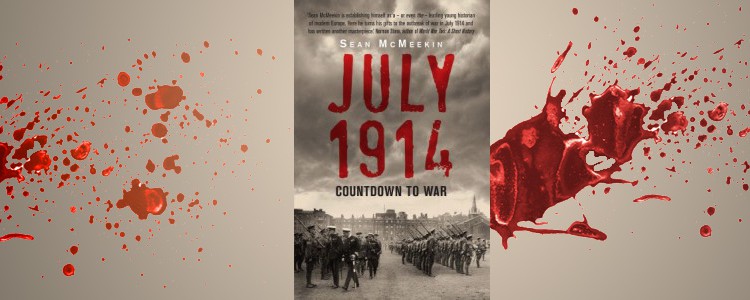
Sean McMeekin “July 1914: Countdown to War”

Sean McMeekin “July 1914: Countdown to War”

July 1914

When we studied about WWI as children, our school textbooks would dismiss in one sentence the assassination in Sarajevo of Archduke Franz Ferdinand of Austria-Hungary as being responsible for the war. In comparison Sean McMeekin’s July 1914: Countdown to War is a big fat book of nearly 470+ pages documenting the assassination, the aftermath in the month of July 1914, and the complicated politics. His account is packed with detail. It does not matter if one is unfamiliar with the nitty-gritties of the Habsburg Empire, the rising power of Russia etc. He makes the claim that the Great War  was “The War of the Ottoman Succession”. It will require a historian, especially of this period to do a scholarly critique of the book, yet it does make an important contribution to the avalanche of books being published in 2014–the centenary of World War I. 

July 1914: Countdown to War is packed with information without getting tedious, is strong on storytelling, making it very accessible to a lay reader too. It is worth reading. I found a print book useful to scribble notes in the margins but a book like this would do well to have a digital interactive edition.

Here are some links related to July 1914: Countdown to War and WWI literature. ( Now for similar articles from different parts of the world.)

http://www.nybooks.com/articles/archives/2014/feb/06/greatest-catastrophe-world-has-seen/ A review article by R. J. W. Evans on NYRB on a bunch of WWI books, including two by Sean McMeekin. ( 6 Feb 2014 issue)

http://www.foreignpolicy.com/articles/2014/05/27/the_house_of_habsburg_revisited_empire_nostalgia_austria_hungary_central_europe An excellent article on Foreign Policy by Simon Winder, “The House of Habsburg Revisited”. ( 27 May 2014.)

https://www.youtube.com/watch?v=rOwaYNiJ6G8 In a discussion of his book, July 1914: Countdown to War,  historian Sean McMeekin reveals how a small cabal of European statesmen used the assassination of Archduke Franz Ferdinand to initiate a long-awaited showdown among the Continent’s powers, ultimately leading to the start of World War I. In this talk he also says that many of the contemporary conflict flashpoints/battlefields are the same as those during WWI. (29 January 2014, The Kansas City Public Library. )

http://www.publishersweekly.com/pw/by-topic/new-titles/adult-announcements/article/62227-the-war-that-fractured-history-100-years-on-wwi-books.html#path/pw/by-topic/new-titles/adult-announcements/article/62227-the-war-that-fractured-history-100-years-on-wwi-books.html A round up on Publishers Weekly of books on WWI, but does not mention any of Sean McMeekin. ( 9 May 2014)

Sean McMeekin July 1914: Countdown to War Icon Books, London, 2013. Pb. pp. 470. Rs. 599

3 June 2014 

Anthony Horowitz “Russian Roulette”

Anthony Horowitz “Russian Roulette”

Russian RouletteWhen the Cold War raged, there were plenty of spy novels being written. With the collapse of USSR, the Berlin Wall, and the collapse of a polarised world even novelists who specialised in this genre were at a loss. In fact it was after many years that John Le Carre released a new book — A Delicate Truth— in 2013. ( My review https://www.jayabhattacharjirose.com/jaya/2013/06/01/a-delicate-truth-john-le-carre-june-2013/ ) But children’s and YA literature has continued to have an appetite for espionage fiction. The new Alex Rider novel, Russian Roulette, is a fine example of it. It is a “prequel” to the hugely popular Alex Rider series. It is about the young Russian man, Yassen Gregorovich who is sent to America to kill the fourteen-year-old spy, Alex Rider. While on the mission he reminisces about his childhood in the village of Estrov, his parents, the chemical warfare and his induction into becoming a lethal contract killer.

Russian Roulette required a fair amount of research especially for the Russian sections of the book. As he mentions in the book – ” So much changed between 1995 and 2000 — the approximate setting of the story — that I’ve been forced to use a certain amount of dramatic licence.” But Anthony Horowitz is a marvellous storyteller that he is able to tell the story with finesse. 

Anthony Horowitz Russian Roulette Walker India, Walker Books, 2013. Pb. pp. 410 Rs. 350

Masha Gessen ( from The Economic Times, 31 Oct 2013)

Masha Gessen ( from The Economic Times, 31 Oct 2013)

Masha Gessen, PutinLast year I read Masha Gessen’s book on Putin- The Man Without a Face: The Unlikely Rise of Vladimir Putin. It was a powerful book and well written. I recommended it to friends but never wrote a review of it. In today’s The Economic Times Ullekh NP has written a column about Masha Gessen, her books, including her forthcoming one on the feminist punk group, Pussy Riot – Words Will Break Cement: The Passion of Pussy Riot. Here is the original url to the article:  http://economictimes.indiatimes.com/news/news-by-industry/et-cetera/goodbye-to-vladimir-putins-russia/articleshow/24957553.cms but I am also c&p it below. )

Masha Gessen, who wrote a hard-hitting book on Putin and has another on Pussy Riot up her sleeve, now prepares to leave a homophobic Moscow

When several of his opponents began calling Russian President Vladimir Putin a “kleptomaniac” for allegedly looting the country’s wealth, writer and journalist Masha Gessen came up with an exotic term: “pleonexia”.

She didn’t find kleptomania — which refers to a pathological desire to possess things for which one has little use — apt enough to describe the characteristics of Russia’s most powerful man, she says. Pleonexia refers to an insatiable desire to have what rightfully belongs to others.

“That is the right term,” says Gessen, who chronicled Putin’s rapid rise from a low-level KGB operative to the country’s president, in The Man Without a Face: The Unlikely Rise of Vladimir Putin, published last year. When the book came out, well-wishers asked her to leave Russia — but she didn’t.

Don’t Want to Lose Kids

Gessen, who is now working on a book on the feminist punk band Pussy Riot, which captured world attention by protesting against Putin, confirms that now she has decided to leave Russia for good. It is not out of fear of retribution, but because Russian authorities are in the process of bringing in a law that could see same-sex couples lose custody of their children. She and her girlfriend will move to New York along with their children shortly.

“I don’t want to lose my children,” she says.

Gessen, author of books as stellar as Perfect Rigour: A Genius and the Mathematical Breakthrough of the Century, a riveting account of how Russian mathematician Grigori Perelman solved the complex Poincare Conjecture, is now highly pessimistic about the future of the Russian economy.

After three years of crackdown on pro-democracy protests in the country — the past one year was the worst — Gessen says she has lost hope about the largest country in the world getting back on track anytime soon. “On all fronts, there is failure,” she says, about the system which persecutes journalists and others who run afoul of the government. Her book on Putin offers a chilling account of, among others, the killing of journalist Anna Politkovskayaand the death of journalist-turned-FSB officer Alexander Valterovich Litvinenko, both in 2006.

Pussy Riot vs Putin

Gessen — whose books and articles have dwelt at length on why entrepreneurs such as Mikhail Khodorkovsky, former chief of Russian oil giant Yukos, often end up in jail in Putin’s Russia — says that none of them was punished for their excesses or shady business deals but, instead, for standing up against Putin.

“Khodorkovsky will stay in jail until Putin is removed,” she says, adding that an economic upheaval is necessary to effect a change in Russia. She, however, doesn’t see Putin’s “military-political project” getting derailed in the short term.

The 46-year-old says that she often had to chase her “sources” for years. One of them was St Petersburg-based politician Marina Salye who fled to the countryside after she received threats. According to Gessen, a probe led by Salye almost unearthed Putin’s alleged corruption deals before he was thrust to the prime minister’s post by Boris Yeltsin’s inner circle in 1999.

Gessen argues that the arrest of Pussy Riot members for protesting against Putin last February marked the beginning of the most oppressive era of post-USSR Russia. After five members of the feminist punk group staged a “protest performance” in a Moscow church, three of them were charged with hooliganism and two among them — Nadezhda Tolokonnikova and Maria Alyokhina — were sent to jail for a two-year term. Gessen’s book on the band, Words Will Break Cement: The Passion of Pussy Riot, will be out in February next year.

Ullekh NP

31 Oct 2013 

Web Analytics Made Easy -
StatCounter