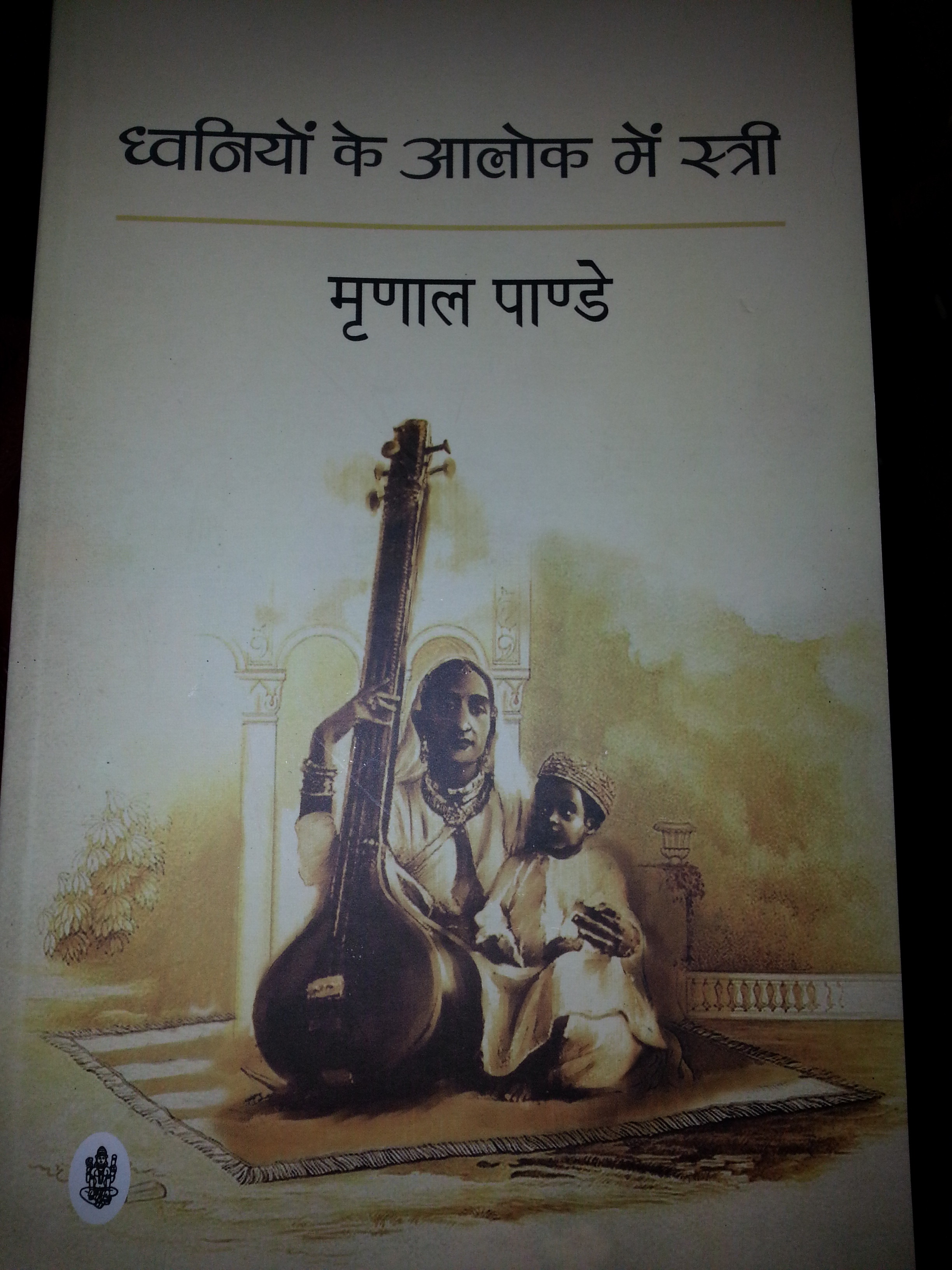
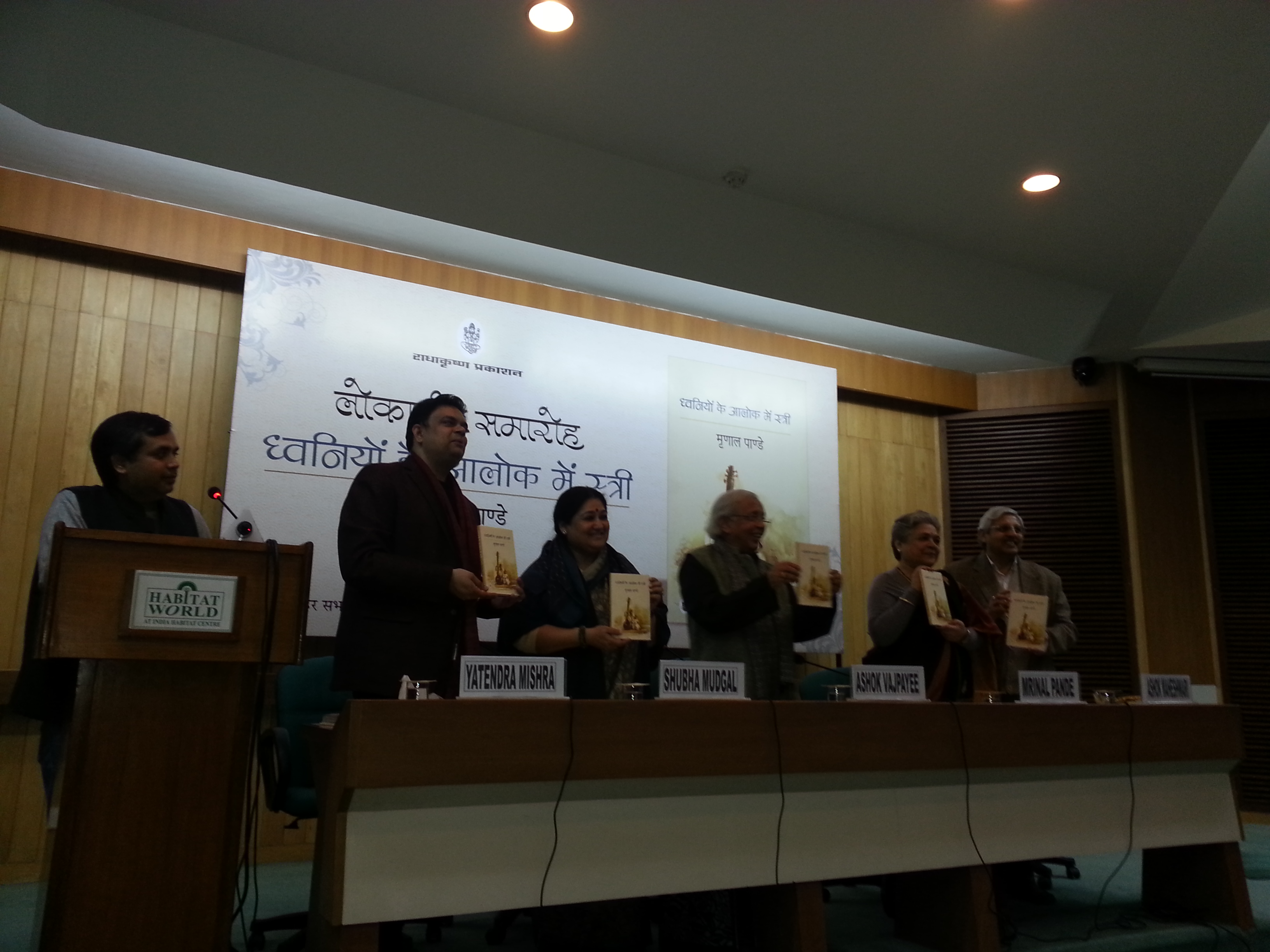
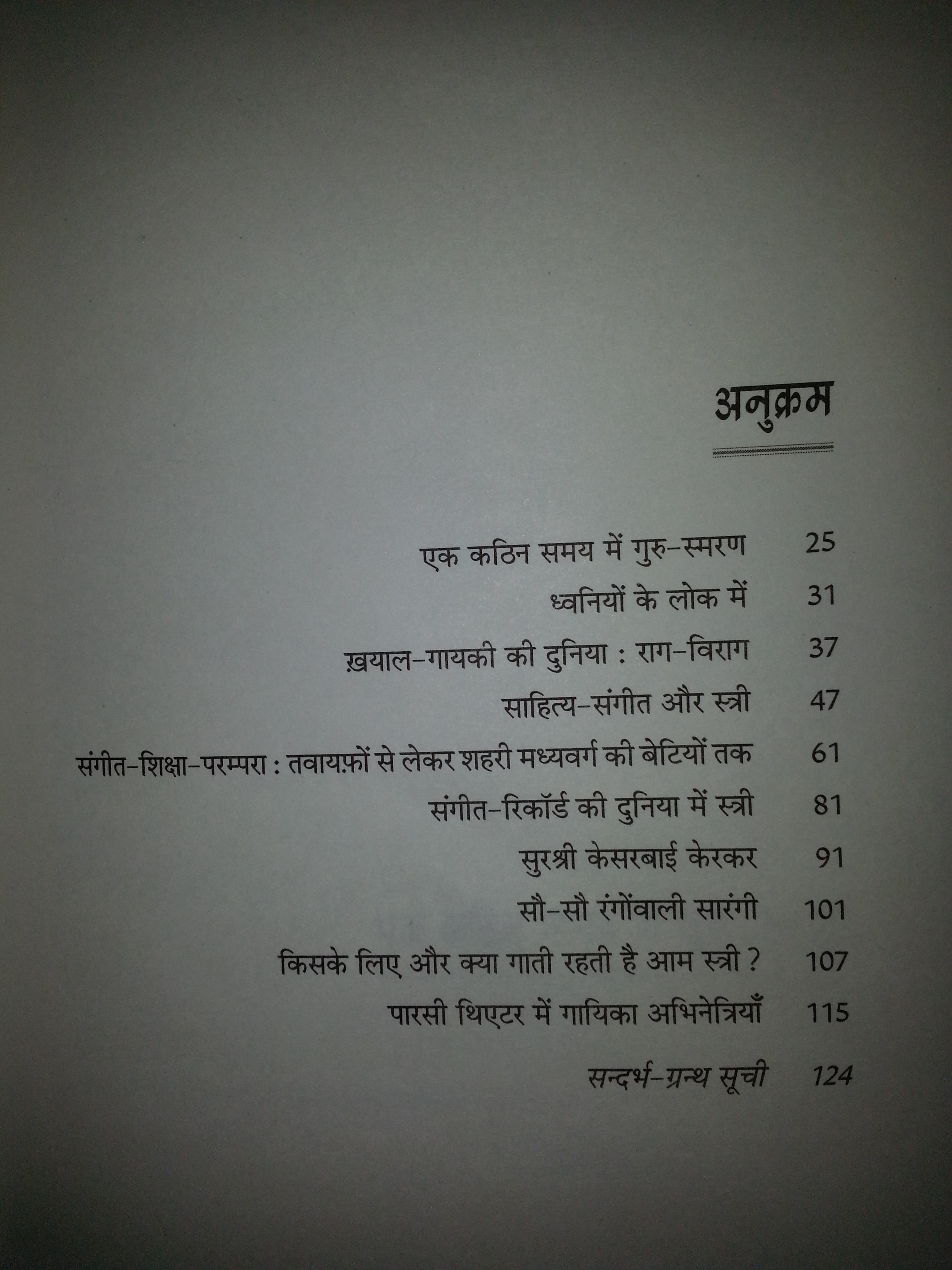
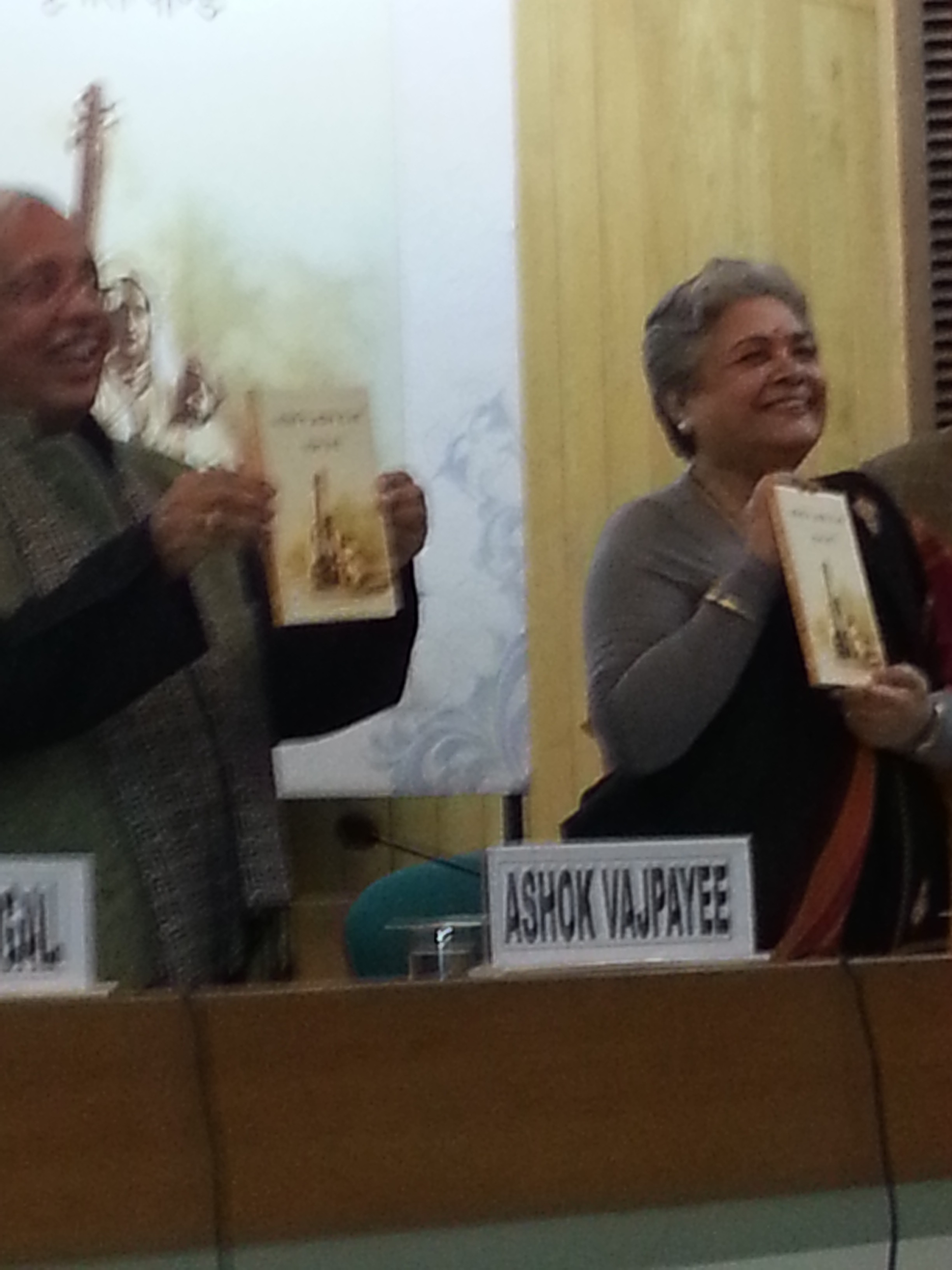
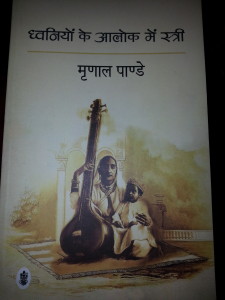
 On Monday, 4 January 2016, I attended Hindi publisher Rajkamal Prakashan’s book launch for noted journalist and writer, Mrinal Pande’s Dhvaniyon ke aalok mein stree . Mrinal Pande has written a nonfiction book about the vast contribution of professional women musicians (largely tawaifs or courtesans till the mid 20thC) to Hindustani classical and semi-classical music in post-1857 India. Most of whom went unmentioned even by famous musicians and Ustads, whom they had lovingly and selflessly tutored and mentored through their early days of penury. The panel includes journalist Yatendra Mishra, singer Shubha
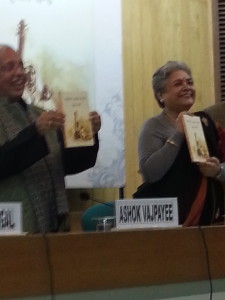
 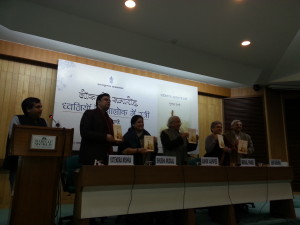 Mudgal, poet Ashok Vajpeyi, Mrinal Pande and publisher Ashok Maheshwari. The event was introduced by editor Satyanand Nirupam.
I enjoyed the event immensely. Two hours went by so swiftly. I could have heard the conversations some more.
 I liked the narrative which emerged from the evening’s chat. Women musicians were a phenomenal influence and in many cases taught men who were to later earn quite a name for themselves. But the focus was not necessarily on the women musicians who have been profiled in the book but many like Shubha Mudgal’s Nani ( maternal grandmother) who yearned to learn music but was not allowed by her father. Instead he insisted she learn the piano. To fulfil her desire of learning Hindustani music Nani had herself photographed holding various Indian musical instruments in the garden. (I am curious though how did the Nani get access to those musical instruments with which she was photographed in the garden?) Or the many rich wives of Bombay boxwallahs or the corporates who were taught music to while their time. It served another purpose too – the male musicians social ambitions of being seeing in the right circles. But the true preservers, inheritors and practitioners of music, were the Hindu and Muslim tawaifs, who kept Hindustani musical traditions alive by performing every night gave music a lease of life. Equally significantly they kept local languages and dialects or “bolis” alive in the Hindi that was commonly known and spoken. They were not averse to borrowing, blending, improvising and creating fresh interpretations as long as music was heard. This for Mrinal Pande is a crucial aspect of the womens musicians contribution to language and musical traditions. Her analysis of Hindi being kept alive since it had not as yet been politicised and hijacked depriving it of its backbone, ie the various bolis some of which were integral to the gharanas. So these remained in
  the social consciousness. I found this gem fascinating.
Another one was that of women singers graduating from anonymity to establishing their name to a recording. The idea that after the 3.5 minutes of 78 rpm had been cut by the German engineers the women to ensure the correct singer was given due credit said her name at the tail end of the song. It is incredible what technology and different kinds of publishing can do for the identity and self-worth of an individual.
The Union Home Ministry note issued in 1946 when Govind Vallabh Pant who was a minister in the provisional government debarring women singers who had a pesha or were tawaifs from singing. Later Mr Keskar, Minister for Information and Broadcasting, post independence, nullified the government note banning,”women whose personal lives are a public scandal”, in 1952. Suddenly it all made sense to my mind…once again the notion of identity of the women along with the patriarchal tyranny which was implicit in the 1946 order. But when Mr Keskar overturned the order he insisted the religion of singer be evident. All muslim singers were to add the prefix “Begum” and hindu singers had to add the suffix, “Devi”. Now that too is a curious move…identification along religious lines. Not unheard of. It could be considered at par with the star all Jews had to stitch on their coats in Nazi Germany.
I liked the story about Mrinal Pande’s mother, the popular Hindi novelist, “Shivani”, taking her husband’s permission to write and then adopting a pen name. Ironically it is Shivani who now remains alive in people’s minds. I enjoyed Shubha Mudgal’s response about her son being cared for by the extended clan while she was on tour and the astonishment expressed by the Indian diaspora who could not fathom how this was possible — “Had she taken permission from her husband to do so?” Having said that I know these women continue to be rare examples and not necessarily the norm.
Even Yatindra Mishra’s tale about his Dadi (paternal grandmother) not being permitted to sing since it would be frowned upon by society especially now that the family had lost their princely status. Given the context that women musicians were mostly tawaifs this would have really complicated matters for the family. So her father did not allow her to sing saying, “What will people say? They will think we have fallen on such hard times that now the daughter of the house is singing to earn!” Funny how far Indian society has now come with children being encouraged to sing and perform publicly in the hope they can become professional singers, preferably in Bollywood.
I liked how gracefully and tactfully Shubha Mudgal and Mrinal Pande dealt with the comment about “deterioration” of Indian classical musicians performing mobile ring tones and snatches of popular Hollywood musicals. It was fascinating to observe the arguments playing out between the purists and those who were arguing for the evolution of musical traditions such as the examples noted by Ashok Vajpayee. He said sometimes he can identify bits of Gwalior or Bhopal gharanas in modern renditions. Interesting.
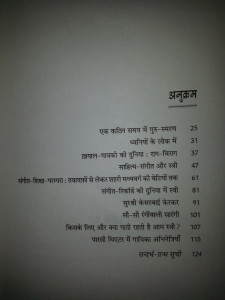
Dhvaniyon ke aalok mein stree has been published by Rajkamal Prakashan. It is available in hardback and paperback.
6 January 2016