
Bruce Springsteen “Born to Run”
Writing about yourself is a funny business. At the end of the day it’s just another story, the story you’ve chosen from the events of your life. I haven’t told you “all” about myself. Discretion and the feelings of others don’t allow it. But in a project like this, the writer has made one promise: to show the reader his mind. In these pages I’ve tried to do that.
Reading memoirs and autobiographies of musicians and rockstars is always fascinating. It contains oodles of gossip and magnificent back stories on how iconic songs were created, performed or relationships forged and broken. For a long time histories of rock music were seen as popular literature and not necessarily given their due space in mainstream publishing. There could have been innumerable reasons for it but the whole notion of pop and rock music is a relatively recent phenomenon. Post-war the explosive music of rock and roll musicians like Elvis Presley, Jerry Lee Lewis, Beatles, et al was hugely influential but also path breaking in their experimentation within traditions of music. So histories of rock musicians are also fascinating social accounts of the evolution of music and a rapidly changing society. Bruce Springsteen’s long awaited memoir Born to Run is deliciously rich for exactly these reasons. It is magnificent for its focused structure, fantastically breezy storytelling ( years of practice as a songwriter?), the ability to know exactly how much to present in words much as a seasoned performer knows exactly how much to deliver to his audience, and to write a memoir in the good old-fashioned literary style.
Most of my writing is emotionally autobiographical. I’ve learned you’ve got to pull up the things that mean something to you in order for them to mean anything to your audience.
While writing Born to Run Bruce Springsteen gives as “frank” an account is possible of his childhood and his desire to be a musician. It was watching “this hip-shaking human earthquake” Elvis Presely perform on the Ed Sullivan show ( actually it was Charles Laughton covering for Ed who was recovering from an accident) that changed Bruce Springsteen forever. He wanted “THE GUITAR” too. The next day he convinced his mother to rent a guitar for him. “I smelled blood.” He was six.
His co-musicians remarked that Bruce Springsteen was to be admired for his determination to succeed as a musician and never did he work at anything else. It was music all the way. For a man who has never learned to read music ( like George Gershwin) Bruce Springsteen has had an extremely successful career and he is grateful for it. He is very aware that “we were rock’s early third generation”. At the cusp of the best of rock’s reinventors of blues, pop and soul, the British wave, yet young enough to experience its originators. Also Springsteen and his band were able to experience the punk explosion of the late seventies and hip-hop in the eighties….”yet the band was unique: the cross-tensions of the fifties blue-collar world and sixties social experience clashing and melding in our music. We are pre- and post-hippie sixties soul survivors. It’s a blend that won’t exactly exist firsthand anymore when we’re done. The world and society changes too quickly and too much.”
Born to Run took Bruce Springsteen seven years to write. According to a wondeful profile published in Vanity Fair the genesis of this memoir originated in a few scribbles Bruce Springsteen wrote after performing at the Super Bowl half-time.
The germ of Born to Run, the book, lies in a short, diaristic piece Springsteen wrote for his Web site in 2009, after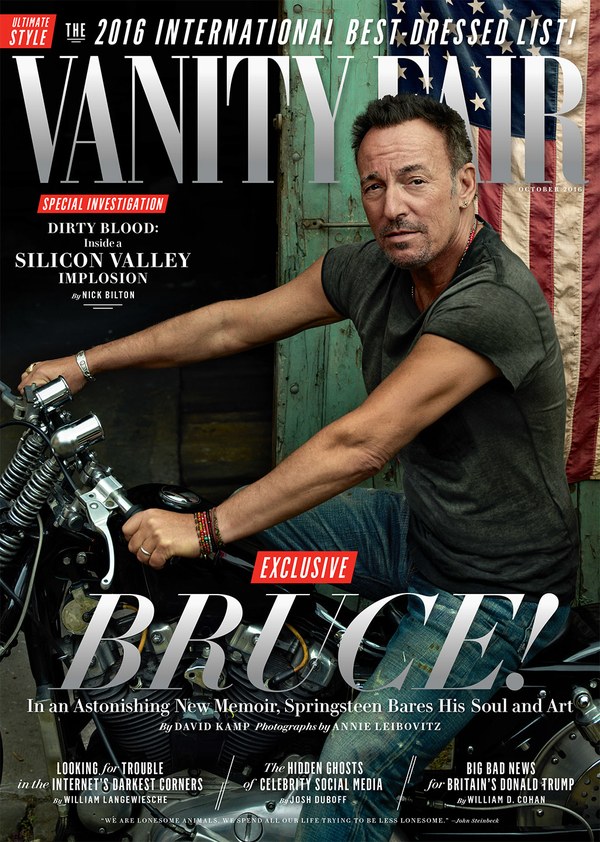 he and the E Street Band played the halftime show of Super Bowl XLIII. The logistics and pressure of doing the 12-minute show threw even as battle-tested a performer as Springsteen for a loop, and he thought the experience would make for a good yarn to share. “Fifteen minutes . . . oh, by the way, I’m somewhat terrified,” he wrote in one passage. “It’s not the usual pre-show jitters, not ‘butterflies,’ not wardrobe malfunction nervousness, I’m talking about five minutes to beach landing, ‘Right Stuff,’ ‘Lord Don’t Let Me Screw the Pooch in Front of 100 Million People,’ ‘One of the biggest television audiences since dinosaurs first screwed on earth’ kind of terror.”
Doing the Super Bowl show, Springsteen said, led him to discover a “pretty good voice to write in.” With time on his hands after the big game, he kept at it, writing down vignettes from his life in longhand while he and Scialfa were staying in Florida, where their daughter, Jessica, a competitive equestrian, was participating in show-jumping events. He was pleased with the results. In fits and starts, back at home in New Jersey and on tour over the next seven years, a full-blown, 500-page autobiography eventually took shape, with no ghost or collaborator. Every word in the book is his own. ( David Kamp “Cover Story: The Book of Bruce Springsteen” Photographs by Annie Leibovitz, October 2016 http://www.vanityfair.com/culture/2016/09/bruce-springsteen-cover-story#1)
Like a veteran storyteller Bruce Springsteen is able to offer a judicious mix of the personal and his professional life to his fans. His revelations include his coming to terms with his Catholicism which for a long time he had rebelled against. But then bemusedly he understands that “once you’re a Catholic, you’re always a Catholic. I don’t often participate in my religion but I know somewhere … deep inside…I’m still on the team.
This was the world where I found the beginnings of my song. In Catholicism, there existed the poetry, danger and darkness that reflected my imagination and my inner self. I found a land of great and harsh beauty, of fantastic stories, of unimaginable punishment and infinite reward. It was a glorious and pathetic place I was either shaped for or fit right into. It has walked alongside me as a waking dream my whole life. So as a young adult I tried to make sense of it.”
Springsteen also bravely reveals the challenges he has faced while tackling his depression. Mental ill-health being an inheritance from his father. “The fire in me felt like it had gone out and I felt dark and hollow inside. Bad thoughts had a heyday. …You feel the thinness of the veil of your identity and an accompanying panic that seems to be just around the corner….I couldn’t get out of bed.”
Born to Run is a title chosen deliberately by Springsteen as an acknowledgement to his legendary music album. Yet it epitomizes his life well. His desire to escape from the poverty and squalor of his working-class childhood home (but not necessarily the deep love and familial affection he received) to performing on the road nonstop with enviable amounts of stamina and energy and becoming a multimillionaire who own a horse farm now. Today he is sixty-seven and still performing live including a concert in summer 2016 that lasted for nearly four and a half hours. Incredibly too and a fact that he is rightly proud of “I’m one of the few artists from those days who owns everything he ever created. All my records are mine. All my songs are mine. It’s rare and it’s a good feeling. ” This is when stories such as of Elvis Presley’s manager, Colonel Parker, who earned notoriety for pocketing most of the singer’s earnings are legendary.
Born to Run is a memoir written with passion and a raw energy reminiscent of Bruce Springsteen the singer and performer. It is a delight to read since it is evident that Springsteen has a critical and sharp understanding of his place in the long line of musicians while happily acknowledging the love for his family. He is at peace with the choices he made and continues to make.
This is a book not to be missed.
Bruce Springsteen Born to Run Simon & Schuster UK, London, 2016. Hb. pp. 520 Rs 799
26 Oct 2016