
Mary Beard, “SPQR: A History of Ancient Rome”
I have spent a good deal of the past fifty years of my life with these ‘first millennium Romans’. I have learnt their languages as well as I can. I have read a good deal of the literature they have left us ( no one has read it all), and I have studied some of the hundreds of thousands of books and papers written over the centuries about them, from Machiavelli and Gibbon to Gore Vidal and beyond. I have tried to decipher the words they carved into stone, and I have dug them up, quite literally, on wet, windy and unglamourous archaeological sites in Roman Britain. And I have wondered for a long time about how best to tell Rome’s story and to explain why I think it matters. … .
I no longer think, as I once naively did, that we have much to learn directly from the Romans — or, for that matter, from the ancient Greeks, or from any other ancient civilisation. We do not need to read of the difficulties of the Roman legions in Mesopotamia or against the Parthians to understand why modern military interventions in western Asia might be ill advised. … .
But I am more and more convinced that we have an enormous amount to learn — as much about ourselves as about the past — by engaging with the history of the Romans, their poetry and prose, their controversies and arguments. Western culture has a varied inheritance. Happily, we are not the heirs of the classical past alone. Nevertheless, since the Renaissance at least, many of our fundamental assumptions about power, citizenship, responsibility, political violence, empire, luxury and beauty have been formed, and tested, in dialogue with the Romans and their writing.
We do not want to follow Cicero’s example, but this clash with the bankrupt aristocrat, or popular revolutionary, with which I started this book still underlies our views of the rights of the citizen and still provides a language for political dissent: “Quo usque tandem abutere, Catilina, patientia nostra?’ The idea of ‘desolation’ masquerading as ‘peace’, as Tacitus put into the mouths of Rome’s British enemies, still echoes in modern critiques of imperialism. And the lurid voices that are attributed to the most memorable Roman emperors have always raised the question of where autocratic excess ends and a reign of terror begins.
(Mary Beard, SPQR, p. 534-6)
SPQR: A History of Ancient Rome by Mary Beard takes its title from a famous Roman 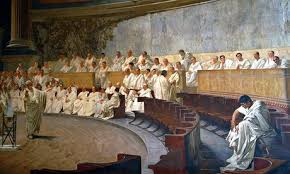 catchphrase, Senatus PopulusQue Romanus, ‘The Senate and People of
 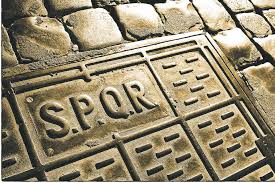 Rome’. For a scholar who has lived with her subject for nearly half a century to produce a clean narrative and create a thoroughly readable book, not packing it with jargon is indeed very commendable. As she says in the opening pages of the book her intention is to write a story that “has to be a bold work of reconstruction, which must squeeze individual pieces of evidence — a single fragment of pottery, or a few letters inscribed on stone”. What is truly incredible with crystal clear clarity she make innumerable connections with the literature (written material, myths and oral legends) left by the Romans to the evidence found at archaeological sites and linking it to contemporary politics. Not for a moment does it become dull. One of my favourite examples is how she analyses the founding myth or legend of Rome to the legend of Romulus and Remus, linking it to Cicero, and interestingly enough to Benito Mussolini. Apparently the nurturing wolf was an addition made in the fifteenth century explicitly to capture the founding myth
 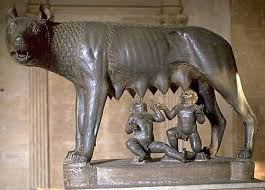 and baby twins. But copies of the famous image are found all over the world thanks to Mussolini who distributed them far and wide as a symbol of Romanita. Later she adds that Livy was one of the Roman sceptics who tried to rationalise this particularly implausible aspect of the tale. “The Latin word for ‘wolf’ ( lupa) was also used as a colloquial term for ‘prostitute’ ( lupanare was one standard term for ‘brothel’). Could it be that a local whore rather than a local wild beast had found and tended the twins?” ( p.59) Similarly throughout the book there are many more examples of such absorbing detail. Whether it be about marriage, politics, elections, citizenship, status of women, adoption, warfare, military, trade, migration etc.
For those in Italy and Britain who live surrounded by Roman ruins and have constant engagement with Roman history this book must be utterly fascinating. Mary Beard has a wonderful agreeable style of writing that makes the history of ancient Rome accessible to everyone. It is not a prerequisite that a fair understanding of the history is required. And yet she has packed SPQR with a detailed bibliography, a timeline, an index and plenty of illustrations/photographs that it can work for the lay reader or the scholar.
In India most Indians go about their daily lives doing exactly what this book is spelling out — talking about the huge impact mythology and ancient literature has had through the ages and in modern times. Indians do it all the time with their oral traditions, myths, folklore and ancient texts. A testimony to this is the immensely successful commercial fiction. It is a fine art by contemporary storytellers to create fantastical stories that blend the modern with the ancient and myth with history. Since these writers are not historians like Mary Beard they take full advantage of their creative license to spin imaginative yarns. Whereas Mary Beard points out in the utterly fascinating SPQR that there is sufficient empirical evidence at ancient Roman archaeological sites whether in Italy or abroad to prove much of the written records inherited over two millennia is more or less authentic.
SPQR has been on the list for many literary prizes including the inaugural British Book Industry Awards, in the adult category for the 10th IBW Book Award and a finalist for the National Book Critics Circle — deservedly so!
Mary Beard SPQR: A History of Ancient Rome Profile Books, London, 2015. Hb. pp. 600 Rs 2250 ( Distributed in India by Hachette India)
5 April 2016