feminist Posts

Interview with Sonora Jha on “Intemperance: A Novel”

For Moneycontrol, I interviewed Sonora Jha on latest publication Intemperance: A Novel. It is published by Penguin Random House India.

Here is the interview:

Sonora Jha is the author of the novels The Laughter and Foreign, and the memoir How to Raise a Feminist Son. She won the AutHer Award for Fiction 2024 for The Laughter.  After a career as a journalist covering crime, politics, and culture in India and Singapore, she moved to the United States to earn a PhD in media and public affairs. Sonora and her work have been featured in the New York Times and literary anthologies, on the BBC, and elsewhere. She is a Loyola Endowed Professor at Seattle University and lives in Seattle.

Her latest novel, Intemperance, is a love story. It is about a middle-aged, twice-divorced, Seattle-based professor, who decides to hold a swayamvar for herself as a fifty-fifth birthday celebration. She decides to lean upon her Hindu roots and resurrect a matrimonial tradition that is no longer practiced but remembered. It is an event held by the bride-to-be’s family where prospective male suitors are invited. Either the suitors line up for the bride to view. The person she likes, she garlands as her betrothed. Alternatively, the assembled suitors have to perform a series of tasks to prove themselves. These could be in the form of one challenging task or multiple rounds. The winner gets the hand of the bride.

The woman, a renowned and respected intellectual in an American town who had once declared she was “past such petty matters as love,” knows she is now setting herself up for widespread societal ridicule. To her surprise, a cast of characters shows up to support her call―a wedding planner looking for the next enchanting thing, a disability rights activist making a documentary film, and even, begrudgingly, her own young adult son. The Men’s Rights Movement protests her project, angry at her objectification of men. She must also reckon with a brutal love story in her ancestry that was endangered by the caste system―a story that placed a generational curse on those in the family who show an intemperance of spirit. As her whole plan spirals into a spectacle, the woman embarks on a journey to decide what feat her suitor must perform to be worthy of her wrinkling hand. What feat will define a newer, better masculinity? What feat will it take for her to trust in the tenderness of love?

Intemperance is at once a satirical feminist folktale and a meditation on how we might reach past all sense and still find love. It is published by Penguin Random House India.

The following interview with Sonora Jha was conducted via email.

  1. What was the genesis of Intemperance? 

    After my last book, The Laughter, which was a dark satire, I found myself longing to write a love story. I started to toy with the idea of a protagonist who plans a swayamvar in middle age, and then I read bell hooks’ brilliant philosophy on love and marriage in Communion: The Female Search for Love. It all came together for me as I crafted a protagonist who makes the search for love a fiendishly playful act.

    2. Why did you choose the title Intemperance? Why not How to live like a Feminist: A Memoir and a Manifesto, echoing your book How to Raise a Feminist Son: A Memoir and Manifesto (2021)? 

    Well, that was a memoir, and this is fiction. And this is not a manifesto either. The word “Intemperance” fit perfectly the practice of living unabashedly as a woman, living past the cautions of moderation and temperance.

    3. For a writer, what is the difference between memoir, autofiction and literary fiction? 

    I believe there’s a bit of one’s own lived experience in every writer’s work, even if the writer is writing fiction from thin air. The norms of memoir dictate, though, that you hew close to fact. With autofiction, you can use your own life as a diving board and make leaps into fiction. This novel of mine is more fiction than autofiction.

    4. When does the authorial narrative and the protagonist’s “I” merge, if at all? 

    It varies for every writer and every work. Kazuo Ishiguro’s The Remains of the Day uses the first-person “I,” but it’s clearly not Ishiguro writing about himself (he’s writing in the first-person voice of Stevens, an English Butler). In my novel, the “I” is the voice of an unnamed narrator, and I let some of my own ideas and interiority swim into hers even though the plot and characters in the story are not from my own life.

    5. Transplanting an ancient Hindu wedding practice like a swayamvar into modern times is a way of testing your feminist ideas, is it not? Although conducting a swayamvar is like reality television today. 

    Yes, I decided to sharpen the concept of the swayamvar from a contemporary lens of power and agency. I decided to play with it. The protagonist encounters goddesses and princesses from Hindu mythology (as well as one character from Homer’s Odyssey) in the form of present-day people who either warn her against having a swayamvar or cheer her on. The book, however, becomes less about the spectacle and more about the journey, both inward and outward.

    6. With every edit of the manuscript, does your feminism become stronger and sharper or does it have to be turned down a notch or two so as to be heard by a vast audience? 

    I didn’t set out to write a “feminist novel.” I set out to write a novel about a woman looking for love. The search for a true and beautiful love for a cis-gender, heterosexual woman today seems to me and several others to require a feminist way of loving, for her as well as for the man she seeks. I believe a vast audience exists for novels about love and novels with feminist stories. Men, women, non-binary people, everyone is aching for love and for fresh love stories with intemperate characters.

    7. On p.167 you ask if “reclusiveness is allowed for women”? So, is it? 

    The protagonist wonders about this. I don’t. I believe healthy doses of solitude and reclusiveness should be everyone’s right to have. I claim these for myself. If more women claim time for themselves, we will have more delicious, richer partnerships.

    8. Your novel has the classic structure of a novel and yet it has many elements of folklore and oral narratives with the interspersing of many micro-stories. Although, the presence of Alokendra and Heera’s story is much more than that. Please comment. 

    Thank you for appreciating that. I wanted to populate the novel with friends, found family, and community. People of all genders and sexuality. Gods and mortals. Sinners and saints. The fearful and the intemperate. I wanted to also show that the protagonist has a tradition in her ancestry where people loved passionately against all rules and against all odds. Placing a queer, inter-caste love story in the litchi orchards of 1895 Bihar gave me much joy as a writer. The protagonist is who she is today because of all the love that came before.

    9. A love story involving an elaborate wedding is the perfect formula for a successful book. So how many conversations and backstories did it take to create this incredibly perceptive feminist commentary to the swayamvar, in itself on the threshold of a very patriarchal institution —matrimony? 

    Subverting the idea of a swayamvar, stealing it away from the patriarchs and their collaborations (kings marrying off their daughters to other kings), making contemporary men in Seattle perform feats for the hand of an aging, twice-divorced women in her sexual prime…all this just spilled out of me. But yes, I am an academic with a journalistic background, so of course I did a lot of research into these practices and also into caste and disability and more. One of the continued conversations that was invaluable to me was with author and journalist Yashica Dutt, who wrote Coming Out as Dalit.

    10. Will you ever consider dramatising this for theatre, say along the lines of Eve Ensler’s The Vagina Monologues

      I hadn’t considered that, but that’s a wonderful idea.

      31 Oct 2025

      “Economica: A global history of women, wealth and power” by Victoria Bateman

      Economica: A global history of women, wealth and power by Dr. Victoria Bateman charts the course of women’s contribution to their national economy and acknowledges work done as being within and without the house too. Quite contrary to what Adam Smith believed that only paid work outside the home was construed as a contribution to the economy. Whereas Dr Bateman shows through empirical evidence marshalled from as far as the Stone Age to the present, the AI age, that women’s contribution, paid or unpaid was an essential part of the economy. Her book is packed with facts, anecdotes, histories, archaeological evidence, data sets etc. For instance, marriage contracts signed between the 11C and 15C included a clause wherein the woman could state she had the right to work after marriage. There are so many bits and pieces of information to share but the most enlightening was her use of the word “overlooked”. To use it constantly in the context of new evidence that confirmed the value of a woman’s work in the past is very empowering use of a simple word. It gives the reader the opportunity to reflect upon situations that they themselves may have been, where their evidence and work is overlooked whereas they are on the right path. It is new evidence so others cannot see it, recognise it, value it, or understand it. Developing faith in oneself and growing from there is what this book helps to achieve. It is not just a revisiting of inherited economic history narratives.

      Here are two snippets from the book:

      p. 218-9 Mary Wollstonecraft and morality

      Wollstonecraft’s family’s attempts to climb the social ladder framed how she saw the world: through the lens of the section of society that lived a life somewhere between aristocrats and ordinary people. She witnessed the way in which this newly expanding class attempted to distinguish themselves from ordinary people through not only money but also morality. And how, by developing what she called this ‘insipid decency’, they could judge themselves to be ‘better’ than the libertine aristocracy. This middle-class monopoly on morality had particularly implications for women, who were expected to be the virginal angels who set a good example to other women in society. By trumpeting the virtues of female purity, the middle classes wanted to ensure that working-class girls, despite their freedom to earn, would not be able to compete with middle-class daughters when it came to attracting the wealthiest husbands. By shrouding the paid labour of women in moral shame, this purity culture risked devaluing the contribution that countless ordinary women were making to the economy, while turning middle-class women into highly-valued, ‘precious’ commodities. Since work for middle-class women was considered nothing more than a stop-gap and could not be allowed to jeopardise their marriage prospect by causing their marriage prospects by causing their virginity to be treated as suspect, ‘decency’ came at the cost of women’s dependence on men. Indeed, the very ability of the middle classes to claim the moral high ground depended on the fact that preserving a young woman’s bodily modesty – ensuring that she was untouched by men – came at a price not only to her but also to her family, who had to ensure that she was chaperoned at all times, was taught separately to boys, and did not have to work alongside men to support herself financially. It was a cost that better-off families were able to bear, but one that working-class families, be design, found unaffordable. Morality, in other words, cost money. And Wollstonecraft had little time for it. 

      Another one from the book:

      I had the good fortune of speaking with Dr Bateman for TOI Bookmark. As soon as the link is released, I will upload it here as well.

      The book is published by Hachette India.

      23 Oct 2025

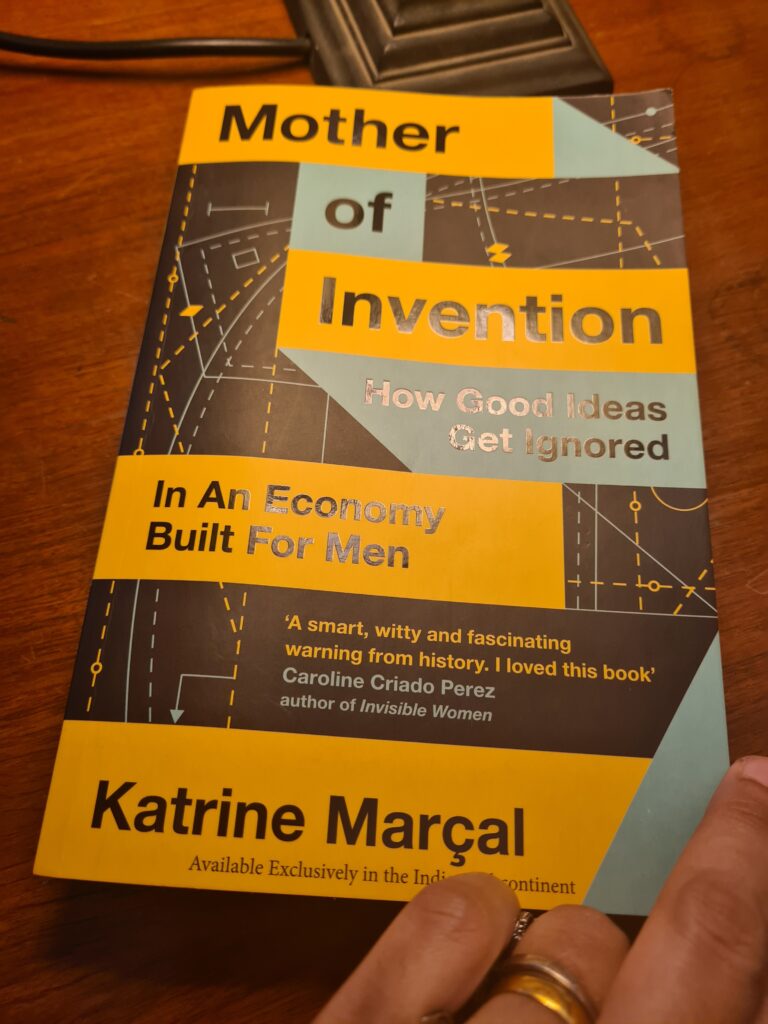
      “Mother of Invention: How Good Ideas get Ignored in an Economy built for Men” by Katrine Marcal, translated from the Swedish by Alex Fleming

      Bestselling author Katrine Marcal’s latest offering, Mother of Invention: How Good Ideas get Ignored in an Economy built for Men ( William Collins, HarperCollins India) is very clearly about the importance of women in contributing to specific economic systems that have gone on to transform social behaviour/history. It has been a sexist understanding, recording and reading of histories that have credited men with the success of certain innovations, whereas Katrine proves with her detailed readings of some of the historic global events has been that the contribution of women was undeniable. Unfortunately, it was not understood sufficiently, recorded or interpreted by men who designed, controlled and managed systems. Take for instance, the absurd case of the seamstresses and Nasa’s inability to approve the space suit, even though they could see that it was far superior to the rest. Their internal assessment recorded that no other suit even came a close second. Yet, because there were no engineers on the job, recording the designs that the women were creating using 4,000 pieces of cloth and using a single-hole sewing machine to ensure precision of their lines, NASA rejected the space suit. It was only after the manufacturing company chose to hire a team of engineers to “translate” a perfectly understable sewing job into gobbledygook, that the NASA top brass was satisfied and gave their approval to the space suit which was eventually worn by Neil Armstrong and Buzz Aldrin when they walked on the moon! Meanwhile the seamstresses themselves scoffed at the pages and pages of material and said they did not have the time to wade through it. The point the author makes is that because sewing was considered a “soft” skill, irrespective of the fact that it had existed for as long as civilization, but was mostly perceived as a woman’s expertise, it was dismissed. It did not have the masculine touch of being presented in technical jargon and thereby making it seem worthwhile. I was reading about Benz and his invention of a horseless carriage and how he was stupid about exploiting it commercially. It required the brilliance of his wife, who sneaked out the car from their garage with her teenage sons, and then drove it to visit her mother, 90 miles away. They drove at the top speed of 16 miles/hour, with many breakdowns along the way. One of them requiring her hat pin to fix. In another when the brakes were heating up, she stopped at a cobbler and asked for a leather strap to be put around the brakes. She reached her mother’s home triumphantly 15 hours later. Many of her innovations of that day are still used in cars. And also thanks to her proving that the horseless carriage could be driven and was safe, the machine became a commercial success. But no one remembers her name, they only remember her husband, who soon became the second half of “Mercedes Benz”.

      Her name? Bertha.

      How is that for a gendered perspective on an age-old story?!

      There are many more such stories in the book. Also a fascinating overview of recent theories about economies from a gendered and a non-gendered perspective. Katrine Marcal dissects these popular statements/books by male “thought leaders” such as Yuval Noah Harari, Jordan Peterson, Nassim Taleb et al. She concludes that it is imperative to include women in narratives because the moment it is done, the ground beneath us shifts and a new and a truer history emerges.

      Katrine has a nuanced reading of the importance of women in history. She has really done a fine job of rescuing women and done them a massive service. She has balanced the accounts as it were to show how integral they are part of any economy. They are equal contributors in making society successful and businesses successful, thereby being essential contributors to the economy. There is a wonderful account in this book on the history of venture capitalism and whalers of the nineteenth century and how many of those concepts have been transplanted decades later to modern businesses. Sadly though, in more cases than one would like, these venture capitalists continue to igmore the contribution made by women to various economies. This is a gender balanced reading of economic history. By this narrative, Katrine is trying to upend the sexist narrative of economy that has been passed through generations and conveyed as the absolute truth.

      It is a good book. Much along the lines of what Angela Saini has done for science, Katrine Marcal has done for women and innovation.

      1 August 2021

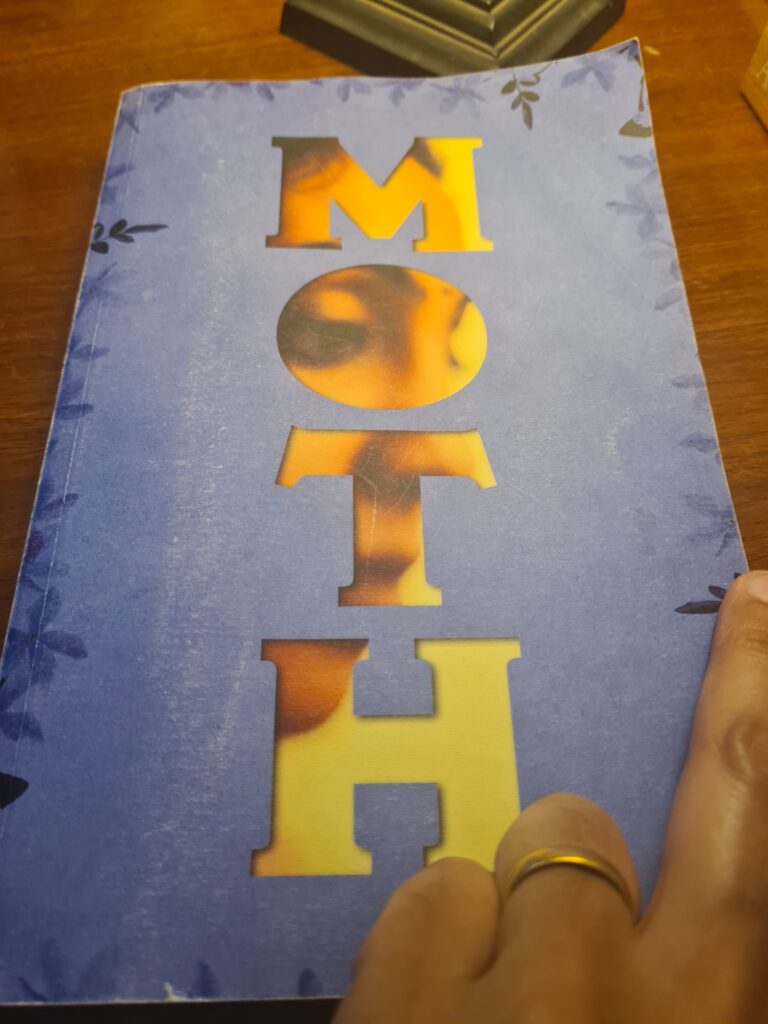
      “Moth” by Melody Razak

      Delhi, 1946

      Ma and Bappu are liberal intellectuals teaching at the local university. Their fourteen-year-old daughter — precocious, headstrong Alma — is soon to be married: Alma is mostly interested in the wedding shoes and in spinning wild stories for her beloved younger sister Roop, a restless child obsessed with death.

      Times are bad for girls in India. The long-awaited independence from British rule is heralding a new era of hope, but also of anger and distrust. Political unrest is brewing, threatening to unravel the rich tapestry of Delhi – a city where different cultures, religions and traditions have co-existed for centuries.

      When Partition happens and the British Raj is fractured overnight, this wonderful family is violently torn apart, and its members are forced to find increasingly desperate ways to survive.

      Moth by debut author, Melody Razak ( Orion Books), has been a surprisingly slow read for me. Usually, I manage to zip through fiction pretty quickly. More so when it is historical fiction as I have a soft spot for this genre. But this one was slow for many reasons. These ranged from false starts in attempting to read it to the many times my mind wandered after reading a section of the story. Let me explain. 

      Melody Razak credits Urvashi Butalia’s seminal book The Other Side of Silence for having inspired her debut novel. I can absolutely understand and recognise that sentiment. I worked with Urvashi for many years. I joined her team the day she split from Kali for Women to establish Zubaan. So, I was privy to a lot of Urvashi Butalia’s work for many years and also helped brand Zubaan. I, like Melody, and many others, had been in awe of Urvashi Butalia’s work for years. She did something fundamentally new. Of capturing the oral histories of women and families after the British left India in 1947. We gained our Independence but the people from the newly created nations suffered tremendously. 

      Urvashi wrote this book after she volunteered to help the riot victims of 1984. It was a watershed year for many of us living in Delhi at the time. The Indian prime minister, Mrs Indira Gandhi, had been assassinated by her bodyguards while she was en route to meet filmmaker and actor, Peter Ustinov. It unleashed the most horrific communal violence we had witnessed at that time in newly Independent India. We were still a young nation at that time. (Now, communalism seems to be a way of life.) Many, many folks were horrified at what had occurred in the capital city. It was unheard of. We had curfew imposed. The army conducted flag marches. The silence was unbearable. No one should ever have to experience the silence of living in violent times. It is very still and still very disturbing. In the far distance, we could hear mobs. We could hear sounds. We would see smoke spires in the sky. And one of the most frightening memories was to see the ashes of paper flutter down on our terraces. When my twin brother and I returned to school after those two terrible two weeks, we noticed kids in our bus who were looking dishevelled and reduced to a cloth bag carrying a few books. They had been affected by the riots for being Sikhs and had lost property and family. It was earth shattering. But we were young. It was our first experience of such violence. But for my maternal grandfather it brought back a flood of memories. Stuff we had not realised he had kept suppressed for decades. 

      My grandfather, N. K. Mukarji, was the last ICS officer in India. The Indian Civil Service was the administrative service established by the British. He joined as a very young man and was allocated the Punjab cadre. This was before 1947, so as a government servant he was posted in and around the then undivided Punjab. He later recalled that as a young man, he would sit with the other officers, many of whom were British, dividing the assets of the Punjab state between India and Pakistan. Many times, the lists drawn seemed arbitrary but he would meticulously minute the meetings. I am sure somewhere documents exist with his neat signature. He also used to tell us about the migrant camps that were set up. For many years, the refugees of 1947 were considered to be the largest mass migration ever recorded in human history. It was unprecedented. There were no rules or policies governing or guiding the officers on how to manage this massive influx of people. He used to tell us of how his signature was forged and converted into stamps. These forgeries were then used to stamp documents of the refugees so that they could use them as valid papers to migrate. Some left overseas too. My grandfather was well aware of these forgeries but the administration was so overwhelmed by the number of people that needed looking after that he turned a blind eye. And if you ever knew him, he was such an upright officer that this act upon his part was so unlike him. He and his colleagues worried about the spread of disease. Cholera and typhoid that still plague large refugee settlements were the bane of their existence even in the 1940s. The only difference being that there were no UN forces or other humanitarian aid organisations to help manage the healthcare of the refugees. There was no organised camp. So, the relief of the onset of the monsoon, literally washed the camp, is something that I still recollect in Nana’s voice. He has been gone for more than two decades but his relief, as if it was a God sent gesture, is something I will never forget. So, the descriptions of the refugee camps in Moth brought back memories of these stories. I could not help but think that the perception of the refugee camps of today that are to a fair degree “organised” because of the aid agencies, was not the case at that time. And this was one of the depictions in Moth that bothered me, the pell mell in the settlement. Instead, the description seems to suggest that it is fairly orderly. It was as if the image had been created from the modern images of refugee camps. 

      Just as these memories came flooding back for my grandfather, so did it happen with many victims of the 1984 riots. The victims were Sikhs. The community to whom the PM’s assassins belonged. Urvashi too is a Sikh. She too had family in Lahore and in India. In fact, when I went to Lahore in Nov 2003, I went in search of the house that belonged to Urvashi’s family and discovered that it was in the process of being pulled down. So, I brought back pictures of it for her. 

      There were many, many reasons why Urvashi was affected by the 1984 riots. But working in the refugee camps of Delhi, listening to stories, being a feminist, she realised the importance of recording these stories. Oral history testimonies were being done in our country even then but not necessarily by individuals at this level. Urvashi’s work is pioneering for many reasons. She explored her family’s history and unearthed many more stories in the process. It has had a huge impact on the way Partition stories are read. 

      Melody Razak picks on a few of the stories such as the women jumping into the well, the abduction of girls/women and taking them away to the other side (since then established as a regular form of persecution of women at times of conflict), the problems of documentation etc. I found it particularly interesting that while Melody Razak has been deeply moved by the incidents recounted in The Other Side of Silence and of course, for this novel, may have done some independent research, Melody has been unable to describe the traumatic incidents. I found that curious as that it is often noticed in the victims that they are unable to recount the actual event. There are mechanisms by which they protect themselves, one of them is to talk about the act in the third person or distance themselves in the plot. Melody does exactly that — distancing herself. It indicates how deeply moved she has been by the testimonies/stories of the events of 1947. 

      By the way, the assassin of Mahatma Gandhi whom Melody mentions, Nathuram Godse, was sentenced to death a few years later by Justice G. D. Khosla. Again, another upright officer who opted to join the judiciary once India became an independent nation. He wrote about the trial of Godse. It is freely available as a booklet online. I met Justice Khosla. He was a friend of my grandfather’s. But by these acts, I feel as if I have been close to history. (Does that statement even make any sense?) 

      Melody Razak gets the grief at the assassination of Mahatma Gandhi very well. I recall meeting people who remembered that day very clearly. This and later, Jawaharlal Nehru’s death. Everyone could recall what they were doing at the precise moment that the news broke about these deaths. The collective grief that was felt at Mahatma Gandhi’s death has been brilliantly captured by Melody. 

      But the reason why I had so many false starts to the book were because of the tiny historical inaccuracies in the opening pages. I can only recall one at the moment. She refers to Amul chocolates. Well, they did not exist till many decades after Independence. Amul is a dairy cooperative that was set up by Nehru under his modern India plans under the leadership of Mr Verghese Kurien (again, someone whom I have met). The chocolates came much, much later. So, this fact could have been checked. There were also spelling errors that annoyed me such as getting the name of All India Radio wrong and hyphenating “All India” or referring to the hot winds that blow in summer as “Lu” instead of as “loo”. (It is a hot wind similar to khamsin.) 

      I can see why Melody Razak has been showered with praise in the media and has been recognised as one of the debut novelists of 2021 by The Observer. She has a great sense of storytelling. Her pace is fantastic. She knows when to slow down her writing tempo or speed it up as per the requirements of the plot. Her characters are so alive. She is able to move freely between the Muslims and the Hindus and describes them well. Alma’s grandmother is particularly vile. To create evil in a person who is mostly ignored by the family, is quite a creative achievement. But alas, she is also so familiar. We have all come across such characters at some point in our lives. Melody also manages to share only that much of the back story of the characters as is relevant to the main plot. Again, an admirable quality as many debut novelists tend to get hijacked by their characters and create unnecessary tangents to the story. Whereas in this case, whether it is the stories of Dilchain, Fatima Begum, Ma, Bappa or even Cookie Aunty/Lakshmi, Melody shares enough to make them rounded rather than flat characters. There is no need to know more about them. 

      I had reservations about the extremely feminist angle to the storytelling. It was sort of unbelievable that these narratives could possibly have existed in 1947/8. It seems as if a very modern structure of feeling has been superimposed upon the past. It does not sit well. But then it brings me to the crux of literary fiction. At what point as Salman Rushdie calls it, does fiction “lift off” from the truth and begin a story of its own? Somewhere the writer has to be given the leeway to let their imagination fly. The reader too has to go easy on the writer for letting them tell the story in their own way. Perhaps I found it uncomfortable, even though I more than heartily agree with the feminist sentiments, because of the amount I know about the events of 1947. But the moment I sort of let myself go and just read the story for what it is, I realised it was the only way to “get into” it and enjoy it. Also, having read a lot of historical fiction recently has been doing this — of revisiting past events and imbuing the women characters with a strength and a personality with a very modern touch. It works for modern readers. And if historical fiction is being redefined today as historical events providing only a backdrop to the storytelling, then I suppose we have to make our peace with it. It is fine. 

      As for the sisters, Alma and Roop, they are incredibly well-created. Although making Roop cut off her hair, roam around naked and wear her father’s trousers whenever she needed to step out seemed a bit farfetched for a five-year-old. But then who are we to argue with the bizarreness of life under conflict. Or for that matter now, during the pandemic. That was another thing that I found so eerily parallel to Moth — our reality of rationing food given the lockdowns and irregular supply of provisions, not sure when to step out (in Moth for fear of communal riots and today, for fear of getting infected by the Covid-19 virus), creating community kitchens (in the novel for refugees and in modern life for migrants who are going home), etc.   

      As is fairly evident, Moth has triggered many memories as well as made me respond to the book in a manner that I did not think it would do. So there in itself lies the answer of a good emerging novelist. Moth is an extraordinary immersive experience and I am glad I read the novel. 

      3 July 2021

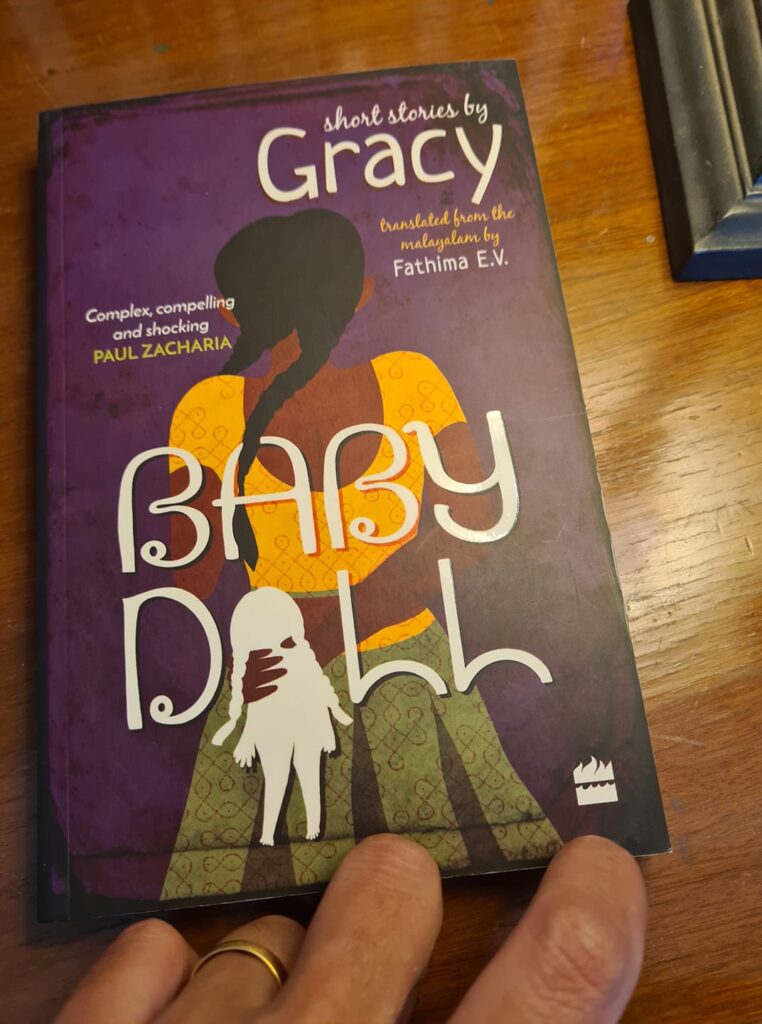
      “Baby Doll” by Gracy, translated by Fathima E.V.

      Baby Doll by Gracy is a very bold, sparkling and forthright collection of short stories, written over a span of thirty years. The stories have been translated by award-winning translator, Fathima E.V. The stories have been arranged chronologically, so there is a sense of the evolution of Gracy as a writer. These stories delve into the ordinary lives of ordinary people but go a little beyond. Gracy unearths and makes visible thoughts, conversations, describes actions of women that would otherwise be unheard of in the written word. In these stories characters are persuasively drawn, irrespective of whether you agree with their thoughts, words and deeds. These are very unexpected stories but I am glad they have been made available in English. It is time that storytellers like Gracy were eligible to participate in literary prizes such as The Women’s Prize for Fiction whose longlist will be announced next week, on 10 March 2021. There needs to be a broader literary landscape to be made available to readers worldwide.

      Fathima ‘s translation is superb. It reads effortlessly in English while recreating the local landscapes beautifully. Unlike some translations where there is a constant struggle between the original and destination language, it does not occur in Baby Doll. The translator’s note is exactly how it should be — written with care and deep understanding of the writer’s body of work, a textual analysis of the short stories included in this anthology and contextualising Gracy’s style of writing within the world of Malayalam literature. Also, without forgetting the significant contribution that these stories make to feminist understanding of being a woman and making visible to the lay reader the many, many ways in which women are oppressed in the name of tradition and social norms. This is truly an excellent collection.

      5 March 2021

      Nikita Gill “Fierce Fairy Tales & Other Stories to Stir Your Soul”

      ‘You thought I must be in need of saving? Because you are in need of a wife? How archaic and condescending.’

      The prince clears his throat and then says, ‘Fair princess, I will do whatever I can tp break the curse that turns you into . . . that thing.’

      ‘That thing, as you call it,’ the princess says, ‘is the magical part of me. I love being the dragon and the dragon loves me.’

      ‘But if not a wife, you will die an old maid,’ he presses on.

      ‘I am half dragon, who told you I will ever die at all?’

      The prince frowns in annoyance, he is obviously vexed and he speaks words that anyone over the course of history will tell you he will regret. ‘I think you need to learn that if you aren’t a wife and a mother, you are a witch and have no place in this world.’ 

      The princess stares at him for a moment and then she snaps her fingers. Guards appear and take the prince by his arms, escort him out, and yet the princess lingers. She looks him in the eye before he is thrown out, the moon dragon’s gleam still in hers, and she speaks words so powerful the wind etches them inside the atmosphere for women to remember through history. ‘I exist. Outside of being a mother, a wife, a sister, a daughter, I exist. I exist as a human first, as a being that experiences joy and suffering, beauty and learning, life and tragedy. I exist because the universe chose to put me here for a purpose higher than my relation to men. I exist because a wise old woman gave me a gift and now magic runs through my veins. So the problem is not my existence as half dragon, half girl. The problem is how you perceive it as so small, you do not believe I can exist at all apart from through my bonds with men.’ 

      And after the prince is thrown out, the moon dragon and the princess continue to share the day and night and live happily ever after.  

      Nikita Gill’s Fierce Fairytales & Other Stories to Stir Your Soul is a collection of reimagined fairy tales consisting of mostly fiercely independent and strong-willed people. The bravery of the individuals stems from within rather than being dependent on men rescuing them. The tales are beautifully illustrated with line drawings. The beauty of the retelling comes through in the multiple layers that exist — as they should in any good poem! Whether it is for a mature reader or a tiddler, there is much pleasure to be derived from these crisply narrated tales. My eight-year-old daughter grabbed the book as soon as it arrived and took it away with her to the ongoing Readathon in school. She returned triumphantly saying how much she had enjoyed the poems and was able to retell them simply in her own way, missing much of the layered nuances that an adult would immediately get, but that is immaterial. The poems worked!

      Fairy tales such as these have existed for generations with the kernel of the story being more or less as is. Somehow the flavour of each story is retained in Fierce Fairy Tales as are the characters but the stories have the unique stamp Nikita Gill’s storytelling — fiesty, sparkling, sharp, tongue-in-cheek, bold and true. The poems in this volume offer a way of seeing. The book blurb advertises the collection as “Feminist Fairytales for Young and Old”. So true! Given that these poems can be read in solitude or read aloud, either way they will be transformative as there are many ideas embedded in them.

      Share Fierce Fairytales widely!

      18 November 2018 

      To order on Amazon India

      Hardback 

      Kindle

      An interview with Bina Shah on her feminist dystopic novel “Before She Sleeps”

      Before She Sleeps is Pakistani writer Bina Shah’s fifth novel. ( On Twitter: @binashah ) It is about an “illegal” commune of women who reside in an abandoned warehouse on the outskirts of Green City. Their space is called Panah which in Persian means shelter. These women are led by a leader, Lina, and only appear under the cover of darkness. They survive by paying their bills in cryptocurrency with purchases usually made on the black market. Their business is to offer platonic cuddles to male clients in Green City but it is all to be kept under wraps otherwise the “Agency” will hunt them down. The story revolves mostly around twenty-four-year-old Sabine who has been living in Panah since she was seventeen.

      The premise for Before She Sleeps is so plausible since it seems much of it already exists if we search long and hard. None of this is really fiction, it’s only pushing the boundaries of truth or reality as we know it today a little further. The Panah can be a metaphor for the silent community women tend to form together even in the most public of spaces with one or two looked up to as guides/mentors. This bonding happens amongst strangers too. Sometimes it is fleeting, sometimes more permanent. Though the dark side of the viciousness of women towards other women too exists.

      The relevance of Before She Sleeps with references to “rare whales and giant turtles that had been cloned back into existence”. More so given recent news coming in of 40,000-year-old worms being revived to life. Or “All beef, eggs, in fact anything natural, is created in a lab with synthetic polymers, proteins, DNA.” as news trickles in of meat being manufactured in labs.

      Yet the further one reads Before She Sleeps the sense that the story is an excuse for the author’s personality and beliefs that run deep through, definitely more in this book than any of the previous novels Bina Shah wrote. Before She Sleeps will become her transitional work in her oeuvre in time to come. It’s the channelling of herself into a new kind of writer, one who does not abandon her past but looks ahead firmly taking along with her all the recent socio-political experiences accrued. The gender violence evident in the discrimination towards women (otherwise why would there be such a shortage of women in the city?), the persistent patriarchal constructs of social rules of engagement, the very recognisable authoritarian figures in most of the male characters even the nameless ones like Rupa’s “father” who tries to rape her are symptomatic of her simmering rage against the horrors that perpetrated towards women continuously. There is undeniably something different in this novel as compared to her early works. Take for example the section on recipes. “When I found the cookbook, it’s spidery, ethereal handwriting already fading from the pages, I wanted desperately to save it’s contents, if not it’s form. Our mothers, aunts, grandmothers live only in representations of their lives as we, their daughters, try to re-create them.” This is not an off-the-cuff observation by a novelist but it is a sharp observation by Bina, the woman, the thinker, the opinion maker, who has been mulling on this truth for a very long time. In her correspondence with me, Bina Shah says “Unfortunately I think what caused that beyond a doubt was the assassination of my friend Sabeen Mahmud. Suddenly everything because so much more intense, grief-filled, and serious, when I was writing the novel back in 2015. I poured all my emotions about her death – anger, grief, fear, helplessness – into the book, into Sabine’s thoughts.”

      Before She Sleeps is an important addition to the rapidly expanding science fiction literature from South Asia and increasingly from the Middle East.

      *****
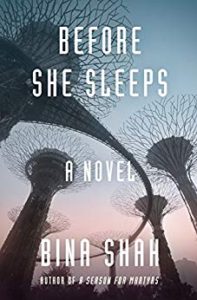
      Bina Shah has recently become a regular contributor to the International New York Times. She is a Pakistani writer who is a frequent guest on the BBC. She has contributed essays to GrantaThe Independent, and The Guardian and writes a monthly column for Dawn, the top English-language newspaper in Pakistan. She holds degrees from Wellesley College and the Harvard Graduate School of Education, and is an alumna of the University of Iowa’s International Writers Workshop. Her novel Slum Child was a bestseller in Italy, and she has been published in English, Spanish, German and Italian. A Season for Martyrs is her U.S. debut. She lives in Karachi.

      1. “No citizen is permitted to write or maintain a personal journal or diary” Is the crux of this dystopia is it not? Women need these private spaces to share their thoughts but you take it away they are walking bombs, ready to explore at any moment. This is reality. How and why did you devise this horrific rule?

      A regime doesn’t want witnesses to its horrors, and diaries and journals are specific forms of resistance. I was thinking of the diary of Anne Frank, but also the diary that Malala Yousufzai kept under the Taliban and published in the BBC as Gul Makkai. They are historical records as much as personal accounts, and most authoritarian regimes don’t want evidence of the crimes they’ve perpetrated on their victims.

      2. How and why did you start thinking of Before She Sleeps especially when the modern classic The Handmaid’s Tale continues to be published and now exists on television too?

      I wrote a short story called “Sleep” which became the first chapter of my novel, back in 2006. I added to it until it became about 100 pages long. Then I left it in a drawer, thinking it was a ridiculous premise and I couldn’t execute it. I took the short story to a literature festival in Copenhagen in 2013, and when I read it to the audience, the poet Warsan Shire, who was also there, told me that I had to turn it into a novel. I listened to her, and started working on it in 2014, long before the television series came out. The Handmaid’s Tale was not much of an influence on my work. 1984 by George Orwell was much more on my mind in the devising of such an authoritarian regime. But also the dictatorships that I have lived under in Pakistan, and those of secular dictators in Middle Eastern countries, as well as repressive Islamist regimes in Iran and Saudi Arabia.

      3. Isn’t this novel quite a shift for you in the stories you select to tell though the strong women remain the focal point? 

      It’s a change in genre which was risky and quite frightening for me as a writer. It’s easier and more comfortable to stick with what you have always been doing. But it represented a huge challenge and I decided to give it a try.

      4. Has your maintaining the Feminstani blog and writing for papers like The New York Times informed your writing style for novels? Do you notice a shift in the way you present material?

      I don’t write the same way in a novel as I do in my blog or my journalism. The writing I do for fiction is more poetic, more musical, more laden with references to other texts, literary (poetry and prose), artwork, religion (there are Quranic references, influences from Sufism, Islamic philosophy), and politics and history. It’s much more creative than my blog or my journalism can ever be.

       5. “My fear is an animal I can’t hide”. Isn’t this true of all women? 

      It’s true of all humans sometimes.

      6. Why choose the first person narrative to tell this story for Sabine and third person for the others?

      Only Sabine has the first person narrative and that is to make you feel more close to her. It’s more intimate. The others are all told in third person. I wanted to distinguish Sabine from the other narrators, make you feel more invested in her story. I needed both men and women to lend their voices to this narrative, to show the effects of the regime on both genders. I’m making the argument that a world without the female gender is an unbalanced world, and hurts everyone. Most proponents of male domination don’t seem to understand that at all.

      7. Is this your first spec-fic book? How did you invent terms like “currency stick”, genetic switch chips, virtual tunnels on the Deep Web, memory slips, and thought-to-device to name a few innovations mentioned? 

      It’s my first speculative fiction, dystopian book. I never imagined I’d write one. I made up those technologies that you mention. Others, like lab-made meat, or cloned animals, seemed a logical extension of the science we have already, although I did write about them long before they came into the news.

      8. How much research this novel require?

      A lot! I did a lot of research on the science, since several of the main characters are scientists. I also researched the geographical area I was writing about. I travelled to Dubai several times to observe the landscape, the buildings. And I was caught in a huge dust storm the likes of which I’ve never seen in my life. It appears in a seminal scene in the book as a kind of deus ex machina.

      9. “Sometimes I’m seized by sorrow at the position we’re all in, how fragile our inner safeguards against the betrayals that can happen to us in many ways, internal and external.” Why do I get the impression that this is a lament by Sabine not just for the immediate story but by you as well at a larger level too?  

      It seems a fairly self-evident observation about the world. I’m sure all of us have felt this way at least once in our lives.

      10. What is the short story that this novel grew out of? Is it available online? 

      No, it’s not available online, it was only published in Denmark by a boutique publisher in a very limited edition. Sorry – but this one is miles better!

      Buy the hardback and Kindle edition on Amazon India.

      14 August 2018 

       

      Fostering a reading culture / Happy Mother’s Day!

      (C) Sudhanva Deshpande

      (An extended version of this article was published on Bibliobibuli, my blog on Times of India, on Saturday 12 May 2018. Bibliobibuli focuses on publishing and literature.) 

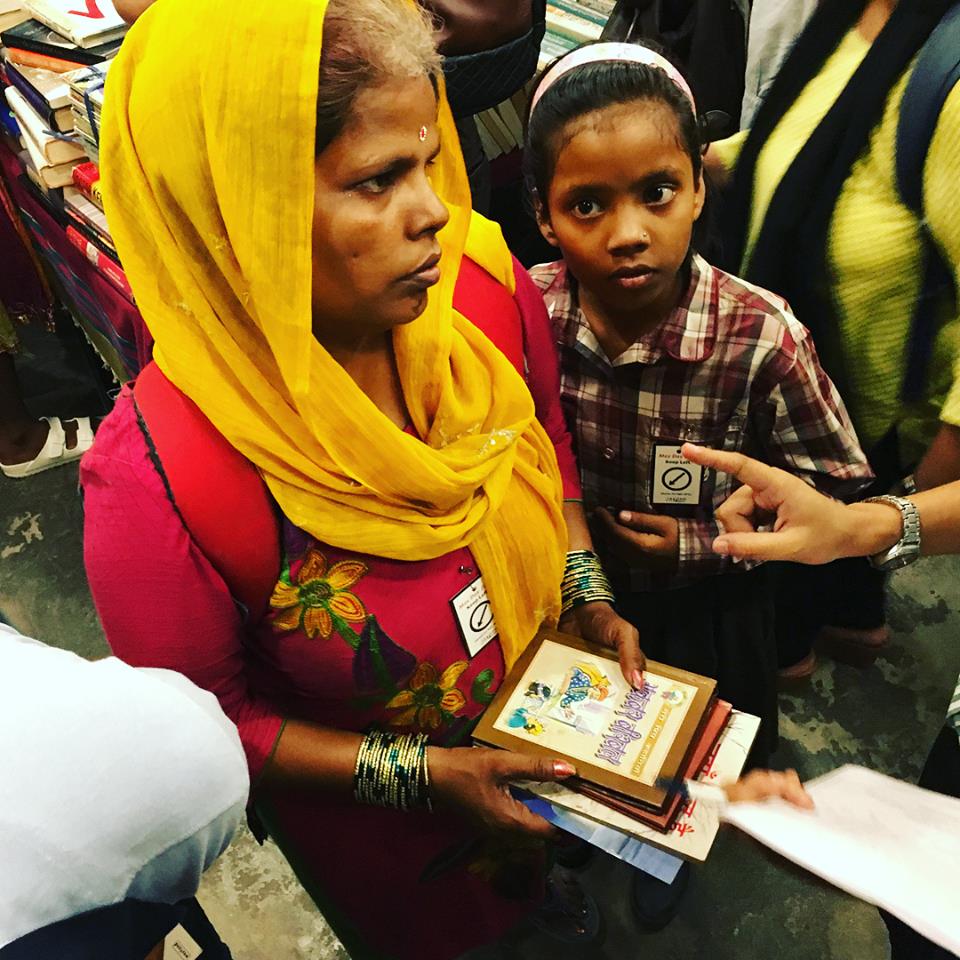
      Every Labour Day, the May Day Bookstore & Café holds a big book sale. It consists mostly of second-hand books being sold at reasonable prices and customers flock to the store. This year was no different. Later Sudhanva Deshpande, Managing Editor, LeftWord Books, posted a picture on social media platforms he had taken of a mother holding a tiny pile of books while her daughter stood by watching expectantly. It is a very powerful picture as it works at multiple levels. It is obvious the mother is in charge of her daughter’s education and is keen she learns further. She is the primary force. She is determined to buy the books for her child even though she can ill-afford the small number of books in her hand. The mother had only Rs 10 to pay for the books. She was short of money and unable to pay the billed amount. The unfortunate seemingly admonishing finger in the picture is not really doing what it seems to be doing according to the photographer. The bookshop attendants were telling the mother to take the books away and pay later, whenever she could!

      (C) Mayank Austen Soofi

      Books are respected all over the world but in India they are revered. Few can afford them and those who can, treasure what they possess. This picture by The Delhi Walla, epitomises it splendidly where the few books owned by the security guard are placed on the same shelf as the portrait of the god. It is understandable that the mother in the picture wishes her daughter to be literate as with it comes respect. For her to be in a bookstore is a path breaking moment. It symbolises the crumbling of a notional barrier of what is traditionally perceived as a popular middle class cultural space — the bookstore. Brick and mortar stores by their very definition tend to be exclusive even if some owners do not desire it to be so. Whereas the reality is that footfalls are restricted to those who are comfortable in these elitist spaces.

      This is a sad truth because a thriving reading culture is critical for the well-being of a community and by extension the society. The Scholastic India Kids and Family Reading Report ( KFRR) found that “Parents and children agree by a wide margin that

      John Travolta’s house with the airplane parked in it. (Image taken off the internet)

      strong reading skills are among the most important skills children should have.” Undoubtedly reading opens a world of possibilities. When Hollywood actor John Travolta gave an interview to magazine editor Priya Kumari Rana ( Outlook Splurge, November 2015, Vol 6) he recalled reading Gordon’s Jet Flight (1961) as a child. It was about a little boy who took his first flight on a 707. At the time the 707 was the last word in aviation. It triggered an ambition and a dream. Today, Travolta not only is a trained pilot but owns a 707!

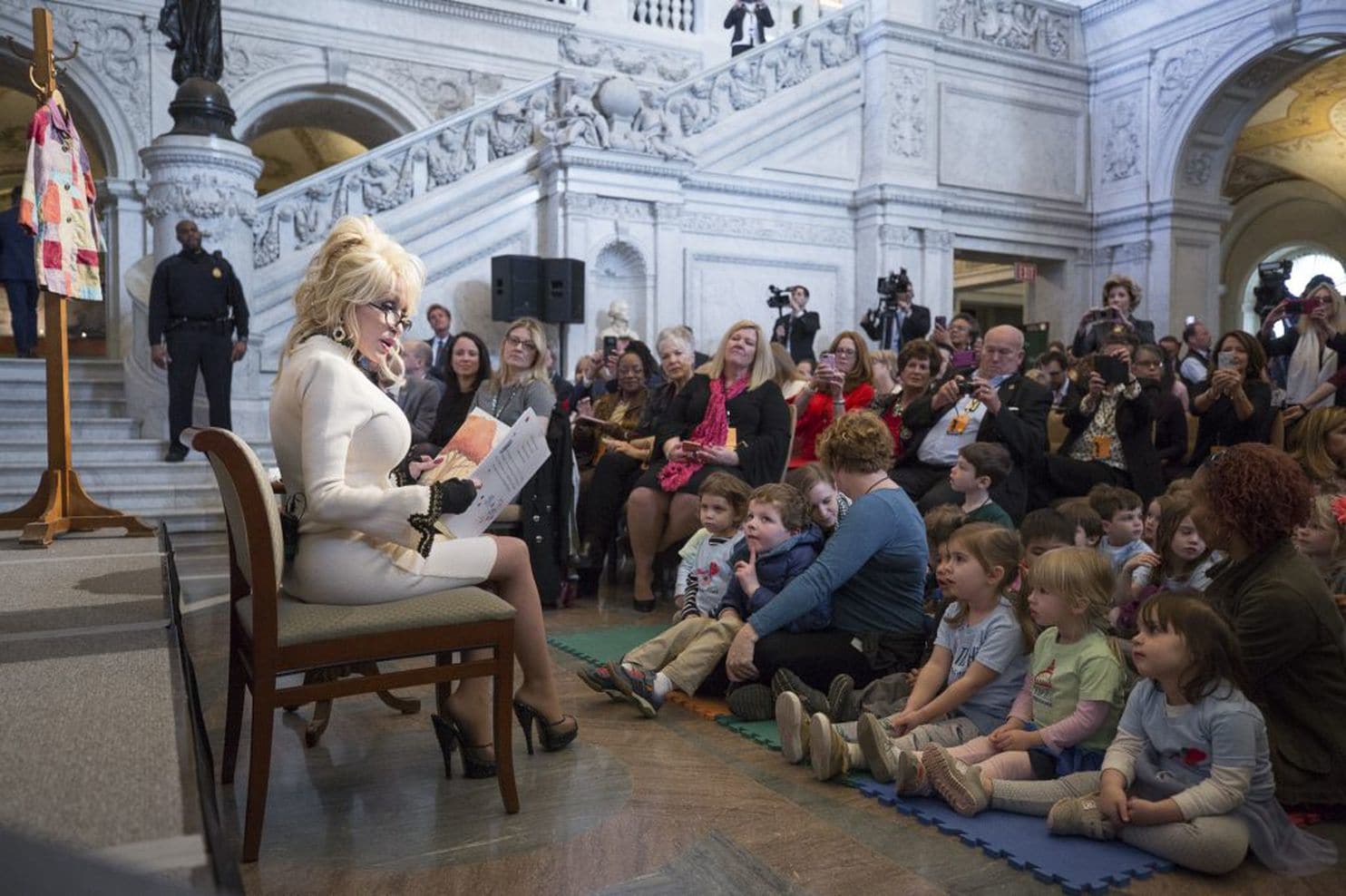
      Buying books continues to be a dream for many individuals and families across the globe. American country singer Dolly Parton likes to give away books with her Imagination Library. In Feb 2018 she crossed the 100 millionth book. Writer Jojo Myes has pledged to save UK Charity Quick Reads ( Reading Agency ) from closure by funding its adult literacy programme for the next three years. Outreach community programmes are critical for fostering a reading culture particularly if access to existing cultural spaces are restricted.

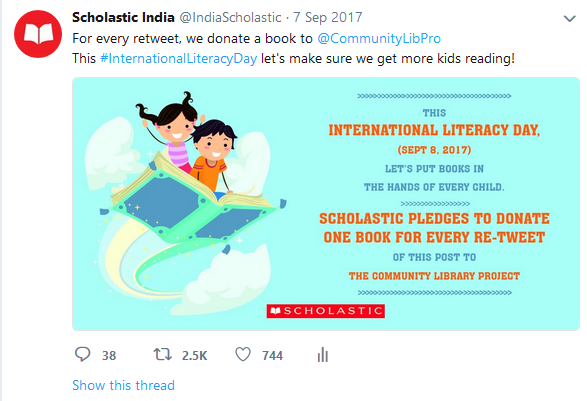
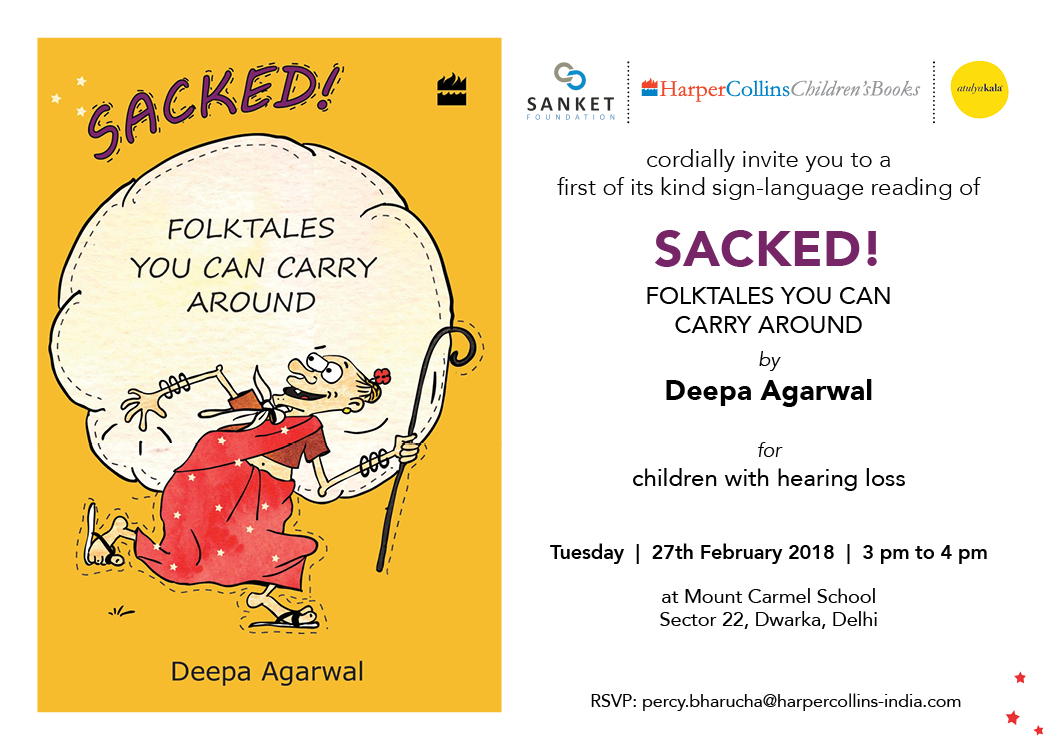
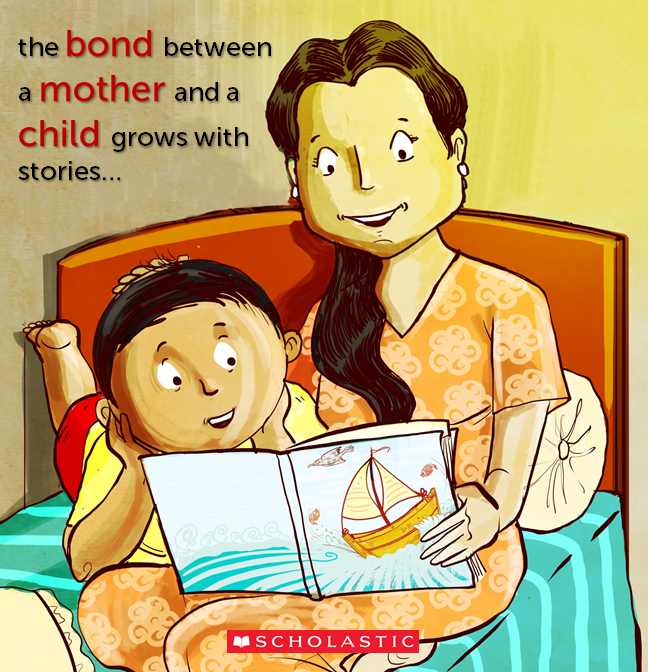
      Recently HarperCollins India organised an innovative book launch for children’s author Deepa Agarwal’s Sacked:Folktales You Can Carry Around. It involved a reading for children with hearing loss. So  while the author spoke there was a person standing next to her using sign language to translate what was being said. Recognising this need to foster reading, the nearly 100-year-old firm Scholastic  ran a very successful Twitter campaign in India (Sept 2017) where every retweet ensured a book donation to a community library. The publishing firm donated approximately 2000 books. Now they are running a similar campaign for Mother’s Day 2018 (Sunday, 13 May 2018) where a picture uploaded of a mother and a child reading will get one lucky family a book hamper.

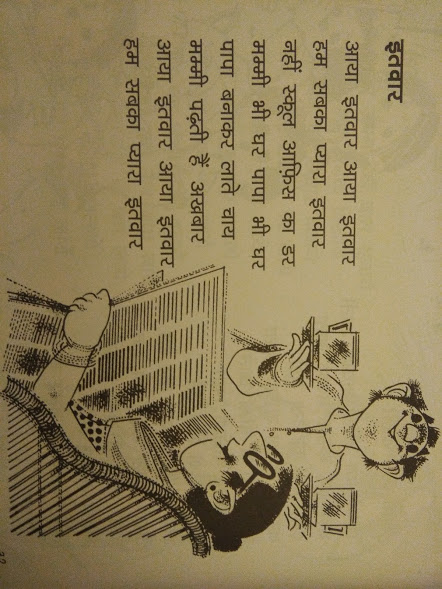
      Reading is a social activity. New readers need role models and encouragement. This is captured beautifully in feminist Kamla Bhasin’s nursery rhyme ( available in Hindi and English).

      It’s Sunday, it’s Sunday

      Holiday and fun day.


      No mad rush to get to school

      No timetable, no strict rule.

      Mother’s home and so is father

      All of us are here together.


      Father’s like a busy bee

      Making us hot cups of tea.

      Mother sits and reads the news

      Now and then she gives her views.


      It’s Sunday, it’s Sunday

      Holiday and fun day.

      Kamla Bhasin, “It’s Sunday”

      Noted Karnatik vocalist T. M Krishna in his book Reshaping Art makes an important point where he argues art has to break its casteist, classist and gender barriers and be welcoming to all particularly if cultural landscape has to expand. He asks for the inner workings of the art form to be infused with social and aesthetic sensitivity.

      T. M. Krishna practices what he preaches. In December 2017 he sang a Tamil sufi song of Nagoor Hanifa which T.M. Krishna performed in a British-era Afghan Church in Colaba, Mumbai. He ended his performance with an invocation to allah in the church. Since then he has done other such performances.

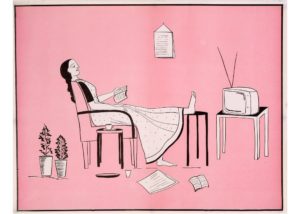
      Breaking cultural barriers and making books readily accessible and contributing to the growth of readers is exactly what the publishing ecosystem has to strive for. And as Kamla Bhasin rightly says the personal is political. There is nothing purely private or public. Every personal act of ours affects society. The act of reading and encouraging their children to read by mothers is not always welcomed in households, even today. Literacy empowers women with ideas, the ability to think and question for themselves, an act that is most often seen as defiance especially within very strongly patriarchal families. This act was captured beautifully in a wordless poster designed many years ago by a Hyderabad-based NGO, Asmita. It shows a woman with her feet up, reading a book, a television set in front of her and the floor littered with open books. Majority of women who see the poster laugh with happiness at the image for the peace it radiates but also at the impossibility of ever having such a situation at home.

      So mothers like the one in the photograph are excellent role models and must be celebrated!

      Happy Mother’s Day!

      11 May 2018 

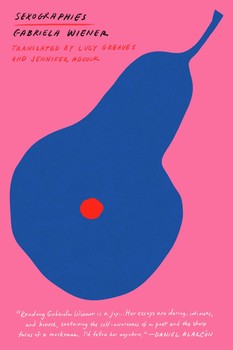
      “Sexographies” by Gabriela Wiener

      According to the  biography posted online renowned Peruvian journalist Gabriela Wiener (Lima, 1975) is author of the collections of crônicas Sexografías, Nueve Lunas, and Mozart, la iguana con priapismo y otras historias. Her work also includes the poetry collection Ejercicios para el endurecimiento del espíritu. Her latest book is Llamada perdida (2014). She writes regularly for the newspapers El Pais(Spain) and La República (Perú). She also writes for several magazines of America and Europe, such as Etiqueta Negra (Perú), Anfibia (Argentina), Il corriere della Sera (Italy), S. XXI (France), and Virginia Quarterly Review (United States). In Madrid, she worked as editor of the Spanish edition of Marie Claire. She left the magazine in 2014 to work on her first novel.

      Restless Books will be publishing Sexographies in May 2018. It has been translated from the Spanish by Jennifer Adcock and Lucy Greaves. This is a form of reportage that is like none other. A collection of brutal essays written in the first person that are impossible to classify in any genre. The writing breaks all known norms. It is perhaps preferable to say that the focus of every essay determines the style of writing whether it is  “infiltrating the most dangerous Peruvian prison, participating in sexual exchanges in swingers clubs, traveling the dark paths of the Bois de Boulogne in Paris in the company of transvestites and prostitutes, undergoing a complicated process of egg donation in Spain, and participating in a ritual of ayahuasca ingestion in the Amazon jungle“. A truer book blurb was never written when Sexographies is described as “an eye-opening, kamikaze journey across the contours of the human body and mind”.

      Included in Sexographies is Gabriela Wiener’s profile of Isabel Allende. It is a brilliantly illuminating conversation-cum-profile of an older woman writer. Isabel Allende is almost venerated by the younger one, Gabriela Wiener, and yet they are able to understand each other as individuals, women, and writers. They meet on International Women’s Day. Gabriela Wiener notes that “Bolano called her an escribidora — a prolific and bad writer. Making fun of Isabel Allende isn’t a sign of intelligence, it’s part of Latin American literary folklore.” She goes on to observe that “The novelist, after all, is a traditional woman who was brought up to be a good girl, and who worked to free herself through literature.” Meanwhile Isabel Allende acknowledges that she has a fair amount of criticism hurled at her but she takes it in her stride as she takes her success. She realises she is often under the critical scanner for the simple fact “I sell books.” Isabel Allende’s life’s philosophy is to strike a balance between frivolity and depth; she says “Since then I haven’t stopped being feminine, sexy, and a feminist. It can be done.”

      Here is an excerpt from the essay “Isabel Allende Will Keep Writing from the Hereafter”published with the permission of Restless Books. ( Publication date: May 15, 2018. Contact Nathan Rostron, Editor and Marketing Director: nathan@restlessbooks.com )

      *******

      Allende is an easy target for the canonizers of novels. It’s possible that not many of her critics are willing to admit that the virulence of their attacks are based on prejudice: she’s an upper- class woman who used to write a feminist column for a fashion magazine in the 1970s. At the age of forty, without any academic training, she started publishing novels, made autobiographical fiction her signature, and her books started flying off supermarket shelves. In a world where the stupidest things tend to be the most popular, sales of fifty million copies can only arouse suspicion.

      But put yourself in her shoes: try having the surname Allende in Chile, going into exile, getting divorced, bringing up children, dedicating yourself to journalism, and writing novels. She was part of a generation of Latin American women who juggled all these things at once, and yet managed to triumph under the long shadow of the Boom—a movement that didn’t really contain a single woman writer, only incredibly loving wives who kept everything nice and comfortable so that their husbands could finish their books and win that Nobel Prize.

      Try writing from the bottom tip of the American continent about emotions and sex instead of tunnels and labyrinths. Now try to sustain a literary career over three decades with unwavering success. Try, moreover, to produce as many well-written novels as she has. Because Isabel Allende’s books are well-written: there is a voice and an imagination. Isabel Allende builds her stories around simplicity. She occasionally succumbs to cheapness, lace, and frills, but her expression is founded on the richness of family stories, everyday comedy and drama, and the intimate knowledge of a feminine universe, as in The House of the Spirits. In Eva Luna or The Infinite Plan, being colloquial and inventive makes her prose even more personal and confessional. Her books reveal history through memory and reclaim sex so that it belongs to the home and not to poets of the body. In Paula, perhaps the best of her books, she describes a man’s suffering in the presence of his comatose daughter’s body. In it, the consciousness of being human reaches levels that Allende’s language cannot match.

      We know the outcome of Allende’s adventure: few have built such a solid relationship with their readers, a relationship based on something mysterious and addictive that they find in her pages and which defies any logic outside itself. Isabel Allende isn’t Virginia Woolf, she’s not Clarice Lispector, and she’s not Alice Munro; but neither is she a bestseller à la Dan Brown with his simple-minded esoteric vision of the crime novel. And yet he isn’t criticized half as often as she is.

      What’s the sell-by date of a popular writer after the publication of their last hit? At this women-only conference I’ve heard names I hadn’t heard for years: Laura Esquivel and Ángeles Mastretta, for example. And the first thing I thought was “they’re still alive?” Yesterday I saw Mastretta, the author of commercial bombshells such as Tear This Heart Out and Lovesick, gliding down the corridors of the Palacio de Bellas Artes with her dramatic cheekbones, her carefully coiffed hair, and her fragile movements, and it was like stepping back into the eighties. On Wikipedia, I discover that she’s carried on publishing books. In the last two decades of the twentieth century, the books of these three women were labeled “women’s literature,” a kind of derivation of “true literature” with sugary, sentimental additives of which Allende is the highest-profile proponent. Following its initial golden years, “women’s literature” seems to have fallen out of favor, and Allende alone has remained a bestseller. After the success of Like Water for Chocolate, Esquivel took refuge in a mansion in the outskirts of Mexico City, tried out being a member of parliament, and now facilitates workshops and publishes books in the style of 12 Steps to Happiness. Years after that enormous cocoa feast, Allende wrote her own book about sex and cocaine: Aphrodite, a book where cooking recipes lead to love (also known as the kind of book that immediately banishes you from the annals of literature with a capital L).

      Gabriela Wiener Sexographies ( translated by Lucy Greaves and Jennifer Adcock) Restless Books, Brooklyn, 2018. Pb. pp. 

      2 May 2018 


      “The Lioness in Winter: Writing an Old Woman’s Life”

      Ann Burack-Weiss’s The Lioness in Winter: Writing an Old Woman’s Life is a slim volume where she explores through women writer’s prose what it means to them getting old. For decades she herself has been a social work practitioner who focused from day one of her career on the caregiving of the elderly. It was unusual when she chose this vocation in the 1960s but four decades later it is not. ” I became a social worker with the aged because I was afraid for my life.” It gives her a perspective and an understanding in a particular phase of a woman’s life when she is inevitably relegated to grandparent duties whereas continuity theory states that as people age they do not change their patterns of thought or action but continue to approach life in the same way as they always have.

      Ann Burack-Weiss has been fascinated with the memoir/ autobiography or the essentials of life-writing experience. It encompasses a range of forms such as the transcribed interview, dictation, journal, letter and auto-fiction. According to her since the 1960s feminist scholars have been explored the woman’s “agency” ( the ability to speak and act on her own behalf) or the lack thereof. “They note that, through the ages, most of the writing about women, in fiction and nonfiction, has been by men, and that the male lens inevitably leads to distortion.” But as she discovers that many of her quoted authors in the book — Colette, Fisher, Sarton, Florida Scott-Maxwell– had published compelling life writing well before the editors determined what was worthy of inclusion in their collections. “The only possible explanation for their exclusion is that the editors themselves had little interest in what the old women had to say.”

      The writers included in this book are categorised according to arbitrary time divisions:

      1862-1909 (Fin de Siecle) — Colette, Simone de Beauvoir, M.F.K. Fisher, Anai Nin, Florida Scott-Maxwell, Eudora Welty, Edith Wharton

      1910-1929 (Progressive Era) — Diana Athill, Maya Angelou, Marguerite Duras, Marilyn French, Doris Grumbach, Carolyn G. Heilbrun, Madeline L’Engle, Gerda Lerner, Doris Lessing, Adrienne Rich, May Sarton

      1930-1943 (Great Depression- World War II) — Isabel Allende, Mary Catherine Bateson, Joan Didion, Margaret Drabble, Annie Ernaux, Vivian Gornick, Toni Morrison, Joyce Carol Oates, Edna O’Brien, Mary Oliver, Marge Piercy, Anne Ropihe, Lynne Sharon Schwartz, Alix Kates Shulman

      1944-1960 (Baby Boomers) — Diane Ackerman, Alison Bechdel, Terry Castle, Mary Gordon, Kay Redfield Jamison, Nancy Mairs, Nancy K. Miller, Alice Walker

      It is interesting Ann Burack-Weiss chooses to quote Toni Morrison’s Nobel Prize for Literature ( 2002) acceptance speech where Morrison focuses on “word-work” and being an old woman. Toni Morrison’s last novel God Help the Child ( 2015) which began life as a memoir but transformed into a slim novel explores these very themes. It reflects upon the cycle of life from the perspective of an older writer. What truly struck me at the end of 2015 was that none of the “Best of 2015” lists included this novel even though it was “Toni Morrison”. Perhaps old age is too stark a reminder of one’s mortality.

      It is a slim volume but gives one much to think about.

      Ann Burack-Weiss The Lioness in Winter: Writing an Old Woman’s Life Columbia University Press, New York, 2015. Pb. pp.190 

      27 Sept 2017 


      Web Analytics Made Easy -
StatCounter