unannounced visitor I dropped by into my dream careful not to awaken the buried whispers I lit a candle by their grave startling the slumbering shadows into a frenzy of activity bats taking wing flying blindly into one another this in turn caused the whispers to awaken look me in the eye and begin to do what they did best
bear witness
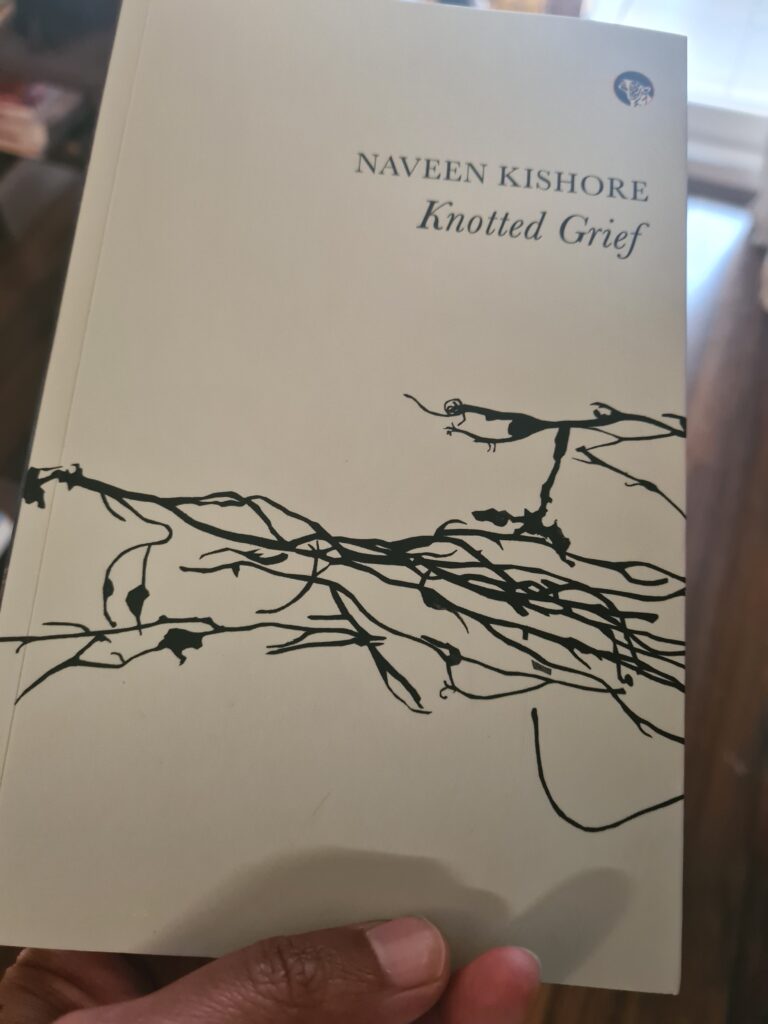
Legendary publisher Naveen Kishore, founder, Seagull Books, has published his debut collection of poetry called Knotted Grief. It has been published by Speaking Tiger Books. He is the recipient of the Goethe Medal, a Chevalier de l’Ordre des Arts et des Lettres and was awarded the 2021 Ottaway Award for the Promotion of International Literature. Those who are fortunate to communicate with him directly and regularly, have been aware of his talents as a poet for a very long time. His emails are interspered with poetry or at times are only written in verse. The manner in which he responds to situations, events, moments, emotions are well described in his poems but also the way in which he arranges the words on the page. The visual element is as important as the content, ideas and emotions. For years, I have asked Naveen Kishore to get his poems published. I have always found the poems fantastic. It is a gift to be able to compose poems easily focussing upon the reader, so it always seem as if the poems are special. So I was delighted when the publication of Knotted Grief was announced by Speaking Tiger Books.
In Knotted Grief, the collection of poems are categorised according to “Coda”, “Kashmiriyat”, “Street Full of Widows”, “Selected Griefs”, “Tilted Sky”, “Under the Skin” and “Birdcall”. The poems are of varying lengths, from a cluster of words to verses scattered on the page. The sparse arrangement on the page ensures that the reader is absorbed by the few words on the page.
Upon reading the volume, I posed a few questions to Naveen Kishore. Here is the slightly edited version of the Q&A.
How did this collection happen? The collection happened by accident when my publisher friend Xavier Hennekinne of Gazebo ‘discovered’ that I write poetry by finding some of my poems in online poetry journals. he asked my if I had a book and I said no I have many folders with poems I have been writing for the last ten years! The reason fr not having a manuscript was simple enough. I was so busy writing I couldn’t stop, take stock, and put one together. This was solved by my friend and translator Tess Lewis who offered to select a first draft so that publishers could read it like a book! I went on to share this with Xavier at Gazebo and he in turn shared it with his poetry editor Phil Day, who is himself a poet and a painter. Phil then requested I send hi the four hundred odd poems I had set aside while selecting this collection and immersed himself in these for a few months and came up with Knotted Grief as you read it now!! Gazebo will publish on April 1st. The Speaking Tiger edition happened when I shared the Australian page set version except that Ravi selected more poems because he wanted an additional thirty pages. There is no collaboration between Seagull and Speaking Tiger! I offered my manuscript as any first time author to a publisher I admire. Seagull has nothing to do with it except do what we always do spread the word for friends in publishing!
Did you compose poetry specifically for this volume or did you select from previous compositions? No. I have been writing on the human condition for many years. Kashmir is one theme but it could easily be Palestine. There is no recent or previous. You write every day. Like music. It is all a continuous riyaz.
Why did you focus upon grief? Is it one of the offshoots of the pandemic? I didnt. Choose grief. It is usually the other way round. Grief does the choosing, if I may put it like that. You are visited upon by loss of friends close ones in an ever widening or lessening circle of affection. People close to you die. Go away. So you embrace their memory. Similarly at a political, national versus personal level their is grief that springs from what we as people do to each other. Again the ‘human condition’, ‘Kashmir’ ,’Palestine’ Interchangeable grieving. The poems and yes grieving is never without hope.
You have always written fabulous poetry. Why did you choose to publish your poetry now and not earlier? I cannot as a publisher publish my own books! So one waited for someone to ‘discover’ my poems. Takes time! Besides to me the act of writing is more vital.
How many translations is this poetry being published in? Who are the publishers? Are you supervising the translations or are you letting the poems speak for themselves? So far Rajkamal Prakashan Samuh very generously offered to do the Hindi; Ravi Dee Cee of DC books is doing the Malayalam; Papyrus is doing the Marathi; Unistar in the Punjabi; Chintan in Bengali; I am reaching out in Tamil, Kannada and Assamese too. Let see. Not really supervising but making myself available for translators should they wish to talk about things. Complete freedom to take liberties as long as the essence of the ‘target’ language is hospitable to what I may be attempting in English. So yes the poems have to touch the translators.
As far as I know, the arrangement of the words on the page are as critically important as the poem itself. How will you manage this quality control in the translated texts especially if you are unfamiliar with the destination language? I am flexible. It will boil down to the combination of the translator and editor in the language edition to do the best they feel they can to convey render share the original thought in their own languages. This means they have the freedom to lay out the poems the way they wish.
You are a publisher known for publishing extensive translations. Are there any guidelines/sensibilities that you have honed as a publisher over the years that you would ensure are followed in translating your poetry as well? None. I leave it to the publisher, editor, and translators who become the first sensitive readers in that language. Having said that I may be able to help fine hone the languages I know, Punjabi, Hindi, Bengali.
Would you change the collections ever so slightly in every language or will the same edition be made available in all editions? I think mostly the Indian edition is being followed. I would more or less treat that as the one I would want translated. But open to the variant should it happen organically or for reasons that are yet to come up.
I truly liked Knotted Grief. Perhaps you will too. Buy it. Read it.
Memoirs, autobiographies and biographies are a great introduction to a life. They also share a period through personal stories making history come alive. Memoirs are mostly a great story told from one person’s perspective — “my story”. As Eric Idle says to John Cleese while discussing the latter’s memoir in a public conversation, “well it is very hard to write about yourself” but a memoir is also only a slice of history or what you choose to tell.
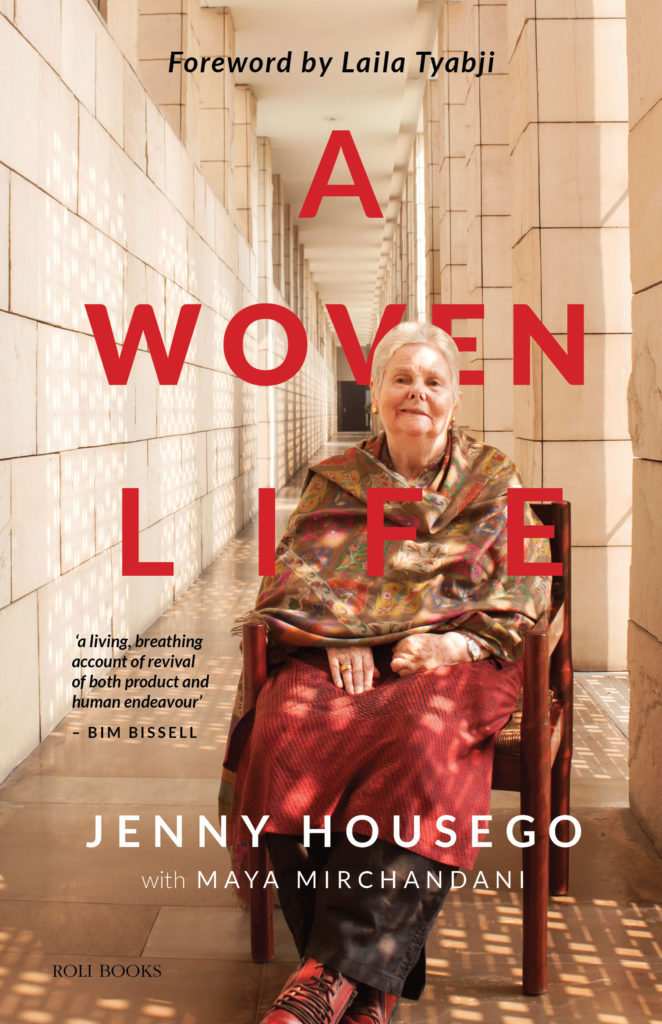
In textile historian, entrepreneur and collector Jenny Housego discusses her childhood in England, her marriage to journalist David Housego and her passion for textiles that was ignited during her stint at V&A, London. She developed a fascination for “Anatolian carpets of the fourteenth and fifteenth centuries … [she wanted to show in her research] that the so-called early Egyptian carpets had actually been made in Anatolia and displayed many examples of early Christian and Byzantine art which seemed to me to bear close similarities to the designs on these carpets.” Her husband, David, was soon posted to Iran, Afghanistan and later India. She accompanied him and sometimes on the tours he undertook. Along the way her love for textiles deepened. On her travels she was able to collect exquisite samples. When she came to India she developed an interest in the paisley designs of Kashmiri shawls. It sparked a lifelong love for the handloom. Jenny Housego managed to convert her keen interest in Indian handlooms into a successful business. At first she set up a company with her then husband, David Housego, called Shades of India. Subsequently when her marriage fell apart she set up another one — Kashmir Loom. This time focussing specifically on her interest for handlooms from Kashmir.
A Woven Life has been co-authored by Maya Mirchandani as Jenny Housego’s left side is paralysed due to a stroke she suffered some years ago. It is a memoir that is easy to read. It has tiny illuminating details that only reinforce how good art combined with talent can survive through the ages. For example, Jenny Housego’s granduncle was the famous American painter, John Singer Sargent. In one of his portraits uses a Kashmiri paisley shawl woven in India. Jenny Housego spotted it in the painting while searching for antique shawls whose motifs she could incorporate in the Kashmir Loom design library. She decided to find out if the shawl still existed. Sure enough. It did. She sent the image to Warren Adelson, a friend and well-known art dealer in New York who specialized in Sargent paintings. The shawl had been used as a regular prop in many of Sargent’s paintings but he had decided to gift it to one of his clients. Incredibly the shawl was now owned by a British peer, Lord Cholmondeley, who kept it at his stately home.
Presumably, Sargent must have painted an ancestor of the lord’s wife with the shawl wrapped around her and then must have given it to her. Warren wrote to him on my behalf and his Lordship kindly agreed to bring it to London for me to see. In the hallway of his Mayfair home on a cold, dark rainy day, the shawl was brought to me and placed on a table. The hallway was badly lit and no one offered to hold it up for me to photograph properly. I remember draping it over a side table as well as I could, then my flash failed. The wool was coarse, clearly woven from local sheep, not pashmina at all, but the shawl was exquisite in spite of the rough wool. It had been looked after well. Woven using the technique called ‘kani’ for which Kashmir is renowned, it had patterns on a large border and on either end of the shawl were big paisleys in shades of blue with accents of kashmir loom: stepping out of another’s shadow reds and pinks. Each paisley was made up of tiny leaves and flowers woven to form the shape. Above the main border was another row of much smaller paisleys woven the same way, but set at an angle, slanting to the right. The outer border at the very end of the paisleys wrapped around the entire shawl like a vine of tiny blue-green leaves. Bent over it in that dark hallway, I knew I had to try and recreate it. I didn’t know if it would work, but I was certain it would become Kashmir Loom’s signature item if it did.
Her life with David Housego had very interesting moments. For instance, they were living in Iran in the period before the revolution, so the shift in sentiments from the Shah to the Ayatollah were palpable. Then as a prominent foreign correspondent, David Housego, had access to many sensitive stories. For instance, David had written in the Economist, saying that the Iranians were building a naval base at Chabahar on the eastern side of the Gulf coast. Husband and wife journeyed to Chabahar where the Iranian government representatives denied the existence of such a base until a night watchman who had obviously not briefed by the officials confirmed that David’s report was correct. Another terrifying moment is Jenny Housego’s account of David and her younger son, Kim’s, abduction by militants in Kashmir. Kim was taken away from his parents in Srinagar and there was no trace of him for seventeen days. Given that David was a well-known British correspondent based in South Asia, he knew relevant people across the subcontinent. These included politicians, diplomats, journalists etc. As a result, according to Jenny’s memoir, David was able to keep the pressure on the militants since he had activated all the channels and would hold regular press conferences. David too mentions the abduction of Kim in an article he published in 2011. ( David Housego, “An Indian Journey“, Seminar, 2011.)
A Woven Life has two very distinct narratives embedded in it. One is Jenny Housego’s passion for textiles particulary Kashmiri weaves. The second is her life with David Housego. In fact it was David who inadvertantly set her off on this journey of textiles by encouraging her to apply for a job as a museum assistant at the Victoria and Albert Museum ( V&A) in London. She was apprenticed to Dr May Beattie, a leading scholar of her time in Oriental rugs and carpets. It obviously ignited a passion that Laila Tyabji, Chairperson, Dastkar, recognised upon meeting Jenny Housego for the first time. She recalls it in her foreword to the book:
... we settled down to watch her slide presentation of the Punja durries’ documentation and out came the second side of Jenny! Behind the diffident, very British, understated, rather shy exterior was an insightful, academically trained mind; the scholarship coupled with a passionate excitement about her subject. …I still remember Jenny’s illuminating exposition of ‘interlocking circles’ and how so many motifs and designs are based on combinations of this. After that I saw interlocking circles everywhere – on Etruscan mosaics, Celtic stone carving, Mughal jaali lattice work, Kutchi ajrakh block prints, rococo wrought iron, Indonesian wax resist batiks.
Despite her marriage falling apart after thirty years, Jenny Housego is unable to recount incidents in her memoir without mentioning David regularly. She comes across as bitter while talking about his non-existent parental duties when their sons were toddlers. Having said that David was an integral part of her life and to a large extent seems to have given her the opportunities to pursue her interests in textiles. In the book trailer for A Woven Lifethere are lovely snapshots recorded from Jenny Housego’s life, many of them are of the Housegos as a happy family — a bit at variance from what the text portrays. Regretfully it does not have sufficient details about textile histories and Kashmiri handlooms. The book would have been richer by offering more detailed insight into these traditional forms of weaving. Nevertheless A Woven Life is a quick read.
PS I read an advance proof of the book, given the current lockdown due to the Covid19 healthcare crisis. Sadly, it did not have a single photograph. But I am assured by the marketing team that the print edition will have photographs accompanying the text.
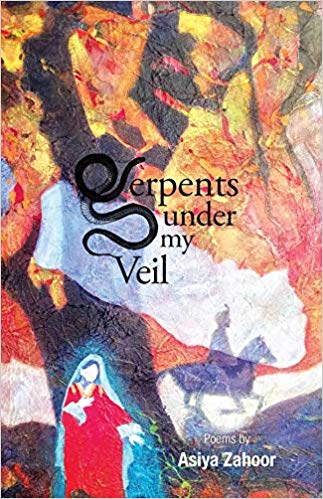
There are many books and essays to discuss but today I would like to share two poems from a slim but exquisite and powerful collection of poetry called Serpents Under My Veil. It is by Kashimiri poet Asiya Zahoor. The book was published on 15 August 2019. She has written on Kashmiri and Caribbean Literature, exile and psycholinguistics. Her film ‘The Stitch’ has won the Critics award in the Second South Asian film Film Festival by Federation of Film Society of India and has been screened at various festivals including the 48th Roshd International Festival in Tehran. Her poetry is translated into many languages.
****
Lightness of Being in a Heavily
Militarised Zone
before they lay barbed wire
across our tongues
let’s sing of almond blossoms

before they hammer our heads
to harvest thoughts let’s think
what we want to think

before they wall our sleep
let’s whisper dreams
into cold cruel ears

before they blind us
with a burst of lead
let’s mirror our darkness

let’s engrave this story
with fingertips on palms
before they erase our words
*******
My Grandmother Spun Soft Revolutions on a Charkha
Turning the fleece
of a Kashmir goat
into cashmere.

Her lullabies
on a rabab
put heavy guns
to sleep.

Her prayers soared
from chimneys,
wished for rivers
not cursed with myths,
breasts not drilled
with bullets,
streets not hemmed

with barbed wire,
history
not written with scars.
She paused her singing
to boil almanacs
in a samovar,
inhaling embers,

exhaling fire. Her passion
faded like posters
on municipal walls

we ignore in our daily routine.
She offered trays
of mustard rice
to a shrine on a mountain

where a soothsayer
had predicted,
embers turn to ashes.


(C) The copyright to the poems rests with Asiya Zahoor.
Serpents Under My Veil has been published by Tethys, an imprint of Yatra Books.
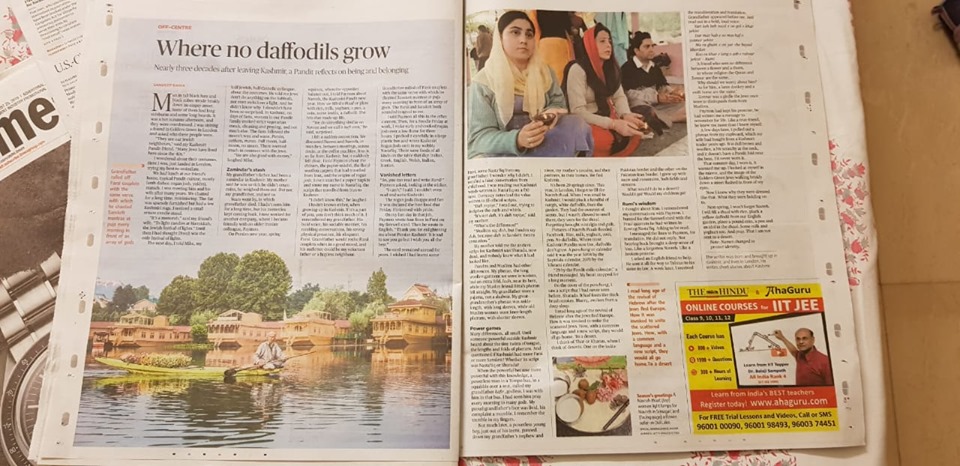
On 24/25 August 2019, Sandeep Raina’s “Where No Daffodils Grow” was published in the Hindu Literary Supplement. Here is the link. Given the space restrictions in print, the article had to be edited. Reproduced below with the kind permission of the author is the unedited version.
Sandeep Raina was born and brought up in Baramulla, Kashmir. He studied engineering in Srinagar, and when in 1990 militancy gripped the Kashmir valley, he finished his education and left for Delhi. He lived in Delhi for 10 years and then in Istanbul for 3 years before moving to Surrey, England where he has been living for the past 15+ years with his wife and 3 children. Sandeep’s wife is a doctor in Surrey, their daughter studies medicine at the University of London, and their twin sons are studying engineering at the Cambridge University.
Sandeep has worked as a senior engineering executive in mobile telecoms for the past 28 years and travels globally for his work. As a mobile telecoms evangelist, he has been invited to speak at many conferences across Europe and the USA, and has published numerous professional articles. Currently, he works for a French-American telecommunications software company in London.
Sandeep has written a novel based on Kashmir, which took him over 11 years to write. The reason to write a novel was that it worked as a slow cathartic process to counter the traumatic and violent experiences of the early-90s Kashmir, and the harsh life of being a migrant/refugee in Delhi. As part of his life and travels outside Kashmir, he has acquired different perspectives of the Kashmir conflict. Through his writing about the Kashmiri people, of all communities, caught in the long-drawn, brutal conflict, he aims to present a better understanding of their predicament.
Sandeep has also published short stories about Kashmir, which reflect the exchanges with people caught in conflicts like Kashmir. They not only highlight the broken relationships, the loss of trust, the rising communal politics of Kashmir and India, but also offer introspection and a hope for the communities that have been disadvantaged because of the strife.
His stories have been published in several magazines and papers, including, The Hindu, The Guardian, The Telegraph, and The Times of India/The Economic Times.
****
Men in tall black hats and flowing black
robes strode briskly down an empty street. Some of them had long side burns and
some had long beards. It was a summer
afternoon, hot, and they were quite overdressed. I was visiting a friend in
Golders Green in London and asked him what was going on, who were those people,
why the costumes?
“Nothing, they are our Jewish neighbours back
from a synagogue,” said the Kashmiri Pandit friend. “Many Jews live here since
the 40s.”
Why were they dressed in such a pronounced
manner? I wondered. Here was I, trying my best to assimilate, just landed in
London. It didn’t make sense.
We had lunch at our friend’s home, typical
Pandit cuisine, mostly lamb dishes: rogan
josh, yakhni and matsch. I had
met him and his wife after many years. We chatted for long on the table,
reminiscing. The flat was sparsely furnished but had a few Kashmiri rugs. I noticed
a small ornate candle stand in the window and asked what it was.
“It is a menorah,” said my friend’s wife. “To light candles in the Jewish
festival of lights, Hanukkah.”
Until then I had thought Diwali was the
only festival of lights.
“Everybody
in this apartment building is a Jew, most of them old,” said my friend. “And
they are very nice people.”
The next day, I told Mike, my colleague in
office, about the Jews in costume. Mike was a small young man, who once had
said that being Jewish, Catholic and French was the worst one could be in
England, and he was all of them. One of his parents was French and Catholic,
the other English and Jewish.
“There are other interesting things that we
do, such as not doing anything on Sabbath,” he laughed. “Not even switching on a
light.”
“Why?” I said.
He didn’t want to explain or didn’t know.
I shouldn’t have been so surprised. In
Kashmir, on days of fasts, women in our Kashmiri Pandit family cooked strict vegetarian
meals, cleaning and praying, and not doing much else. And the fasts followed
the moon’s wax and wane. Punim, aetham, mavas. On full moon, mid
moon, and no moon. There seemed to be much in common with the Jews.
“We
are also really good with money,” laughed Mike.
My grandfather’s father had been a zamindar,
a landowner, in Kashmir. My mother said that he was so rich that he didn’t
count coins, he weighed them out of hand balances. But, my grandfather was not
rich, nor us. My mental comparisons with the Jews ended at this thought.
Years went by. In which my grandfather
died. I hadn’t seen him for a long time, but his memories kept on coming back
to me in many different ways. By now we had moved into a new house, and I worked
for a different company, in a different town in England, where I became
friendly with an older Iranian colleague, Paymon.
It was the Persian new year, on spring
equinox, when the day equals night, and the opposites balance out, when I told
Paymon about Navreh, the Kashmiri Pandit new year. How on the eve, we filled a thaal, a deep plate with rice, milk, yogurt,
a pen, a coin, some lentils, a daffodil. Bits that made life.
“We do something similar on Navroz, and we
call it haft seen,” he said, surprised.
I felt a sudden connection build. We discussed
Navroz and Navreh in snatches between meetings, across our office desks, on the
coffee machine. Iran is so far from Kashmir, but it suddenly felt close. I told
Paymon about the chinars, the papier-mâché, and the floral woollen carpets that had travelled from Iran, and
the origins of rogan josh. Things began to tumble out. I even snatched a paper
napkin and wrote my name in Nastaliq, the script that had travelled from Iran to Kashmir.
“I didn’t know this,” he laughed.
I didn’t know either, when growing up in
Kashmir. If it’s a part of you, you don’t think much of it. I remembered my grandfather.
I remembered his bold loud voice, his very sociable manner, his rambling
conversations, his strong physical presence, his eloquent Farsi.
Grandfather used to recite Farsi couplets
when he was in a good mood, when he had an audience, which could be my reluctant
father or a hapless neighbour who had chanced to step by. Grandfather rolled
off the Farsi couplets with the same verve as chanting mantras in Sanskrit,
when he did his puja every morning, with
lots of flower petals and incense sticks, in front of an array of gods. I was
small, the Farsi and the Sanskrit both sounded magical to me, inspiring awe.
I told Paymon all this in the office
canteen, and he listened to me with an older man’s patience.
My euphoria was unabated. For a Foodie
Friday in the office, I woke up early and cooked rogan josh in the morning over
low flame for three hours. My wife
wasn’t happy that I hadn’t let her cook. I packed the rogan josh carefully in a
large plastic box, with a sticker on top and wrote- Kashmiri Rogan Josh in my wobbly Nastaliq, and sped to office, just
in time for lunch. My colleagues had already begun eating, and there were foods
of all kinds on the large canteen table. Italian, Greek, English, Brazilian,
Welsh, Indian, Iranian. The rogan josh was late. Then Paymon saw me.
“So, you can read and write Farsi?” said Paymon,
looking at the sticker, asking me to put some rogan josh on his plate.
“I can’t,” I said. I couldn’t even read and
write Kashmiri.
Rogan josh disappeared fast, everyone ate
it. It was declared the best cooked food on that Friday. I brimmed with pride.
When I left that job, on my last day, Paymon
wrote four lines in Farsi on my farewell card. Under those he wrote in English:
Thank you for enlightening me about
Persian Kashmir. It has been great talking with you. It is sad to see you go
but I wish you all the best.”
I think Paymon said something about those
Farsi words in the card, but in my farewell hurry, I didn’t hear too well.
The card remained unread for years. Later,
I wished I had learnt some Farsi, some Nastaliq from my grandfather. I
wonder why I didn’t. My question took me back to a faint conversation from my
childhood. I was reading out two Kashmiri words written in Nastaliq on a
ten rupee note. In those days, currency notes in India had the value written in
15 official languages, each in its own script.
“Dah
ropiye,” I read out, trying to decipher the curls,
whirls, and dots.
“It’s not dah ropiye, its duh ropiye,”
said my mother.
“What’s the difference?”
“Muslims say dah, but Pandits say duh,
because dah in Sanskrit means cremation. And
Muslims bury their dead.”
My mother also told me that the ancient script
for Kashmiri was Sharada, now dead, and nobody knew what it had looked like.
Pandits and Muslims had other differences
too. I was aware of some. My pheran, the
long woollen garment that I wore in winters, had an extra fold, ladh, near its hem, while Bitta, my Muslim
friend’s pheran fell straight. My grandfather wore a pajama, not a shalwar. My
great grandmother’s pheran was ankle-length, with long sleeves, while old Muslim
women wore knee length pherans, and shorter sleeves.
Many differences, all small. Until someone
powerful outside Kashmir, heard about the tiny twists of tongue, the lengths
and folds of pherans. And questioned if Kashmiri had more Farsi or more Sanskrit?
Whether its script was Nastaliq or Sharada? When the powerful became more powerful with this
knowledge, a powerless man in a tempo bus, after a squabble over a seat, called
my grandfather a kafir, godless. Hurled
the word like a weapon. I was with my grandfather in that bus. I had seen him
pray to God every morning, in fact, many gods. My proud grandfather’s face was livid,
his complaint to the bus driver a mere mumble. I remember my own inertness, the
tremble in my fingers.
Not much later, a powerless young boy, just
out of teens, gunned down my grandfather’s nephew and niece, my mother’s
cousins, with their partners, inside their home. We fled Kashmir.
It’s been 29 springs since that happened. This
year, in London, I forgot to fill up the Navreh thaal. Or look up the new panchang, the Hindu calendar book, which
my mother posts from India every spring. On Navreh eve, when I was small in
Kashmir, I would run out to pluck a handful of nargis, white daffodils, that grew in our garden. They had the
sweetest of scents, but I wasn’t allowed to sniff; they were meant for God. And
on Navreh morning, when the April air pinched my winter-chapped cheeks, I would
wear a new kurta-pajama. Forgetting the thaal has brought sweet nostalgia and tremendous
guilt.
Pictures of Navreh thaals flooded Facebook,
on cue. Rice, milk, yogurt, coin, pen. No daffodils. Where most Kashmiri Pandits
now live, daffodils don’t grow. A panchang said the year is 5094 by the Saptrishi
calendar, 2075 by the Vikrami calendar.
“29 by the Pandit exile calendar,” a friend
messaged. My heart stopped for a long moment.
On the cover of a panchang, I saw a script
that I had never seen before. Sharada. It had fonts like thick brush strokes or
like engravings on stone. Blurry, awoken from a deep sleep.
I had read a book long ago about the
revival of Hebrew after the Jews had fled from European towns. How Hebrew was
invoked to string the scattered Jews. How they would all go home, with a common
language and a new script to a land they could call their own. In a desert.
I think of Thar or Kharan, when I think of
deserts. One on the India-Pakistan border and the other on the Pakistan-Iran
border. I grew up with snow and mountains, I grew up with lush fields, streams
and lakes. What would I do in a desert? What if someone powerful traced my
roots to the Aryan Iranians? And sent me to Kharan in Balochistan. Would I go?
Would my children go? Would my children’s children go?
I am sure the Jews had said this too.
I thought about Iran. I remembered my
conversations about Navroz and Navreh with Paymon. I hunted for the farewell card
from my last job and found it in a stack of birthday cards that our children
had given me over the years. Among dozens of messages written in English was
the quatrain written by Paymon in Farsi, in flowing Nastaliq. Asking to be
read.
I messaged a photo of the lines to Paymon,
asking him if he could translate it for me. Paymon did not reply, I don’t know
why. I had thought Paymon would be a friend for life. Friendship’s a promise. I
thought of who else could help me: Grandfather. But he was not around anymore to
fill me with the awe and magic of his Farsi. Not hearing back from Paymon, not able
to read his message brought a deep sense of loss. Like a forgotten Navreh. Like
a broken promise.
I asked an English friend to help me. He
sent a photo of the Farsi message, all the way to Tehran to his sister-in-law.
A week later, I received the transliteration and the translation in my inbox.
Grandfather appeared before me. And read out in a bold, loud voice:
Yari
keh beh nazd e oo gol o khar yekist
Dar
maz hab e oo mos haf o zonnar yekist
Ma ra
gham e on yar che bayad khordan
Koo
ra khar e lang o asb e rahvar yekist
(Rumi)
“A friend who sees no difference between a flower
and a thorn,
In whose religion, the Quran and Zonnar are
the same,
Why should we worry about him?
As for him, a lame donkey and a swift horse
are the same.”
Zonnar used to be a girdle which Jews wore to
distinguish them from Muslims, long back in time.
Paymon had not forgotten, he had kept his
promise, he had written me a message to remember for life. Like a true friend,
he knew me more than I knew myself.
A few days later, I pulled out a pheran from
my clothes cupboard, which my wife had bought from a Kashmiri trader many years
ago. It is dull brown and woollen, a bit scratchy at the neck, and it does not have
a Pandit fold near the hem. I had never worn it.
That summer day, I wore it. It warmed me up.
I looked at myself in the mirror, and the image of the Golders Green Jews
walking briskly down a street flashed in front of my eyes. Now I knew why they were
dressed like that.
What they were holding on to.
Next spring, I won’t forget Navreh. I will fill
up a thaal with rice, pluck a yellow daffodil from our English garden, place a
pound coin, a pen and an idol of a god in the thaal. Some milk and yogurt too. And
pray. That I’m not sent to a desert.
Every Monday I post some of the books I have received in the previous week. Embedded in the book covers and post will also be links to buy the books on Amazon India. This post will be in addition to my regular blog posts and newsletter.
In today’s Book Post 19 included are some of the titles I received in the past few weeks and are worth mentioning and not necessarily confined to parcels received last week.
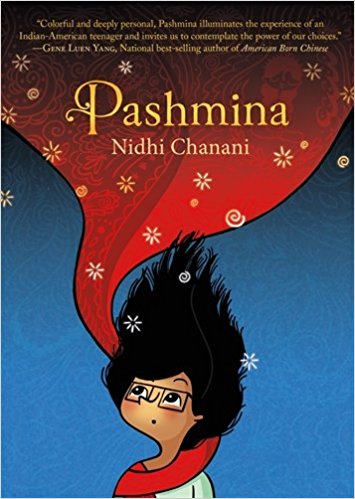
Pashmina by Nidhi Chanani is a graphic novel about a young Indian-American teenager Priyanka, growing up in America, where she lives alone with her mother. She has plenty of questions about India and her father. Her mother gives her information as and when she feels it necessary otherwise manages to evade them. One day at home she discovers a Pashmina shawl, beautifully embroidered. It falls out of the cupboard. Priyanka is enthralled by its beauty and wraps it around herself. When she does her world transforms and she is transported magically to a different world, represented colourfully in the plates which are otherwise black and white. These magical interludes in her life only strengthen Priyanka’s resolve to visit India and find out more about her roots. Despite her mother’s resistance she is able to book a flight to India by using the prize money she won at an art competition. While in India she discovers the truth about her identity, her mother’s decision to migrate and the history behind the shawl.
Pashmina is a beautiful coming-of-age story much like the desilit of nearly two decades that had suddenly become popular except in this case the format is graphic, a generally more acceptable form of storytelling nowadays. Having said that there is a statement on the glossary page saying “Traditionally, the term ‘pashmina’ is associated with shawls that are made from very fine Kashmiri wool. However, in this book, pashmina refers to the embroidered silk shawls that are woven in Nagpur, Maharashtra. ” Even though this clarification has been printed in the book it is misleading to have an entire story which is ostensibly set in America and western Indian state of Maharashtra to have the shawl and its title taken from the state of Kashmir, which is in the north. It may not be confusing for those unfamiliar with India, for whom the exoticism of this story will be appealing rather than the details but it is unfair to stretch the creative license of storytelling to transplant the handloom unique to a state to a different region. Handlooms and handicrafts are unique to every region and representative of the cultural identity of the state. It is also an identity that the artisans and others working in this sector for the preservation of handicrafts strive for — particularly in registering Geographical Indicators (GIs)under the TRIPS Act. So books like Pashmina while creating awareness indirectly about the beautiful shawls also cause damage by blurring regional identities in the minds of people who will ultimately be counted upon preserving handlooms. While writing for children and young adults, of impressionable minds, it is imperative that facts are checked, even if the story is purely fictional.
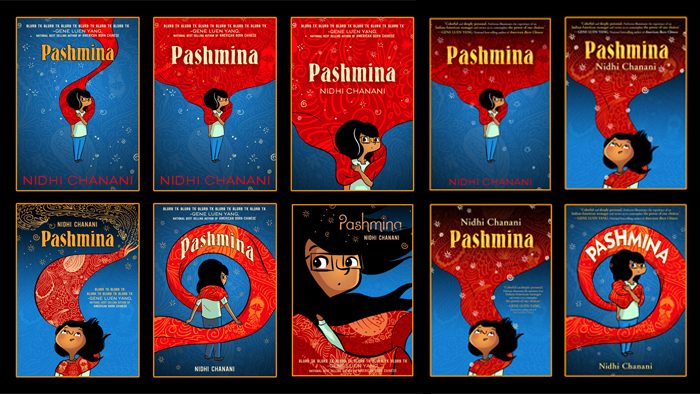
This book has been whispered about and discussed for a while now and its production quality has not disappointed one at all. In fact there is a lovely essay available online by the cover designer on the many avatars his designing underwent before the team selected the final layout.
Be that as it may despite the reservations about the mixed regional identity of the handloom, Pashmina is a lovely introduction to the community of Indian-Americans and the possible questions of identity that plague the younger generations. It is wonderfully represented in the storyline and the artwork. Well worth reading!
Nidhi Chanani Pashmina HarperCollins Children’s Books, an imprint of HarperCollins Publishers, Noida, 2018. Pb. pp. 170 Rs 399
5 May 2018
*Note: All images are off the Internet. If you own the copyright to them please let me know and I will acknowledge it.
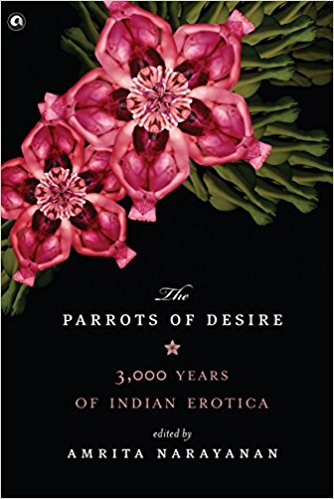
Amrita Narayanan has edited Parrots of Desire: 3,000 Years of Indian Erotica, an anthology consisting of extracts from literature published in India over centuries. There are pieces from Rig Veda; the Tamil Sangam poets; Bhakti poets Antal and Mahadeviyakka, who describe women’s fantasies of men (whether human or godly); short stories by Kamala Das that have been out of print for decades; excerpts from the work of contemporary writers like Mridula Garg, Ginu Kamani, Tarun Tejpal, Deepti Kapoor, Sudhir Kakar et al. It is not as comprehensive in its survey as say the two volumes ofWomen Writing in India were and thus falls short of one’s expectations. Having said that Parrots of Desire is a start maybe to be added to later in a revised edition?
Here is an extract from the opening pages of the well-written introduction published with permission. This section is “Erotic in the Indian Imagination”.
To read centuries of voices writing on the erotic is to become keenly aware of a deep argument that exists in the geography of the subcontinent, an argument between literary romantics—who embrace the erotic for the gloss it adds to life—and religious traditionalists[1]—who caution against the erotic, for its disorderly nature and potential to cause chaos. While romantic and traditionalist voices are unanimous in their belief that the erotic holds an extraordinary power and attraction for human beings, each does something very different with that belief. Romantics are erotically positive: they believe life is made worthwhile by its erotic aspects, that the best life is one in which our understanding and awareness of the erotic are maximally enhanced. Traditionalists, on the other hand, are erotically anxious: they believe that a worthwhile life is one in which the four goals of life[2] are in balance; they do not favour the promotion of the erotic, worrying that if not tightly controlled, the erotic could undermine the other three goals of life. Aficionados of the romantic project used the arts as a vehicle of articulation; their literature, music, drama, even grammar, was thought to be imbued with the erotic and capable of enhancing our understanding of the erotic. Traditionalists used both religious writing and the social contract to articulate the dangers of the erotic, believing that the erotic must be kept on the sidelines, aside from its necessary use as a vehicle for reproduction. Romantics believe that coupling is a central life force, and they appreciate the energy that comes from all couplings, whether man-woman, woman-woman, men who identify as women (and are fantasizing about male gods), or (wo)men with God. Traditionalists believe in the notion of an ‘ideal couple’: heterosexually and monogamously married, with children and extended family in the foreground and a willingness and ability to keep the erotic in the background.
To further understand the argument between traditionalists and romantics, consider a brief history of the time that traditionalism and romanticism have held sway. The purview of this anthology begins about 1000 BCE in ancient India. For the first 800 years or so of this time period, that is, beginning with the Vedas, traditionalist sentiments prevail. During this time, the destabilizing dangers of the erotic are far better articulated in the literature than are its pleasures. From the Vedas onwards, traditionalist literature, which is largely in the form of religious texts, is squarely articulate on the need to manage the destablizing potential of the erotic. Beginning in 200 BCE, however, and continuing for several centuries, literary voices sang the glories of the erotic and their dedication to it—in Tamil, Sanskrit, and Maharashtrian Prakrit. From the second to the sixth century, an Indian literary-erotic-nature idiom was spelt out from Tamil Nadu to Maharashtra and up to Madhya Pradesh. Here the poets embraced the erotic along with its problems, accepting that though the erotic often brought anger, grief and shame, it was still worth embracing for its pleasures. During this medieval period emerged the Tamil Sangam poets and the Maharashtrian Prakrit Gatha Saptasati, the prose and poetry of Kalidasa and Bhartrihari, as well as the Kama Sutra itself. After this golden age of the Romantics, puritanism once again holds sway and the next major erotic work—at least the one that has survived—is the collection of romantic poems known as the Amarusataka, written in Sanskrit in the seventh or eighth century and attributed to King Amaru of Kashmir. From the eighth century onwards there is again a long period in which very few important works have survived, the next set being from the Bhakti poets who compose discontinuously from the ninth to the fifteenth centuries in praise of erotic love with God himself. The fact that Bhakti poets praise erotic love only in language that involves a deity suggests that this was considered the most elegant and refined expression of romanticism at that time. Alternatively, perhaps, the social climate—which by this time included both Hindu and Muslim puritans—did not support an articulation of a more explicit person-to-person erotic love. The taboos on self-expression of erotic love might have impinged particularly on women poets and the re-direction of this love to the divine might have spared them the censorship that might have otherwise been forthcoming. Another way of thinking about it is that, dispirited with the limitations of romantic love between humans, some of these poets were able to find a more elevated idiom with the gods.
Following the Bhakti period, the proliferation of the Urdu language and the culture of refinement associated with Islamic courtly love played an important pro-romantic influence; but as the Hindu and Muslim puritans were joined by the British puritans in the seventeenth century, one has the sense that romanticism was very much in the dark ages. Nevertheless, important works continued to emerge in a more scattered fashion. Amongst these individual works are those written by courtesans, such as the Telugu Radhika Santawanam (The Appeasement of Radhika) by Muddupalani, in the eighteenth century. Another is the erotic proponent of the Lucknow school of poetry, Qalandar Bakhsh Jur’at, known for his bawdy yet spiritual imaginings of women in sexual union. As the reader advances towards and past the twentieth century, individual writers offer an exploration of contemporary erotic problems alternating with the past. Contemporary Indian writers who match and build on the efforts of their ancestors write in, among other languages, English, Tamil and Malayalam, and continue to shed profound light on the erotic. In this anthology the contemporary writers I have chosen include those who have made a searing commentary on the relationship between kama and society: Perumal Murugan, Kamala Das; those whose reverential treatment of the erotic couple recalls the glorious medieval period: Pritish Nandy, K. Satchidanandan, Tarun Tejpal; writers like Manto and Ambai whose erotic-nostalgic writings make us feel lustful and tender at once; modern Bhakti poets like Arundhathi Subramaniam and Kala Krishnan Ramesh; and those who have treated in great depth the extraordinary conflicts that the erotic poses for an individual life: here found in the works of Mridula Garg, Deepti Kapoor and Ginu Kamani
[1]I chose the word traditionalist and not puritan because of the historical origins of puritanism that are not pertinent to India. However I thought it worth mentioning that the traditionalist argument is close in nature to the puritan argument. Here puritan is used in the sense of against pleasure, see for example, H. L. Mencken, who sardonically defined Puritanism as ‘the haunting fear that someone, somewhere may be happy’.
[2]The four aims of life (purusharthas): artha (wealth), kama (desire), dharma (duty) and moksha (salvation from the cycle of life and death).
Amrita Narayanan ( ed.) Parrots of Desire: 3,000 Years of Indian Erotica Aleph Book Company, New Delhi, 2017. Hb. pp. 304
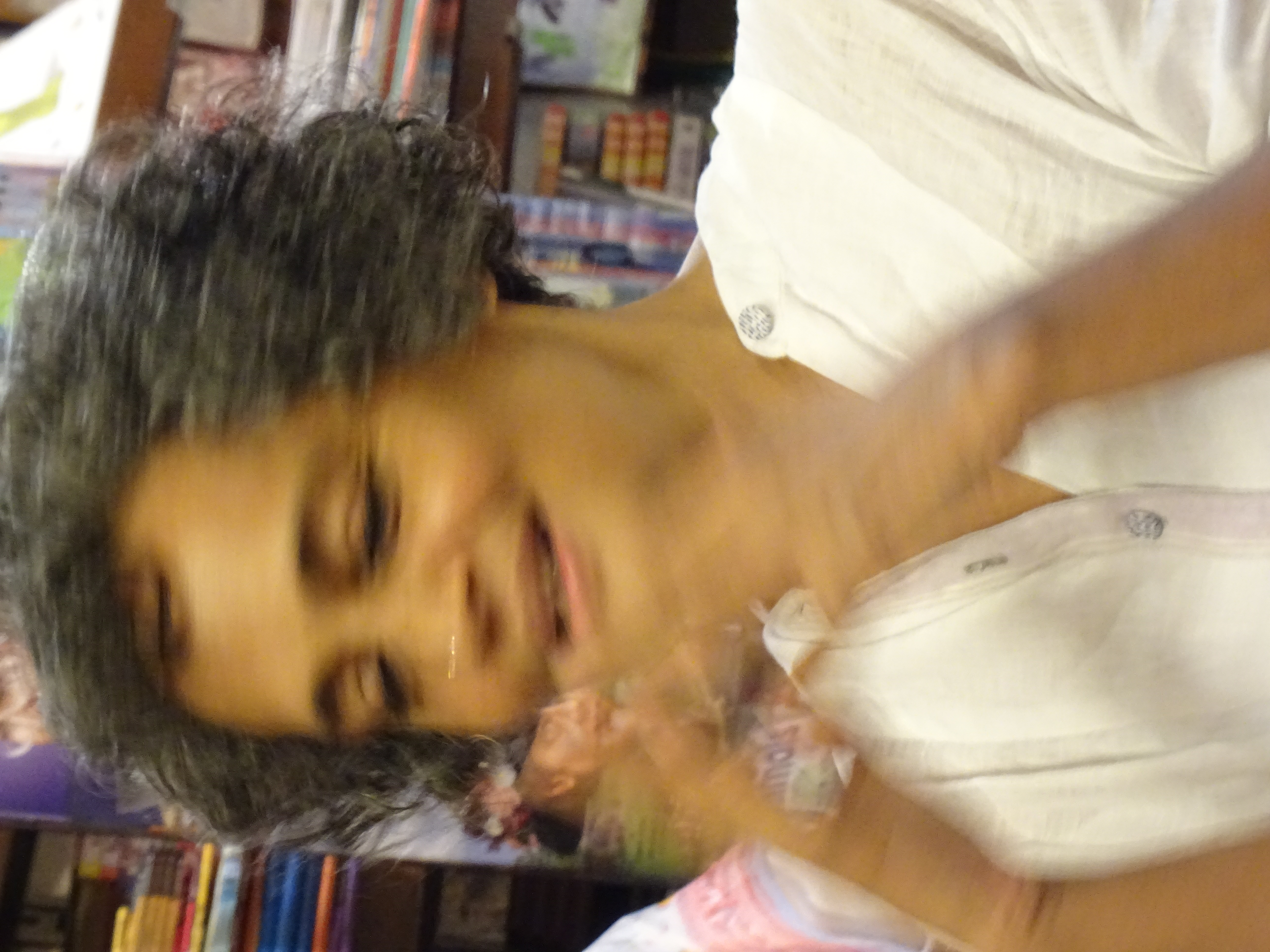
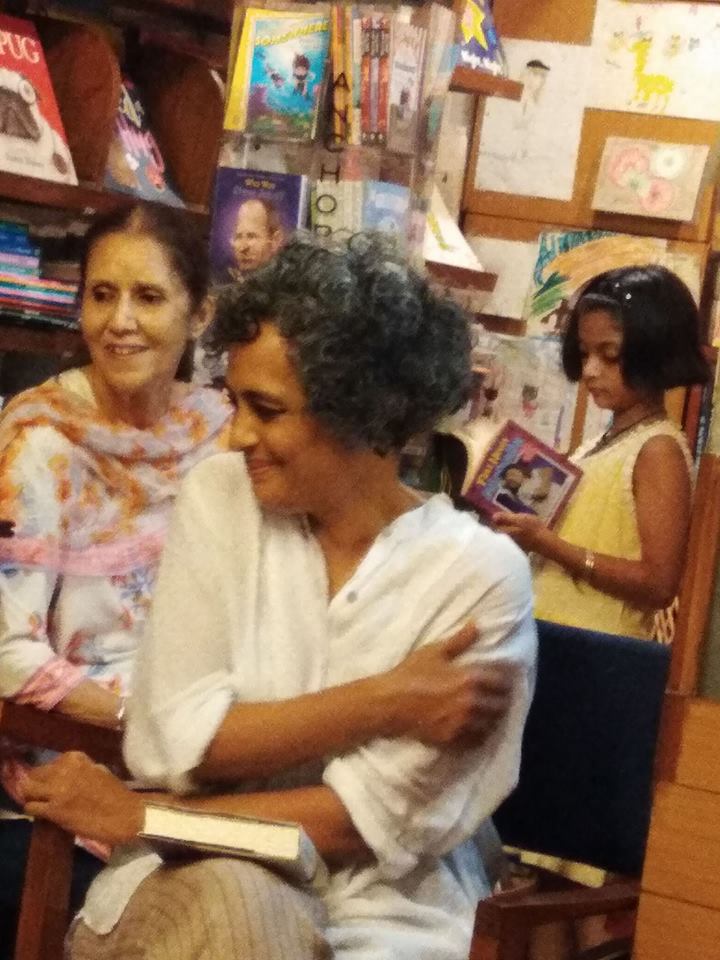
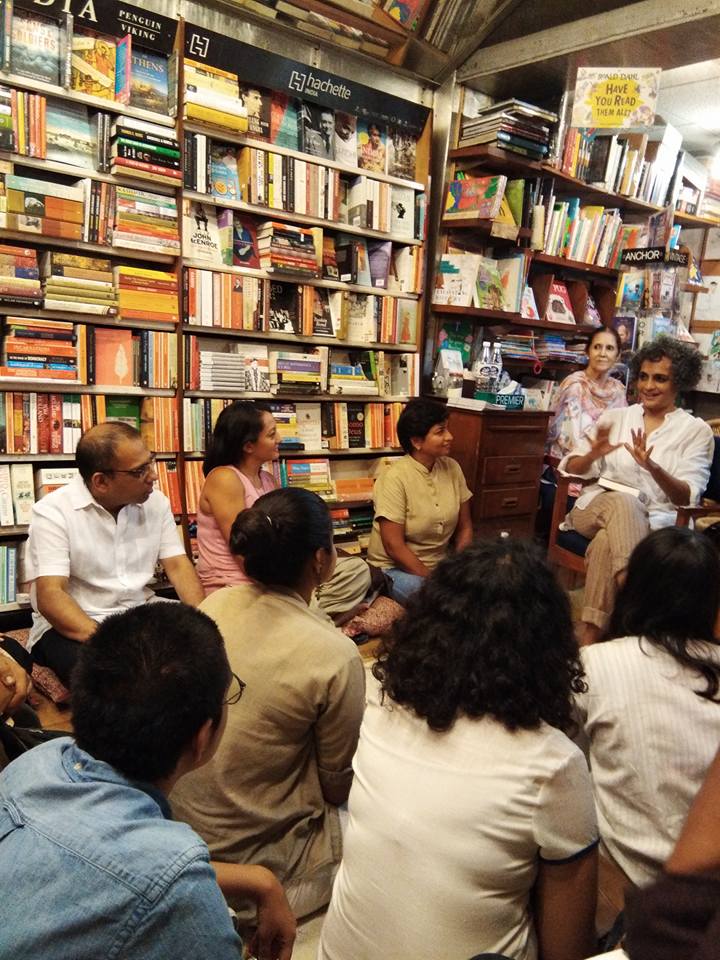
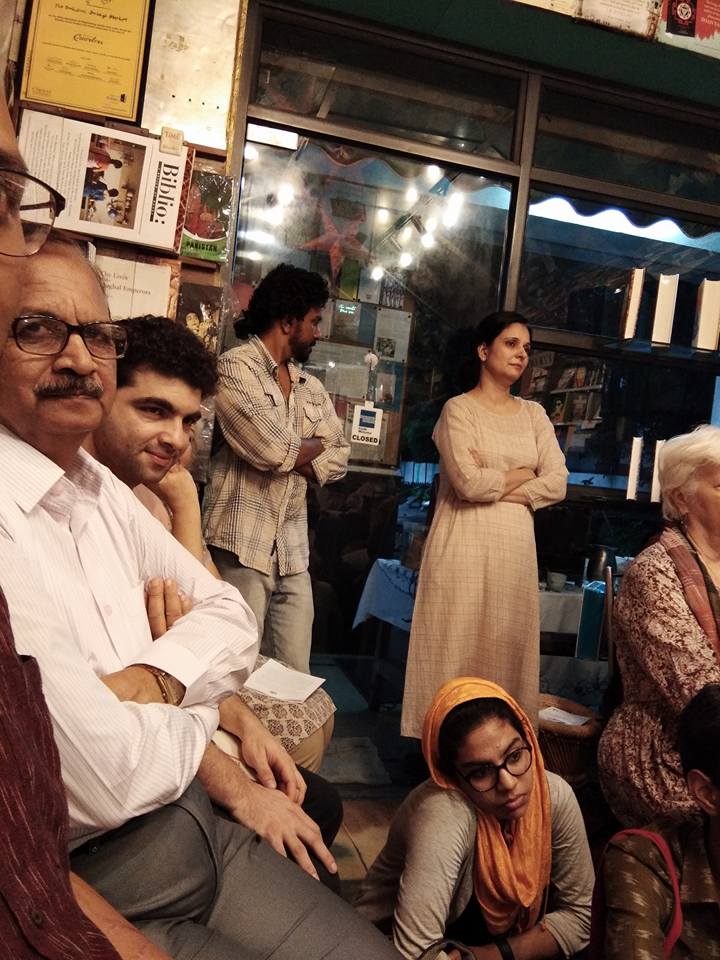
On Friday 25 August 2017 The Bookshop held a lovely interaction with award winning writer Arundhati Roy. The Bookshop is a warm space that magically transforms a literary evening into an electric engagement. Personal invitations had been sent to the select audience. There was no structure to the event which was a pleasure.
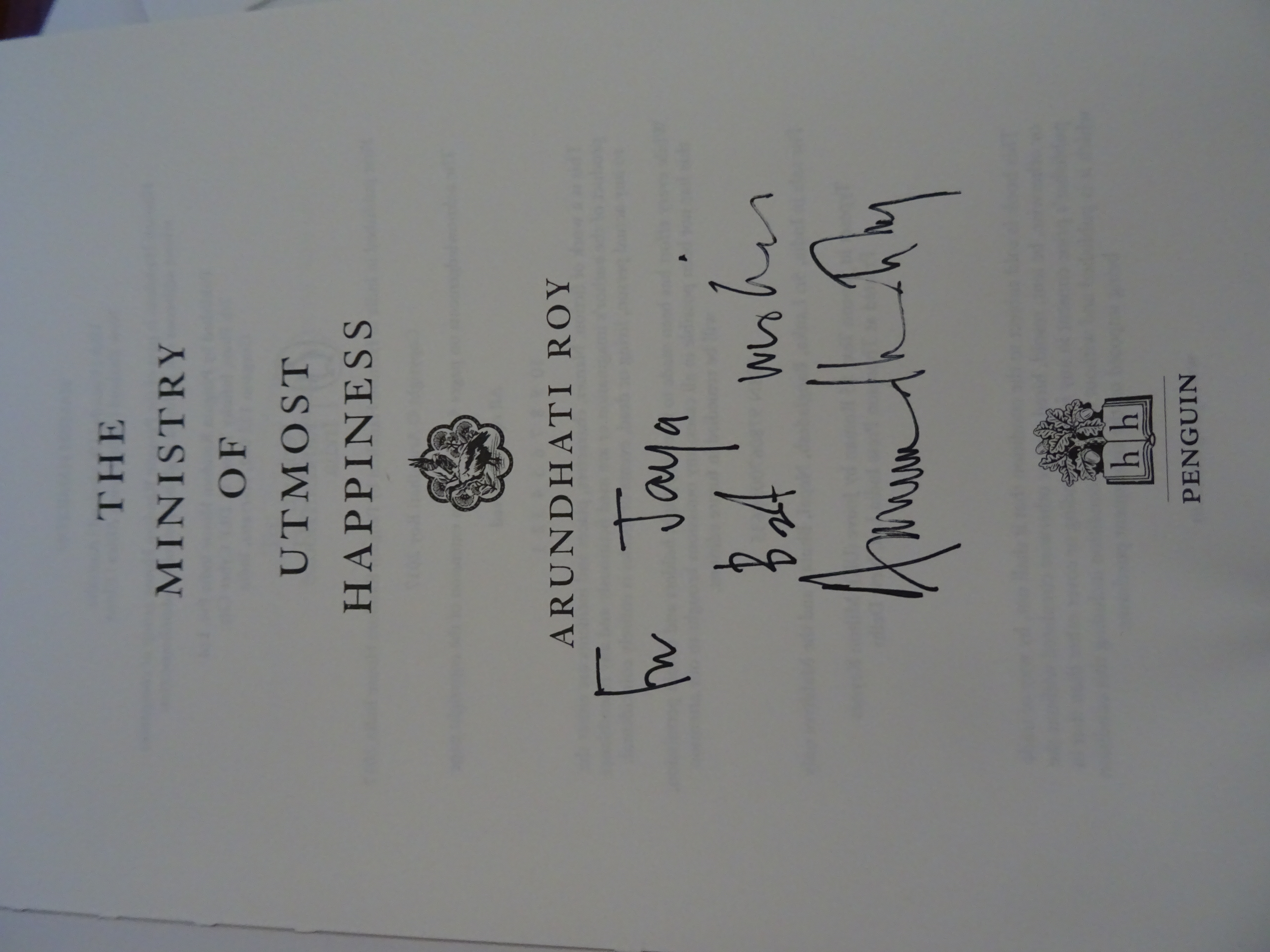
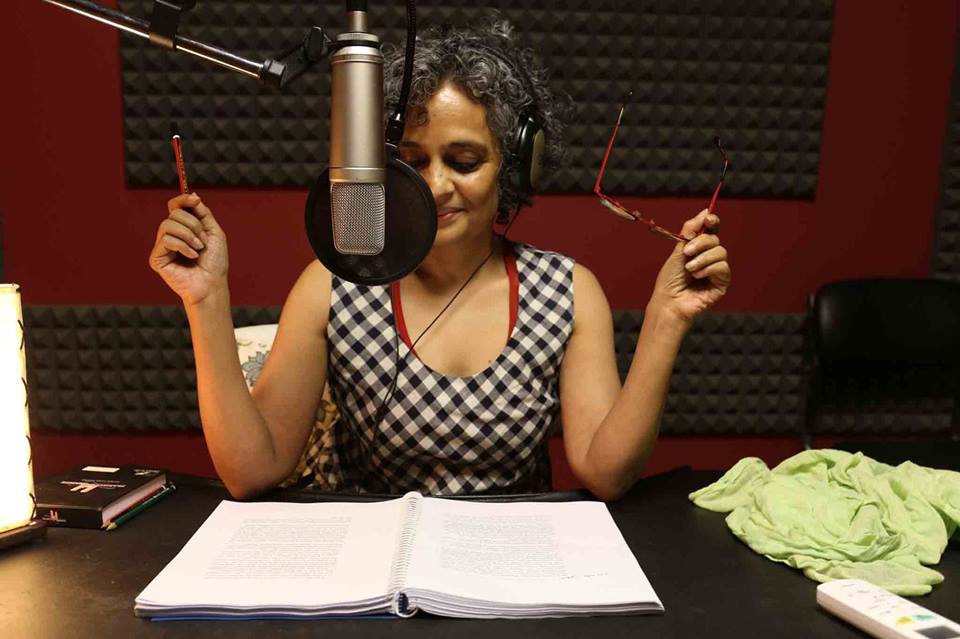
Arundhati Roy plunged straight into a conversation. She began the evening remembering the late owner and legendary bookseller K. D. Singh. She then read a long passage out of her novel The Ministry of Utmost Happiness . Hearing an author read out from their own novels is an unpredictable experience but in this case turned out to be extraordinary. Despite the novel being varied and politically charged in many places, reading it alone, a reader tends to respond to the text. Listening to Arundhati Roy narrate it last night was revelatory as she has a soft lilt to her voice which brings out the rhythm and structure of the storytelling, softpedalling to some extent the political punch, but never undermining. Hearing her read out aloud was like being lulled into a level of consciousness where the magic of storytelling overtook one and yet once it is was over it was the politically charged experience of the episode from Kashmir which she chose to narrate that lingered on. It probably would be worth getting the audiobook which the novelist has recorded herself. On the left is a picture taken by Mayank Austen Soofi and tweeted on 17 May 2017 by Simon Prosser, Publisher, Hamish Hamilton, Penguin Random House. On 24 August 2017 a digital companion to the novel was released called the Re: Reader. It is being hosted on a website of its own. According to the report in the Hindu, “The Re:Reader can be accessed on a smart phone by logging on to its website. The visitor is greeted by a ‘floating menu’ of different chapters, each with its own set of animated icons, sound effects, music, and a carefully chosen excerpt.
“Re:Reader has snippets of text from the 12 chapters of the book. Animations show the text in a new light; music brings the period to life, and with portions read by Arundhati Roy, it makes for a dreamy, heady ride. But none of these bits of ‘media’ are presented as ‘content’ for independent consumption. They are there to tempt, to intrigue, to transport the viewer to the Utmost world, not to reveal or substantially replace it.” Later this innovative reading experience may be converted into an app.
At The Bookshop interaction Arundhati Roy mentioned how when she writes fiction she does not let anyone, including her literary agent David Godwin, know that there is a work in progress as she is unable to handle the questions about when it will be ready for submission. Also knowing full well that once she hands over a manuscript there is frenzied activity and she needs to be prepared for it. Interestingly when the manuscript of this novel was finally completed to her satisfaction she lay down on her couch and wept for hours.
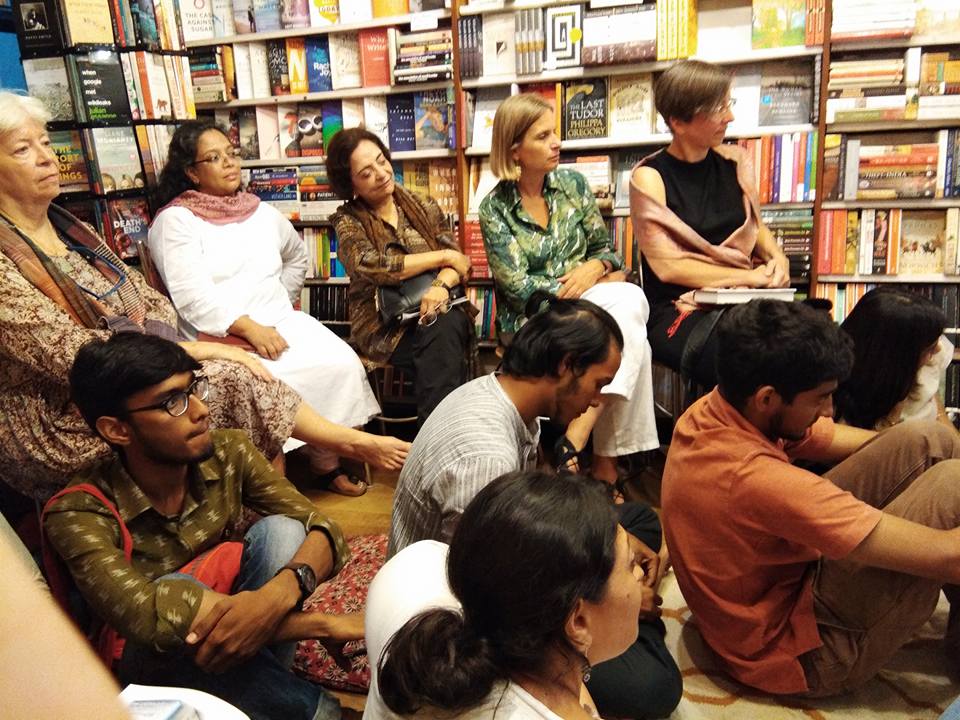
Given the small group sitting in a circle around and at the feet of the author made for a lovely intimate gathering allowing for conversation to flow easily. Sure there were many in the audience who were awe-struck by the celebrity they were enagaging with and yet the vibes were peaceful. It was an evening where Arundhati Roy shared insights about her writing and editing process, some of which I scribbled down in my edition of the novel.
There are many parts of the book which need a book of their own.
This book is fiction as much as my first novel The God of Small Things was. I use every part of myself to write fiction. Experience informs your writing. Fiction is trying to create a universe which if it were unreal what would be the point of creating it?
When asked if it was an “autobiographical novel” she said “What is an autobiography? These questions do not matter if this autobiographical or the truth. The character in fiction is more real and eternal than the real person.”
While writing fiction my body feels very different. With non-fiction there is a sense of urgency. In fiction I am just at my own speed. It is almost like cooking — it takes as much time as it takes.
When asked about editing her manuscripts she replied “ I don’t draft and redraft sentences which some people attribute to arrogance. I think of structure and characters take their own time to deepen. These are people I want to be able to spend rest of my life with. I don’t write sequentially. I already have a sense of it. It is a combination of control and release.”
On the structure of this novel she said: “This book is much more complexly structured. It is like a big metropolis in the fluid world. It has its old parts and its pathways. It has its democracy. The crowds have faces in it. When you see the narrative as a city then you are going down blind alleys.”
On writing: “The way things are here and now I would not want to write it scared. Just write.” She added ” Factual knowledge has to be charged. My instinctiveness works the best for fiction.”
On the parallels being drawn between Anjum and Mona ( made famous by Dayanita Singh’s photographs), she said “Anjum is not Mona but she is in Mona’s situation. Mona is definitely not a political person unlike Anjum.”
Arunava Sinha, journalist and established Bengali to English translator, posed an interesting question to Arundhati Roy. He asked if she had had any interesting questions from her translators. Apparently the Polish translator has been flummoxed by sentences such as “evil weevil always make the cut” whereas the French translator has found the “Acknowledgements” the toughest such as “who queered my pitch”. As for the Hindi and Urdu translations she is working upon them line by line.
While discussing her author tours as was done over summer she says she felt as if she herself was a tourist living in Jannat for she visited 20 cities in the space of 24 days. Surprisingly she returned home with no jet lag whatsoever! The reception to her book has been tremendous and she has been reading and promoting the book to packed audiences. In Buffalo, for instance, she was to address a 1000-strong audience and surprisingly not a single copy of the book was sold at the venue since every single member of the audience was carrying their very own dog-eared copy of the novel. Another anecdote was about Kashmir which forms a large part of this novel since “you cannot tell the story of Kashmir in a footnote”. She has recently returned from a visit to the state where she met Khan Sahib, an old friend, who had scribbled in his copy of the book extensively with comments trying to figure out the references in the book. What was even more incredulous were the visitors she had coming by all night asking her to autograph their editions of the book.
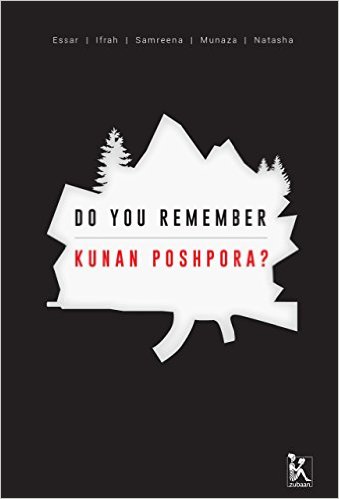
In the week when Kashmir is burning after the death of twenty-one-year-old Burhan Wani or as he is being referred in Indian media as “the poster boy of new militancy” ( http://bit.ly/29BWjgf ) it would be sobering to read Do You Remember Kunan Poshpora? Published by Zubaan in March 2016 it is about the mass rape of women and the brutal sexual torture of men in the twin villages of Kunan and Poshpora by soldiers of the Indian Armed Forces. The book also includes the text of the confidential report of the then Divisional Commissioner Kashmir Wajahat Habibullah (along with the deleted paragraphs). Since the book was published there were more developments in the case but could not be included in the publication.
I am posting extracts from the book. The sequencing is mine.
While I was composing this blog post noted human rights lawyer Vrinda Grover posted on Facebook the following:
Our silence, as young protestors are being killed in Kashmir and many severely injured, is suffocating me.
Kashmir is a political dispute and needs a political engagement. We must protest and demand an end to this militarisation. After the 2010 killings of over 112 persons by security forces in Kashmir, 4 of us – Sukumar Muralidharan, Bela Somari and Ravi Hemadri and myself – traveled across Kashmir visted the families of those killed and the wounded. We documented the excessive and indiscriminate use of lethal force against unarmed protestors that led to the grievous loss of life; the pellet gun and catapults that caused blindness and multiple organ injuries; the hospital in Patan that was attacked by the CRPF where injured were being treated and a child shot dead in the hospital premises; children like Tufail Mattoo and Sameer Rah were killed. No FIR was ever lodged and no one was held accountable for these killings. https://kafila.org/2011/03/26/four-months-the-kashmir-valley-will-never-forget-a-fact-finding-report/
Death has rolled its dice again.”
“We knew that if we remained silent, they would do it again, if not in our village then somewhere else.” — A survivor
This book is that you are about to read is unusual, special and quite extraordinary. It spans, traverses and tracks a long passage of time — 24 years — during which the truth of the mass rape of women and the brutal sexual torture of men in the twin villages of Kunan and Poshpora by soldiers of the Indian Armed Forces, was sought to be distorted, denied or buried by the Indian state and its many agencies. When a truth of this nature and magnitude is thus treated or suppressed, the quest for justice is boosted not only amongst the victims / survivors but also amongst large sections of the population; women and men, none of whom is unscathed or untouched by the mass violence surrounding them. They are in fact, witnesses.
Many have grown up in the midst of this violence; the myriad forms it takes, the fear and terror that it unleashes on a daily basis, the lies and lawlessness of the state; be it on a street or one’s home — it is their lived experience. So it is with the five young authors of this book. They were either not born or just born at the time of the ‘incident’ in early 1991.
When I met these young women in the summer of 2013 ( at the office of JKCCS, the Jammu and Kashmir Coalition of Civil Society) in the course of my own work on sexual violence and impunity in J&K, each one of them was poring over various documents in English or Urdu in files that were scattered open; these were the documents that told and corroborated the ‘story’ of the mass rape in Kunan and Poshpora that JKCCS had accessed through several RTIs ( right to information) that they had filed in different government departments. There were also records of the victims’ / survivors’ testimonies that these young women had procured over a period of time. I was struck by the number of documents and the amount of information that was there, it reminded me of how different it was compared to fifteen years ago when hardly any information was available, either official or unofficial, particularly regarding sexual crimes/rape. Silence and fear had prevailed then but here were these young women fearlessly articulating the problem and determined to fight the state authorities for justice and accountability.
I was curious to know what had inspired them to look into a ‘case’ that took place so many years ago, even before some of them were born. What prompted them to take on this arduous journey, to undertake their frequent travels to Kupwara where these two villages are located? How did they manage to gain the trust and confidence of the victims / survivors such that they were willing to share their stories yet again, this time with a group of young, concerned women? One of them voiced it poignantly and succinctly: when a young woman physiotherapy student was gang-raped in a moving bus on the streets of Delhi in December 2012, the outrage among people was such that the entire country erupted into militant protests that demanded justice for the victim and punishment for the accused. How come the frequent rapes in J&K by the armed forces do not move the same Indians to protest this crime, not even when it is a mass rape of women as in Kunan and Poshpora? ‘We decided’, she told me, ‘that we have to raise our voice and wage our own struggle against such crimes. If we don’t, no one else will.’
This sentiment is reflected in the book when the authors ask: Is rape in India punishable but rape in Kashmir justifiable when committed by the men in uniform, the protestors of India’s honour in Kashmir? Is this the typical ‘face’ or attitude of the Indian authorities — of burying the truth and denying Justice? ‘In Kashmir, Justice is a hard thing to find’ say the authors at one point, reminding me of what a Sri Lankan woman in one of the IDP camps had once told me, ‘Justice is a dark room for us’.
…
The authors thus began to excavate the truth, by sifting it through a web of lies and botched-up investigations, by painstakingly building a bridge of trust and hope between the victims / survivors of Kunan Poshpora and the various courts of law where justice is meant to be dispensed.
These women were instrumental in re-opening the Kunan Poshpora case and demanding that it be re-investigated. They mobilized nearly a hundred women from different walks of life including a few women from their own families. Fifty of them joined these young women to file a PIL ( Public Interest Litigation ) at the lower court in Kupwara in 2013, even though the case had been closed as untraced by the JK police in 1991.
…
( From the ‘Preface’ by Sahba Husain. pp xxiii – xxvi)
The Sexual Violence and Impunity Project ( SVI) is a three-year research project, supported by the International Development Research Centre ( IDRC), Canada, and coordinated by Zubaan. Led by a group of nine advisors* from five countries ( Bangladesh, India, Nepal, Pakistan, Sri Lanka), and supported by groups and individuals on the ground, the SVI project started with the objectives of developing and deepening their understanding on sexual violence and impunity in South Asia through workshops, discussions, interviews and commissioned research papers on the prevalences of sexual violence, and the structures that provide immunity to perpetrators in all five countries.
…
Our discussions began in January 2012, when a group of women from South Asia came together in a meeting facilitated by a small IDRC grant, to begin the process of thinking about these issues. We were concerned not only at the legal silences around the question of sexual violence and impunity, but also how deeply the ‘normalization’ of sexual violence and the acceptance of impunity, had taken root in our societies.
It became clear to use that women’s movements across South Asia had made important contributions in bringing the issue of sexual violence and impunity to public attention. And yet, there were significant gaps, …
Over the three-year period since this project began, there have been amendments in the criminal law of India and the definition of sexual assault has expanded, we have gained considerable grounds in our understanding on impunity for sexual violence and consequently are better able to speak about it and fight for justice. It is noteworthy that during the recent targeted violence in Muzzafarnagar in India in 2013, seven Muslim women who were brutally gang raped and sexually assaulted by men belonging to other communities, filed writ petitions for protecting their right to life under Article 21. In a landmark judgement in March 2014, recognizing the rehabilitation needs of the survivors of targeted mass rape, the Supreme Court of India ordered that a compensation of INR 500,000 each for rehabilitation be paid to the women by the state government.
The ‘Occupy Baluwatar’ movement of December 2012 which some see as the ripple effects of the Delhi protests against sexual violence and demands for justice, had sexual violence and impunity at its centre. One of the major outcomes of the movement was the 27 November 2015 amendment broadening the definition of rape, bringing same-sex rape and marital rape into the ambit of law.
In Pakistan too, small steps forward were taken in the shape of a parliamentary panel approval in February 2015 of amendments in the anti-rape laws, supporting DNA profiling as evidence during the investigation and prohibition on character assassination of rape victims during the trial. …
The eight volumes ( one each on Bangladesh, Nepal, Pakistan and Sri Lanka, two on India, and two standalone books on impunity and on an incident of mass rape in Kunan Poshpora in Indian Kashmir) that comprise this series, are one of the many outcomes of this project. The collective knowledge built on the subject through workshops, discussion fora, testimonies and interviews is part of our collective repository and we are committed to making it available to be used by activists, students and scholars. …
( From the Introduction by Urvashi Butalia, Laxmi Murthy and Navsharan Singh. pp ix – xviii)
*The nine advisors are: Ameena Mohsin, Hameeda Hossain, Kishali Pinto Jayawardena, Kumari Jayawardena, Mandira Sharma, Nighat Said Khan, Saba Gul Khattak, Sahba Husain, Sharmila Rege and Uma Chakravarti.
Essar Batool, Irfah Butt, Samreena Mushtaq, Munaza Rashid, & Natasha Rather Do You Remember Kunan Poshpora? ( Introduction by Urvashi Butalia, Laxmi Murthy and Navsharan Singh) Zubaan Series on Sexual Violence and Impunity in South Asia co-published with IDRC, Zubaan, 2016. Pb. pp. 250. Rs. 395
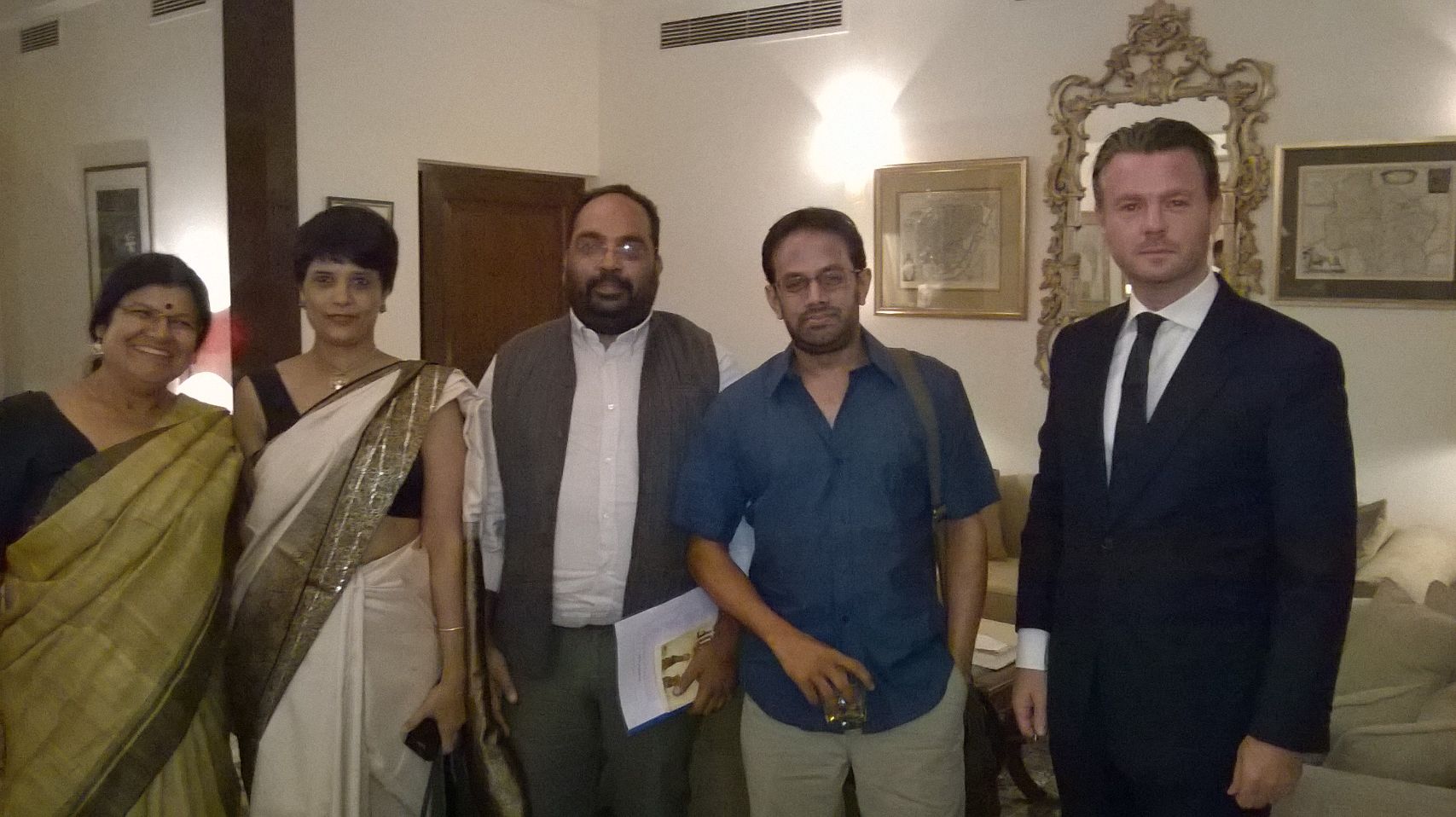
On Thursday, 16 Oct 2014, H.E. Ambassador Feilim McLaughlin of Ireland hosted a literary soiree at his residence. It was organized to commemorate the centenary of World War I. The event consisted of an exhibition on the Irish poet W.B. Yeats and a panel discussion on “Conflict and Literature”. The panelists were three Indian authors/journalists—Paro Anand, Samanth Subramanian and Amandeep Sandhu and the discussion was moderated by Ambassador McLaughlin. Ambassador of Ireland Feilim McLaughlin said the event was intended to explore the role of the writer in portraying or interpreting conflict, drawing parallels between the experience in Ireland and South Asia. The evening was curated by Jaya Bhattacharji Rose.
Panel discussion on “Conflict and Literature”, moderated by H.E. Ambassador Feilim McLaughlin
It was a one-of-a-kind evening with the lovely ambience and Irish music playing in the background. The three panelists were authors who had lived, worked with or interviewed persons in conflict zones in different parts of South Asia. Their personal stories and reading of relevant portions from their published works were straight from the heart. The invitees were handpicked. The three Indian authors who spoke were Paro Anand whose YA novel No Guns at My Son’s Funeral is being turned into a film; Amandeep Sandhu, author of the critically acclaimed testimonial fiction Roll of Honour and Samanth Subramanian who has recently published The Divided Island, reportage from Sri Lanka. The select audience were mesmerized silent by the readings and interaction of the authors. Several shed a tear or two. Most had a lump in their throat. The topics or narrated experiences hit a raw chord in many, especially those with a background or family from Partition, ’84 riots and communal conflicts. Author, Dr Kimberley Chawla says, “In this day and age, one tends to forget or ignore conflict past or present that may be occurring just a few hundred kilometres away, but it continues to be relevant. This literary event brought it right back home and reminded all present how lucky we were to have what we have and that we or our families managed to survive.” Many in the audience were seen congratulating the Irish embassy for pulling off such a topic which actually left the audience sentimental and empathic and there were no accusatory or aggressively political arguments or comparisons with other countries. Remarkably there was pin drop silence throughout the event.
Keki Daruwalla, Novelist, Poet and Chairperson, DSC Literature Prize 2014: “I feel it was a very fine evening. The Ambassador Mr. Feilim McLaughlin had done his homework. (One normally doesn’t see Their Excellencies getting into the nitty-gritty of a cultural event). The mix was perfect with Paro Anand speaking of the handicapped children. It was very moving. Amandeep Sandhu spoke of 1984. Wish he had read more from his book.”
M. A. Sikandar, Director, NBT ( National Book Trust of India) “A wonderful evening with Authors who highlighted the flip side if real India. I amazed by the intense of reading by these authors who are from diverse background and culture. Credit goes to the Irish Ambassador and Jaya.”
Paro Anand : “Trying to make sense of a long ago war through today’s conflicts brought three writers together. IN the peace of Delhi’s Diplomatic Enclave, we wove words of wars and conflicts that do and don’t belong to us….each telling of our engagement with wars without as much as within. It was a journey that none of us would choose to make, but most of us have to.”
Amandeep Sandhu: “it was a brilliant evening curated by Jaya Bhattacharji Rose and hosted by the Irish Ambassador. I loved that I could meet and converse with a variety of writers, artists and people. I hope we have more such events in which we can discuss art and literature which is relevant to our times.”
Samanth Subramanian: “The event was a wonderful way to discuss the specificities of some conflicts, with the knowledge throughout that all conflicts have so much that in common. Even as we remember the hundredth anniversary of the beginning of the First World War, we find its themes playing out in the world around us today.”
Paro Anand is one of India’s top writers. Best known for her writings for young adults, she has always pushed boundaries and challenged preconceived notions of the limits of writings for young people. She has been described as a fearless writer with a big heart. She works extensively for young people in difficult circumstances, especially with orphans of separatist violence in Kashmir. Using literature as a creative outlet, she provided a platform for the traumatized young to express their grief in ways that they had been unable to before. This release gave them the ability to move beyond and look into their future, instead of staying frozen in their very violent past. One of the over-riding feelings she came away with was the need to tell these stories to a wider audience and thus bring the alienated back into the mainstream consciousness.
Samanth Subramanian is a New Delhi-based writer and journalist. He has written op-eds and reportage for the New Yorker, the New York Times and the Wall Street Journal, and book reviews and cultural criticism for the New Republic, the Guardian and Book forum. His first book, a collection of travel essays titled “Following Fish: Travels Around the Indian Coast,” was published in India in 2010 and in the United Kingdom in 2013. “Following Fish” won the Shakti Bhatt First Book Prize in 2010 and was shortlisted for the Andre Simon Book Award in 2013. Subramanian received a Bachelor’s degree in journalism from Pennsylvania State University and a Master’s degree in international affairs from Columbia University. He has lived in the United Kingdom, India, Indonesia, the United States and Sri Lanka. “This Divided Island: Stories from the Sri Lankan War,” his second book, was published in July.
Amandeep Sandhu is currently a Fellow at Akademie Schloss Solitude, Stuttgart, Germany (2013-15) working on his third novel which deals with how art shapes the historiography of a land. His Master of Arts, English Literature (1994-96) was from the University of Hyderabad and Diploma in Journalism (1997-98) from the Asian School of Journalism. In the late 1990s he was a journalist with The Economic Times. He has been a Technical Writer with top Information Technology companies for more than a decade: Novell, Oracle and Cadence Design systems. Over the last few years he has been actively reviewing books for The Hindu, The Asian Age, The Indian Express, BusinessWorld and writing a column in Tehelka on issues related to Punjab.