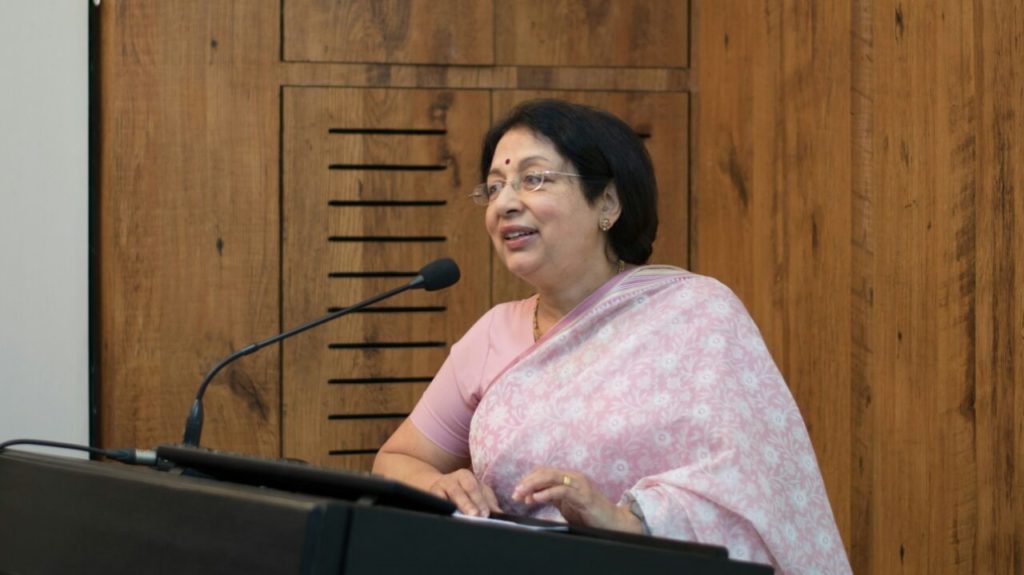
Anjali Nerlekar is Associate Professor at Rutgers University, and coeditor of Modernism/ Modernity. Most recently, she co-edited the Oxford Handbook of Modern Indian Literatures in 2024. She is the author of Bombay Modern: Arun Kolatkar and Bilingual Literary Culture (NUP, 2016; Speaking Tiger, 2017), and has also coedited a special double issue of Journal of Postcolonial Writing on “The Worlds of Bombay Poetry” and a special issue of South Asia: A Journal of South Asian Studies on “Postcolonial Archives.” She also continues the work of building “The Bombay Poets’ Archive” at the Rare Manuscripts Collection at Cornell University. Her research interests include Her research interests include multilingual Indian modernisms; modern Marathi literature; Indian English literature; Indo-Caribbean literature; translation studies; Caribbean and postcolonial studies; and Indian print culture.
Ulka Anjaria is Professor of English and Barbara Mandel Professor of Humanities at Brandeis University. She is also Director of the Mandel Center for the Humanities at Brandeis. Her research interests include South Asian literature and film, realism, and the global novel. She is the author of Realism in the Twentieth-Century Indian Novel: Colonial Difference and Literary Form (2012), Reading India Now: Contemporary Formations in Literature and Popular Culture (2019), and Understanding Bollywood: The Grammar of Hindi Cinema (2021), along with essays and chapters in several journals and volumes. She is the editor of A History of the Indian Novel in English (2015) and co-editor (with Anjali Nerlekar) of The Oxford Handbook of Modern Indian Literatures (2024). She is currently working on a monograph tentatively titled Bad Mothers, on gender, caste, and modernism in 20th-century Indian literature.
Recently, they co-edited The Oxford Handbook of Modern Indian Literatures (Oxford Handbooks), published in India by Oxford University Press.
The Oxford Handbook of Modern Indian Literatures refutes the Anglocentrism of much literary criticism of the global South by examining “Indian Literature” as a multilingual, dialogic, and plural space constituted by both continuities and divergences. In forty-three chapters and with a team of scholars who exemplify the method of historically situated and theoretically rigorous literary criticism, this volume shows how the idea of Indian literature is a relational and comparative concept. Through readings of a vast diversity of multilingual literature in a range of genres, the chapters highlight contact zones and interchanges across seemingly sedimented boundaries. The Handbook provides an overview of the current state of modern Indian writing and features a range of texts and approaches from across India’s many languages and literary traditions, examining and amplifying recent critical attention to the multilingualism that is at the base of any curation of what could be termed, with qualification, “Indian Literatures.” The book ranges from the 19th century to the 21st, with especial focus on the centrality of gender and caste to Indian modernism and new generic formations such as graphic novels, autofiction, and videogames.
It was a pleasure speaking with the two professors on TOI Bookmark. Here is a snippet from the conversation:
One of the conversations we had when we went to India and talked to students about this book in September [2024], one of the questions students had was how can you subsume, and this was an example, how can you subsume Tamil Modernism under India? So we tried to explain as if we already know the term what India is? But in the actual chapters and in the actual work follows, its gets queried, dismantled, reformulated. For example, Tamil Modernism or the question of Tamil is featured here but then we also talk about Tamil in Sri Lanka and Tamil in Singapore. A chapter goes across India and Singapore. The border, contact zones of the borders is another concept that we always kept in mind. This idea of relationality and contact zones from which we started looking at the idea of what it is that is Indian or what that it is modern for example?
Listen to it on Spotify:
TOI Bookmark is a weekly podcast on literature and publishing. TOI is an acronym for the Times of India (TOI) which is the world’s largest newspaper and India’s No. 1 digital news platform with over 3 billion page views per month. The TOI website is one of the most visited news sites in the world with 200 million unique monthly visitors and about 1.6 billion monthly page views. TOI is the world’s largest English newspaper with a daily circulation of more than 4 million copies, across many editions, and is read daily by approximately 13.5 million readers. The podcasts are promoted across all TOI platforms. I have recorded more than 138+ sessions with Jnanpith, Padma Bhushan, and Padma Shree awardees, International Booker Prize winners, Booker Prize winners, Women’s Prize for Fiction, Nobel Laureates, Pulitzer Prize, Stella Prize, AutHer Awards, Erasmus Prize, BAFTA etc. Sometimes the podcast interviews are carried across all editions of the print paper with a QR code embedded in it.
Some of the authors who have been interviewed are: Banu Mushtaq, Deepa Bhashti, Samantha Harvey, Jenny Erpenbeck, Michael Hoffman, Paul Murray, V. V. Ganeshananthan, Hisham Matar, Anita Desai, Amitava Kumar, Hari Kunzro, Venki Ramakishnan, Siddhartha Deb, Elaine Feeney, Manjula Padmanabhan, NYRB Classics editor and founder Edwin Frank, Jonathan Escoffery, Joya Chatterji, Arati Kumar-Rao, Paul Lynch, Dr Kathryn Mannix, Cat Bohannon, Sebastian Barry, Shabnam Minwalla, Paul Harding, Ayobami Adebayo, Pradeep Sebastian, G N Devy, Angela Saini, Manav Kaul, Amitav Ghosh, Damodar Mauzo, Boria Majumdar, Geetanjali Mishra, Viet Thanh Nguyen, William Dalrymple, Abdulrazak Gurnah, and Annie Ernaux.
Mini
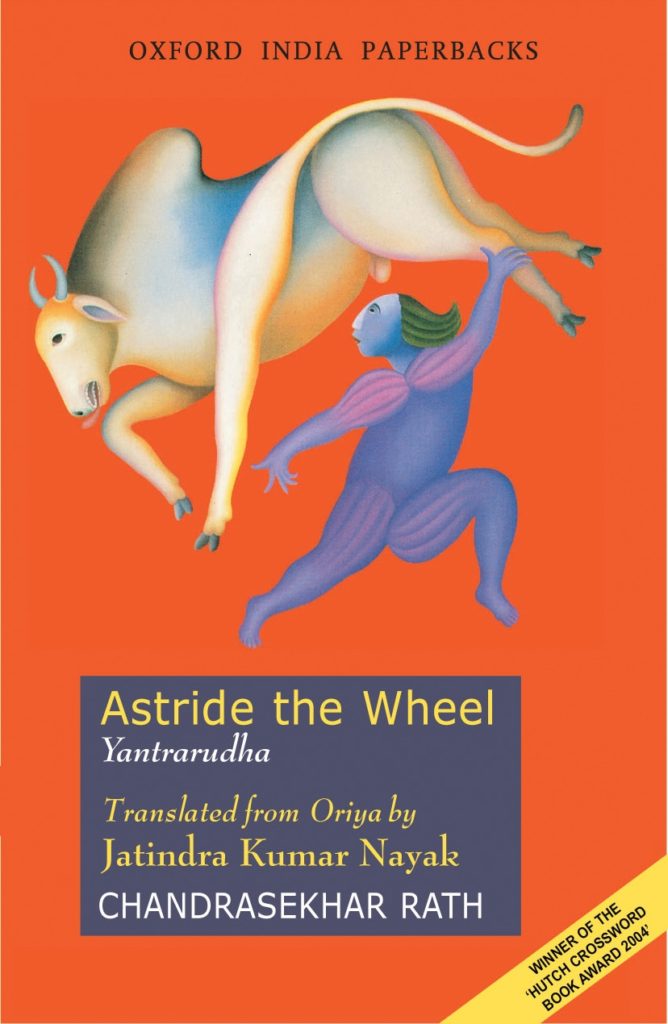
Krishnan worked with Macmillan India (1980-2000) and with Oxford University
Press (2001-2018) to source, edit and promote translations into English of
works by Indian writers from 13 languages many of which won national prizes and
are included in study courses both in India and in universities overseas.
She is currently co-ordinating multiple publishers to build a programme of Tamil-English translations. This is an initiative designed by the Tamil Nadu government and located in their Textbooks and Educational Services division.
1.How did you begin your career as an editor of texts translated from Indian languages into English?
Well…I think
it is fair to say that it began as both an accident and an affinity for things
Indian long submerged by training in English Literature! I always felt a vague
dissatisfaction with the texts I was reading / studying but had no clear idea
of how to access materials written by Indians. Nor how to relate them to what
seemed to be important intellectual tools gained in UG and PG degrees in English
Literature. In the late 1960s-early 70s when I was a student, books were not
that easily available. Because my father was with the Deccan Herald (Bangalore) I got to read the books he received for
review and that was about all. My college and university libraries did not
stock books by Indian authors.
Seven years
after my post-graduation I got an opportunity to freelance with Macmillan India
in Madras. I was put to work on anthologies of prose, poetry, fiction and so
on. Quite dull work really but I kept asking my editor why she couldn’t include
some Indian writers other than Nehru, Sri Aurobindo and Tagore. “The members of
Boards of Studies do not even consider other Indian writers worth teaching,” she
said. I thought to myself that if I ever got a chance I would campaign for the inclusion
of Indian writers in foundation English courses.
I got my
chance when my editor (Viji Sreenivasan) left, creating a vacuum which I
filled. I was a square peg in a square hole. A week later the Kerala Sahitya Akademi
and Macmillan India signed agreements to produce a two volume publication
titled Comparative Indian Literature
edited by KM George; with 16 chief editors and 200 contributors, it was a
stupendous work. The entire chronology of Indian literature was catalogued and described.
Ancient Poetry (all the languages recognized at that time) Modern Poetry.
Ancient Theatre, Modern Theatre. Fiction. Short and Long. And so on and so on.
It was 4000 pages and took five years to push into shape. I worked on nothing
else.
But where
might all those Indian language works, described in this publication be
accessed? Only a very small number of them were available in English
translation. So, since fools rush in, I designed a project of modern novels
from eleven Indian languages and tried to persuade Macmillans to invest in the
idea. They were astounded. They were textbook
publishers and I was their golden goose publishing for the school and college
market. Why waste editorial time and money on translation? So I set about
looking for support outside Macmillans. If I secured funding I would be allowed
to do the project. For seven years I went from door to door trying to convince
powerful institutions to part with some money for Indian literature. Mind you I
had nothing to show anyone as a promise of what might be possible. Only a
single failed translation by V Abdulla of Malayatoor Ramakrishnan’s Verukal.
Finally, in March 1992, my friends Valli Alagappan, her father, Mr AMM
Arunachalam and her aunt Mrs Sivakami Narayanan who jointly ran the MR AR
Educational Society of Madras agreed to fund me. I still do not know why they
decided to help me. I had nothing to recommend me but my enthusiasm and
determination. I received a letter saying that they would set aside Rs 80,000
per book for 50 books.
No one was more surprised than my highly commercial management but there
was trouble. Though my Vice President R Narayanaswamy supported me, my Managing
Director Sharad Wasani was unwilling to let me spend a lot of time on what he
saw as an unsaleable project. When he received the forms seeking his approval
he refused to sign. I wrote him, “You are the only person in the world who will
refuse funding for his country s literature”and closed by offering to resign.
Only two people from that time left — Jayan Menon and Sukanya Chandhoke—
who will remember this.
Anyway, after Wasani changed his mind, I invited eleven eminent writers to be the chief editors for the languages I had selected for the project ( Tamil, Telugu, Kannada, Malayalam, Gujarati, Marathi, Oriya, Bengali, Urdu, Hindi and Punjabi) and they helped to make up lists of five post-Independence novels from their respective langauges. Because I had been dealing with 16 chief editors on the C.I.L volumes I didn’t think this strange at all but anyone who discussed the project with me was astonished at the volume of work I had undertaken. It didn’t seem like work at all to me ! At last I was getting to do what I had really wanted to do when I entered publishing 12 years before.
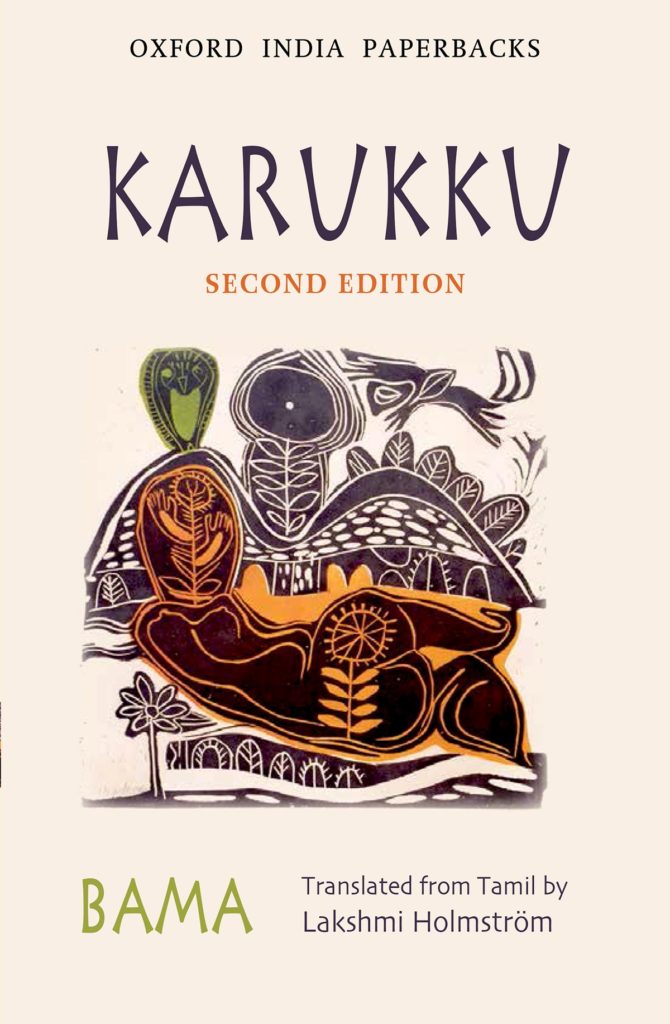
Many important works were published in full for the first time in English: Brushte ( Outcaste) by Matampu Kunhukuttan, Randamoozham ( Second Turn) by MT Vasudevan Nair, Bharathipura by UR Ananthamurthy, Danapani (The Survivor) by Gopinath Mohanty, Subarnalatha by Ashapurna Debi, Ponniyin Selvan by Kalki and Karukku by Bama.
In all, between 1996 and 2000 when I left Macmillans I published 37 volumes. They went out of circulation a year or two after I left the company and the C.I.I.L Mysore bought the whole project including unsold stocks in 2007 with a view to republishng the entire list. It never happened because the Director (UN Singh) whose dream it had been, left the Institute.
2. What were the languages you first worked on? How many languages have you worked upon so far?
The first scripts I worked on were translations from Malayalam and Tamil. In all, I’ve worked on translations from Tamil, Telugu, Kannada, Malayalam, Konkani, Marathi, Gujarati, Bengali, Odia, Hindi, Kashmiri, Punjabi, Urdu, and just one from Dogri.
3. How do you select which book is to be translated especially if it is a language you are unfamiliar with?
As I said because of the work I did on Comparative Indian Literature it wasn’t difficult to identify what needed to be translated particularly if the Sahitya Akademi had not already commissioned translations. Then again once the Macmillan project took off I was flooded with advice and suggestions. The difficulty was what to leave out. A great disadvantage is that I could not and therefore did not read the critical material on any of these works. I rely a great deal on the advice of others. But when it comes to translators I use a process of running trial drafts of different kinds of passages from the selected work — one might be a descriptive paragraph, a second something very emotional or lyrical, a third passage would cover conversation – to check the translator’s strengths and where s/he might back off, or skip or be lazy. The editing process can take anything from two drafts to six depending on the competence of the translator and the cooperation between all parties. Long silences, gaps in the process are not healthy for the project nor is impatience or being a speed queen the answer. As for the reception of a translation! Much depends on how well the publisher promotes the finished product. Publishing is only 50% of the responsibility. The other 50% depends on promotion and follow-up.
4. Do you think it is necessary for an editor to be familiar with the source language? If not, how can the editor ensure that the translation is true to the original text?
Of course it is important for the editor to know the source language but then in how many languages can one gain proficiency? The editor/ publisher must appoint reviewers who will read the translation carefully to ensure (as far as possible) that nothing has been left out or distorted. Then the editor can take over and polish in consultation with the translator and author.
5. What are the kind of guidelines you think an editor of translations should be bear in mind while working on a manuscript?
Listen very carefully to the voice of the author. Does it chime with the
translator’s? It helps to have someone read out the original even if you do not
know the language while you follow the English in a parallel reading. You
cannot but help hear the inflexions and emotions as the reading proceeds.
Be respectful. Very important to gain the confidence of the translator. Make suggestions tactfully. Once the translator is convinced you are not out to destroy his work or appropriate it, he will breathe easy and work and redraft willingly. It helps to read other works from the same period and familiarize oneself with the language – bank of that time. You need to enter that world emotionally through images and atmosphere not just intellectually through words.
6. What is your definition of a “good translation”? What are the qualities it must have?
This is something I have been trying to figure out for 30 years! Sometimes a smooth read will fail to capture the imagination of the reader. Sometimes even if a translation is jerky and appears to be rushing along, it will work. I think it is a combination of inspiration and zeal on the part of the translator and very patient work on the part of the editor. The qualities? The language must bring the author alive. It must make you think “If XY had written in English instead of in Marathi this is how he might have phrased it”. Now it is all very well to say this to ourselves but to someone who is not Indian, this might still not work at all. Basically I think we should be translating first for our Indian market before trying to reach spaces and minds outside India.
7. When you began translating texts into English for the Indian market, at the time, most publishing houses ignored translations. Today the reality is very different. Most publishing houses have dedicated translation lists and even the local literary awards are recognising translators. What in your opinion are the pros and cons of this deluge of translations in the market — locally and globally?
It is extremely encouraging to see the increased interest in translations and the care with which they are produced but a worrying feature is the way publishers are responding to criteria laid out by the big literary bursaries and prizes for translation. There is a growing tendency to ignore works published more than 20 or 30 years ago and no one seems to want to do a fresh translation of a classic. Then there is the secret craving on the part of publishers to promote a translation as not a translation. So the translator’s name disappears from the cover page, a most unfair practice. I put this down to the second-classing of translations—as if they are something inferior and not worthy of being viewed as works of art in themselves.
8. Recently machine translations such as Google’s neural technology are making an impact in the space of translation. How do you feel about the impact of machine translation in the literary sphere?
Any technology which helps the human translator will be of enormous help I’m sure but I doubt whether it can supplant imagination and nuanced word choices. For mundane passages for instance this interview can be processed by Google translation but — a poem full of feeling and fire? I doubt it. An approximation would surely be possible but would it be good enough? I’ve always maintained that the translator is as much an artist as the writer of the original work.
9. Your name in Indian publishing is synonymous with translation evangelism. You have been responsible for kick-starting many notable projects. The current one being the Translation Initiative of the Thunchath Ezhuthachan Malayalam University (TEMU). Please elaborate more on this project.
Actually I did not initiate the TEMU project. That was designed by K
Jayakumar the first VC of the University. It was a simple plan: an advisory
committee selected works, I commissioned the translations and marketed the idea
with multiple publishers. In some cases, the publishers already had scripts on
hand; in other cases, I found the translators and did some light editing before
handing over to the concerned group. The University signed agreements with the
publishers to buy 300 copies at a discounted price and the publishers agreed to
carry the logo and mission statement of the University in the selected works. I
did not initiate any project other than the Macmillan list. In OUP I enlarged
and diversified an already extant list which had not — till I began work in
2001— published a single woman writer. Nor had Dalit or Adivasi writers been
considered. That was an arm I grew for OUP India and it has done well.
For a year now, I’ve been working with the Tamil Nadu Textbook Educational Services on a Tamil- English translation project modelled on the TEMU plan. Our collaborators in the first phase are OBS, Niyogi, OUP, Ratna Books, Harper Collins and Vitasta.
10. Can the art of translation and editing a translation be taught or is it a lived experience?
Commitment, determination and passion are crucial to sustained work in
this area. To find a forgotten work, to convince people that it must appear in
English, to struggle with the translator at its rebirth and to learn that a
major publisher in the language of the original work decided to reprint the
book (which had lain in a rabbit – hole for four decades) —- that is the best
thing an editor of translations can hope to enjoy.
Strategies in translation can certainly be taught. Translator training is certainly possible and necessary but finally the translator is on her own except for her editor and together they complete the phantom work. It might succeed. It might not. It might succeed as an aesthetic product and bomb in the sales department. But then that is the fate of any human product which is judged by both ignorant people and by those who know far more than you do. No amount of reading about tennis or watching it on television can help you to be a good player on the court!
11. Translations are most often construed as being undertaken as a labour of love with little financial resources being available for underwriting the costs involved in the task. What are the economics of publishing translations in India? What has been your experience?
Love is great but it won’t put food on the table. Translations need financial support either from a patron or from another line of books from the same publisher who sets aside resources for the translations list.
12. What do you think is the future of literary translations in the world of publishing?
The world literary mart is only just waking up to the hidden power of translations and what they do to cross-pollinate creativity across cultures and civilizations. Consider all the talk about world peace! How can this happen if cultural understanding isn’t an organic process? One way to ensure this is to expose children and young adults to writing from different parts of the world at an impressionable time in their lives. Translation can help the humanities to make a brilliant comeback in a global sense. Comparative literature is impossible to teach without discussing the central role of translation. If we are to survive all the artificially orchestrated hatred and violence and misunderstandings created by politicians and power –mongers, venues of mutual understanding need to be very deliberately developed. Cultural competence, soft –skills — these are words one hears very often but what are we doing to build that theatre of human understanding? I think that if literary translations can be included in academic programmes and introduced into high-interest professions like management, finance and public policy it would help humanize these professions and give publishers the big print runs and inflow they need to keep doing what only they can do.
Note:Women Writing in India edited by Susie Tharu and K Lalitha (OUP) was a reprint of the Feminist Press publication, 1993, NY and not commissioned or developed by Oxford University Press.
The Women in Translation (#WiT) month is celebrated annually in August. There was a flurry of activity online with a number of gems being unearthed and discussed. It is a really fascinating time to discover new writers, new translators, new publishers etc. Whilst I enjoyed reading the various articles, interviews, profiles and even book extracts that were made available online, I realised there was a deafening silence from the Indian subcontinent.
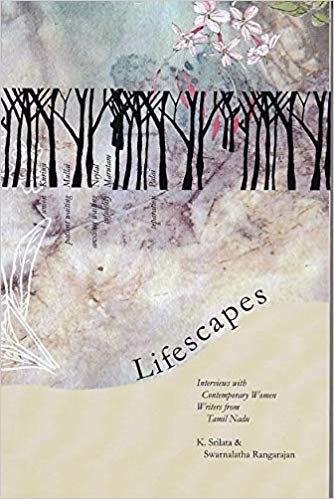
Another fascinating aspect of the Indian publishing industry is that as it grows, the market grows, and so does the interest in the craft of writing. For long writers have written and published their works in various literary magazines, “women’s magazines”, newspapers etc. Of course there are now online literary spaces, discussion forums and sometimes even in the print media where writers are interviewed and their craft discussed. But interviewing writers, especially women, is an art unto itself. Women writers inevitably have to find the time to write amongst the rhythm of many other duties and commitments they need to fulfil. This was more so in the past than now when increasingly there are more and more “professional writers”. Even so, reading about the craft of writing by women writers continus to be an exciting world since irrespective of socio-economic class, many writers share the same concerns and have similar pressures. Women Unlimited, an associate of Kali for Women, has for years published interviews with women writers. Their latest publication is Lifescapes: Interviews with Contemporary Women Writers from Tamil Nadu. The Tamil publishing landscape is not an easy one to understand with many interesting threads running through it, all of which were influential upon the seventeen women writers interviewed by the editors — K. Srilata and Swarnlatha Rangarajan. While the interviews themselves are insightful, it is the structural arrangement of each entry that is fascinating for it has the mandatory biography about the author, a sample of her writing, a head note by the editors introducing the writer and why they chose her specifically to be included in the anthology and finally, the interview. Every detail adds just sufficient information creating an image of the writer that the reader definitely wants to know more about.
Ever since World Literature began to open new publishing horizons in the Anglo-American book market as well as the growth of the desi diaspora as a lucrative readership, did the spotlight on translations from regional languages into English become an attractive proposition for many firms. As a result there is a feast of offerings particularly as the multi-national publishers expand their fare. Be that as it may there are some fabulous publishers such as Women Unlimited, Zubaan, Orient Black Swan, Speaking Tiger, Permanent Black ( on occasion), Aleph Book Company, Yoda Press, Westland/Amazon and Oxford University Press that have been publishing translations for a while. It is impossible to list all but here some of the wonderful titles published recently.
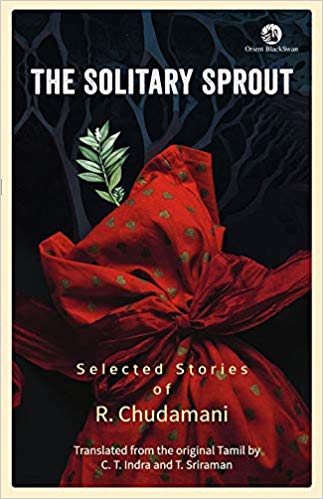
The Solitary Sprout: Selected Stories of R. Chudamani ( translated from Tamil by C.T. Indra and T. Sriraman) is a fabulous collection of short stories. In fact, R. Chudamani (1931-2010) has often been considered as an early feminist among Tamil writers. The Solitary Sprout is a wonderful selection of Chudamani’s short stories with “No fury like a mother’s”, “Herself” and “Not a stepfather” standing out as very modern stories. It is hard to believe that these were written many decades ago. The sharp insight and clear ideas that the writer shares can take one’s breath away even now. For instance, “No fury like a mother’s” is about three mothers of young schoolgirls who are furious at how their daughters are ill-treated by their school teacher. The punishment meted out to the young girls by the teacher is to strip the girls publicly. The three mothers team up and pressurise the teacher to resign otherwise they threaten to mete out the same treatment to her as she did to their daughters. “Herself” is about a mother who once her children are married and settled with families of their own, discovers her trueself and becomes a music teacher as well is a voluntary worker at the Primary Health Centre in her village. Much to her visiting daughter’s dismay who had expected a month’s vacation at her parent’s home free from all responsibilities including babysitting her own son. Instead the daughter discovers she has to pitch in with household chores at her parents home and continue to look after her own son. She is deeply disappointed and upset as her memories of her mother was one who was always free and available for the family. It rattles the daughter. More so as her father supports his wife’s actions and sees no wrong. “Not a stepfather” addresses issues like widow remarriage, single parenting, stepfather etc. It is beautifully told from the perspective of the disgruntled mother of the bride who is not amused that her daugther has remarried and expects the new husband also to take care of her young son. It is complicated but within the first visit of the newly married couple to the mother’s house, the son warms up to his new father and gets the blessings of his mother-in-law too. It is a powerful story as it raises so many questions about gendered and social expectations of a woman and a man. The Solitary Sprout is worth reading, sharing and discussing in more forums. These are stories that need to be told more often.
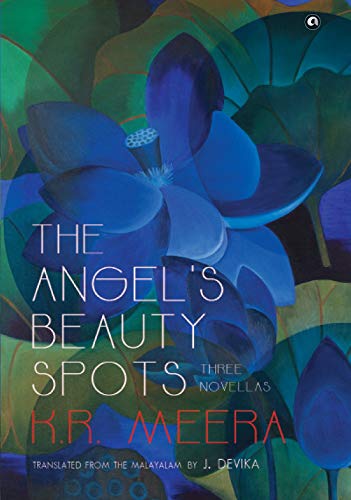
Prolific and powerful writer K. R. Meera has a new collection of three novellas called The Angel’s Beauty Spots. As often is the case with K. R. Meera’s stories, she explores love and its various angles. Sometimes well meaning and powerful love for all intents and purposes can go horribly wrong as in the title novella. K. R. Meera’s stories have this remarkable quality of taking the wind out of the reader’s sails with the horrific and at times inexplicable sequence of events except that some bizarre form of love propelled many of the decisions taken by her characters. Somehow the team of author and translator, K. R. Meera and J. Devika, works well. It is difficult to pinpoint an exact reason but the translation reads smoothly without losing any of the cultural characteristics of sharing a story set in Kerala and written in Malayalam. It just feels perfectly satisfying to read.
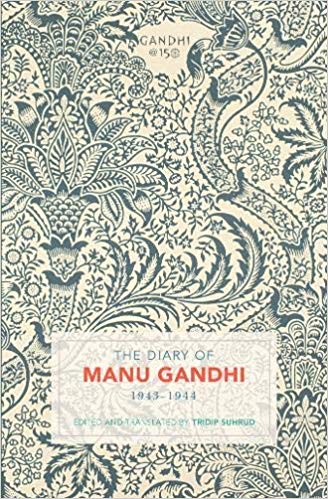
The Diary of Manu Gandhi ( 1943 – 44) are the diaries written by Manubehn ( Mridula) Gandhi, who was the youngest daughter of Mahatma Gandhi’s nephew, Jaisukhlal Amritlal Gandhi and Kasumba. These diaries are preserved in the National Archives of India and for the first time are being translated and edited from Gujarati into English by Tridip Suhrud. Manu Gandhi as a young girl had been encouraged by Mahatma Gandhi to maintain a diary. Manu Gandhi was the one walking beside Mahatma Gandhi at Birla House before his would-be assassin, Nathuram Godse, pushed her aside, so as to be able to shoot his target.
Diary-keeping of Gandhi was an essential duty for all those engaged in pursuit of truth and hence obligatory for Ashramites and satyagrahis. He constantly urged the Ashram community and constructive workers to maintain one. ….A daily diary,he believed, was a mode of self-examination and self-purification; he made it an obligatory observance for all those who walked with him on the Salt march.
While The Diary of Manu Gandhi ( 1943 – 44) is of more academic and historical interest to many readers, it is accompanied by a fine commentary by Gandhian scholar Tridip Suhrud. He offers insights about maintenance of a diary, the translation process, making available critical empirical material such as these diaries which till now many knew of its existence but not many could access. It also documents the growth of a young, under-confident girl to a mature person as evident in the style of her writing, longer sentences, more time spent describing incidents rather than restricting it to scribbles as many of the early entries are. Interestingly, as Tridip Suhrud points out in his introduction, Mahatma Gandhi or Bapu as he was known, would often read and scribble his thoughts in the margins of Manu Gandhi’s diaries. Ideally though it would have been a preferable if in this volume an interview with Tridip Suhrud with a leading gender/oral history expert had been included. It would then give some critical insights in what it means to translate a young girl’s diary many decades later by a highly reputed Gandhian scholar. With due respect even the best academic scholars tend to gloss over certain gender issues that irrespective of how many times they are repeated continue to be important and need to be highilghted. At the same time it would be fascinating to see what emerges from the conversation of a Gandhian expert with a gender expert to see how much Gandhian ways of living influenced the minds and hearts of those in the Ashram or did the basic gendered ways of seeing also get scrubbed away.
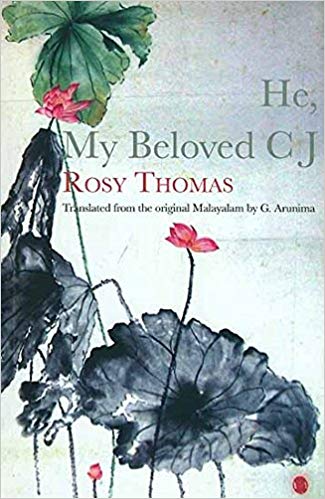
Speaking of memoirs, Rosy Thomas’s He, My Beloved CJ about her life with her husband and well-known Malayalam writer and critic, C. J. Thomas. It has been translated by G. Arunima. C.J. Thomas died young. His wife wrote this memoir much later. While it is a very personal account of her courtship, her marriage and the brief time she spent with her husband during which he opposed her desire to seek employment. Apparently in the Malayalam text, Rosy Thomas often refers to her husband as moorachi ( a colloquial term for conservative). Hence within this context it is quite amazing to read an account of a life that does not necessarily romanticise the couple’s love but is able to subvert the prevalent notions of wifehood. It has descriptions of their homes, their families, their circle of friends and at times some of their discussions on art, creativity and politics. At least in the memoir she comes across at times an equal participant despite his conservative mindset on having a wife who earned a living. Be that as it may, the monotone pitch at which the memoir is written or has been translated in —it is difficult to discern the difference — does not make He, My Beloved CJ easy to read. Of course it is a seminal book and will for a long time be referred to by many scholars interested in knowing more about the literary movement in Kerala or about the legend himself, C. J. Thomas — a man who seems to have acquired mythical proportions in Kerala. How many will access it for being a woman’s witnessing of a fascinating moment in history, only time will tell. Meanwhile the translator’s note is worth reading. G. Arunima writes:
…this biography is as much about C J Thomas and their marriage, as it is about Rosy as a writer. The act of remembrance is also about fashioning her own self and subjectivity, both as a ‘loving’ subject, and as a ‘writer’ and raconteur, observing, weighing, annotating and narrating their life as a text. Rosy Thomas grew up in a literary home; her father, M P Paul, was an intrinsic part of the Progressive Writers’ Movement, the Sahitya Pravarthaka Sahakarna Sangham ( Literary Workers’ Cooperative Society) and had also set up the tutorial college that was named after him. Writers, books and a culture of reading were a central part of her life. Even though these reminiscences do not dwell too much on her own literary or political formation, it is evident that CJ’s world wasn’t alien to her. In her later life she was to become a published writer and translator in her own right; such creativity is obvious even in this text where the nuances of a remembered life are testament to her wit and literary flair.
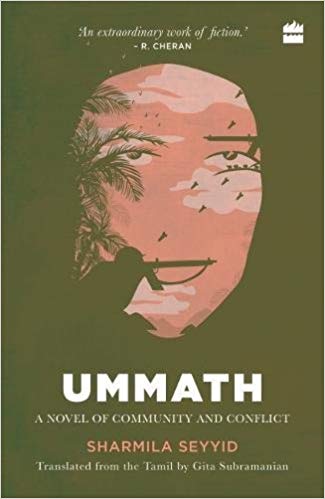
There are many, many more titles that one can discuss such as Sharmila Seyyid’s Ummath: A Novel of Community and Conflict. It is set during the three decades of the Sri Lanka’s civil war. It is told through the lives of three women, Thawakkul, Yoga and Theivanai — one a social activist, the other a Tamil Tiger forced into joining the movement as a child, and the third a disillusioned fighter for the Eelam. The novel has been translated from Tamil by Gita Subramaniam. While it immerses one immediately into the strife torn landscape, it is also puzzling as sometimes the voices of the three main characters seem to acquire the same pitch, making it seem as if the author’s own devastating firsthand experiences of the conflict are making their presence felt throughout the narrative. It is impossible for the English readers to ever solve this puzzle but there is something that comes through in the translation and is not easy to pinpoint. While promoted as fiction, it is easy to see that Ummath with the insights it offers, nature of conversations documented and descriptions of the landscape make this novel a lived experience. This is a challenging story to read but is worth doing so as the conversations about women/gender and conflict are relatively new in public discourse and need to be share more widely.
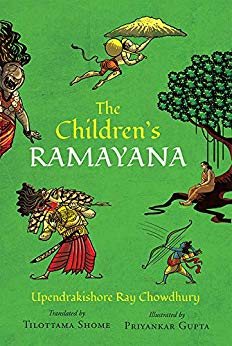
The final book in this roundup is a translation from Bengali of Upendrakishore Ray Chowdhury’s The Children’s Ramayana by first-time translator Tilottama Shome. It is the Ramayana told with its basic story sans the many digressions and minor tales. It is the epic with many of the popular stories retold that many generations of Indians are familiar with. It does not come across as a novice’s attempt at translation. In fact as she says in her translator’s note, “I have tried to retain that delightful quirky tone and the hint of humour told with a straight face that has endeared Upendrakishore Ray Chowdhury’s works to readers for generations” seems to be true. Again it is impossible for English readers to confirm this fact or not but there is something about the zippy pace, ease of reading, a rhythm to the storytelling, making it immensely attractive to read. Perhaps Tilottama Shome being a trained singer ably assisted her in finding the rhythm to this translation. There is something to be said for a trained musical ear and discovering the cadences of a written text making the translation from one language/culture to the next a pleasurable experience!
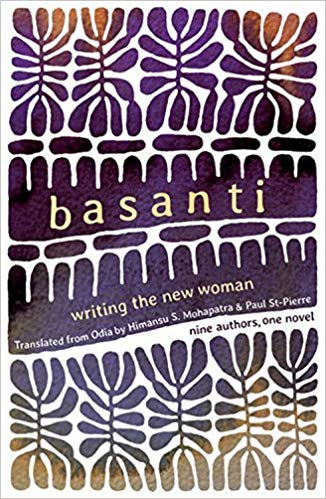
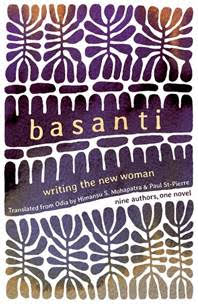
Basanti is an Odia novel written decades ago. It is also a fascinating exercise in literary experimentation. Well ahead of its times. The following extract is from the introduction written by translator Himansu S. Mohapatra and is reprinted by permission of Oxford University Press India
Imagine the inner world of an Odia novel, published in 1931 and set in the conservative Odia society of that time. The eponymous heroine seems to be a misfi t in this society thanks to her unconventional choices. She is friend to a Christian woman. She reads, writes, plays music, sews, and dispenses homeopathic medicine. It also happens that she marries for love. After marriage she comes to her husband’s village in Balasore to take up her new role as the daughter-in-law of a zamindar household, managed by her widowed mother-in-law. A life of petty domesticity and social conformity stretches out before her now. She does not, however, give up on her attempts at replenishing her mental and intellectual wardrobe. To that end she leafs through the pages of a Bengali monthly, writes articles for an Odia literary periodical (Nababani), and reads Tagore’s novel Gora multiple times, not to mention her locking horns with her husband and his male friends over the issue of emancipation of women. She even runs a school for the little girls in the village.
This aspiration on the part of a young woman for a higher mental plane does not evoke any response from the family. On the contrary, it invites opposition from her mother-in-law and even her husband. The element of surprise is not due to the fact that the novel depicts the agony and the sense of suffocation of a woman seeking emancipation from her narrow domestic confi nes. Surprise is in the fact that the novel does for the fi rst time posit activism for women in Odia literature, breaking with the earlier tradition of portraying a woman as a glamorous, adorable object. Yes, in Odia fictional literature Basanti is the fi rst ever woman character to have boldly staked a claim to emancipation of women, presented the means of that emancipation and mapped the pathway to it. The blazing presence of Nababani, Gora, Romain Rolland, and W.B. Yeats in the discourse of the novel is an eloquent testimony to that. Odia prose fiction, admittedly not of long ancestry in the 1920s and 30s, had not imagined such an intellectually vibrant inner world and that too as part of a character’s repertoire until the appearance of the novel Basanti.
I
Basanti is a landmark attempt at writing a new kind of novel in Odisha in the early decades of the twentieth century. Like all new literary offerings of the time in Odisha, it was published in the journal Utkala Sahitya in instalments starting from issue no. 2 of volume 28 for May 1924 to issue no. 8 of volume 30 for November 1926. The work of nine authors, six men and three women, Basanti is a fine gift to Odia fiction from the ‘Sabuja Age’ in literature. This literature was given to exploring new horizons —the Odia word ‘sabuja’, like the word basanti ‘green’ in English, is a symbol of youth, novelty, freshness, and so on—during its all too brief life span of 10 to 15 years. The novel was definitely a new undertaking. The newness existed at least at three levels. First, it was a product of a well-thoughtout plan for collaborative writing. Second, it was a novel with a focus on women. Last, but not least, it was a novel of ideas. The three levels were, of course, closely intertwined. When a group of writers come together for the express purpose of engaging in an act of writing, one can be sure that a new creative impulse, at once social and literary, is in the air. Was the late 1920s in Odisha, which saw the emergence of Basanti, such a time? Did it witness a new creative impulse?
…
III
In the 1920s English education and a wider world mediated by English books had begun to seep into the consciousness of the educated Odias, transforming it from within. The books they read and the ideas they conceived found their way into their Odia writing for which the journals and magazines of the time acted as both receptacles and triggers. Utkala Dipika, founded in 1866 by Gouri Shankar Ray, provided an outlet for their restless journalistic minds eager to explore their environs and shine the light into the areas of darkness. From 1897 onwards it was Utkala Sahitya, a monthly literary journal published under the editorship of the erudite and cultured Biswanath Kar, which set out to create a national literature for Odisha. It may be no exaggeration to say that the Renaissance of Odia letters was scripted in its pages. It was here that Chha Mana Atha Guntha by Senapati was serialized from 1897 to 1899 before being published in book form in 1902. It was here that the serialization of Basanti began in May 1924 and ended in November 1926 before being issued as a book in 1931 by a literary organization named Sabuja Sahitya Samiti formed by the ‘Sabuja’ group of writers. A revised and expanded edition of the novel, used as the source text for this English translation, was published in 1968 by the New Students’ Store, Cuttack.
IV
The passage from a single author to multiple authors was a significant aspect of Basanti. The novel saw the convergence of two new forces. One was a new writing strategy which the initiators of the novel referred to as a ‘collective composition method’. The other was the collective imagining of the new woman. This concerted effort at writing a novel was of course an extension of the other concerted efforts that were being seen in the social and political spheres in Odisha. While Gandhi’s call for non-cooperation with the colonial government had galvanized hearts and minds of every Indian, in Odisha it was the regional issue of the reunifi cation of a dismembered Odisha which struck a chord among Odia intellectuals and writers. The important thing was that the Odia nationalism of the 1920s, having co-existed with an internationalist and cosmopolitan outlook, was not insular. The Odia mind was like a sponge, which absorbed new ideas and new trends such as the psychoanalysis of Sigmund Freud, the mysticism of Swedenborg, the modernism of the Yeats–Eliot–Pound–Joyce generation as well as socialist ideas that reached the Odishan shores both directly through people like Frieda Hauswirth Das and via Bengali literature. As one prominent member of the ‘Sabuja’ group of Odia writers put it in a journal article, published in 1933, their effort was to create a new and fresh—and hence green—literature which, in tune with the international trends, would ‘celebrate the romance of a new reality by extending the frontiers of the everyday reality and reaching down to the unconscious’ (Baikuntha Nath Patnaik, Juga-Bina, 1933, p. 67).
….
It is worth pointing out here that the collaborative writing of the kind seen in Basanti was first to appear in Bengali literature in the Indian context. In fact in the ‘appeal’ published in volume 28 of Sahitya, Kalindi Charan Panigrahi called for a replication of this Bengali experiment with the ‘collective worship of the word’, evinced in the case of Baroyari (written by twelve authors), Bhager Puja (the work of sixteen authors), and Chatuskona (the work of four authors) in Odia literature. The Bengali experiment was obviously not the first. The Spectator, an influential periodical paper in eighteenth-century England, was the creation of many hands. Sir Roger De Coverley, its central character, though first imagined by Richard Steele, is taken over fondly by Joseph Addison, much in the same way in which the contours of the new woman in the titular Basanti are drawn fi rst by the male authors and then taken over and extended by the female authors.
Basanti: Writing the New Woman ( Nine Authors, One Novel) Ananda Shankar Ray, Baishnab Charan Das, Harihar Mahapatra, Kalindi Charan Panigrahi, Muralidhar Mahanti, Prativa Devi, Sarala Devi, Sarat Chandra Mukherjee, and Suprava Devi. Translated from Odia by Himansu S. Mohapatra and Paul St-Pierre
Oxford University Press, New Delhi, 2019. Pb. Pp. 246 Rs 550
Every Monday I post some of the books I have received in the previous week. This post will be in addition to my regular blog posts and newsletter. Today’s Book Post 25 is after a gap of two weeks as January is an exceedingly busy month with the Jaipur Literature Festival, Jaipur BookMark and related events.
In today’s Book Post 25 included are some of the titles I received in the past few weeks as well as bought at the literature festival and are worth mentioning.
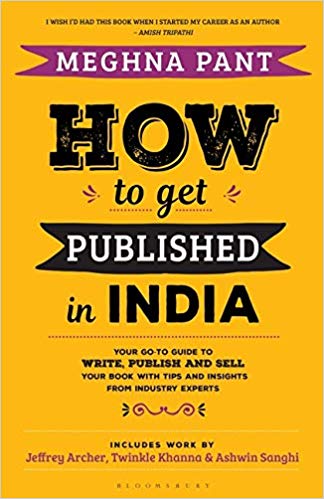
I recently contributed to How to Get Published in Indiaedited by Meghna Pant. The first half is a detailed handbook by Meghna Pant on how to get published but the second half includes essays by Jeffrey Archer, Twinkle Khanna, Ashwin Sanghi, Namita Gokhale, Arunava Sinha, Ravi Subramanian et al.
Here is the essay I wrote:
****
AS LONG as I can recall I have wanted to be a publisher. My first ‘publication’ was a short story in a newspaper when I was a child. Over the years I published book reviews and articles on the publishing industry, such as on the Nai Sarak book market in the heart of old Delhi. These articles were print editions. Back then, owning a computer at home was still a rarity.
In the 1990s, I guest-edited special issues of The Book Review on children’s and young adult literature at a time when this genre was not even considered a category worth taking note of. Putting together an issue meant using the landline phone preferably during office hours to call publishers/reviewers, or posting letters by snail mail to publishers within India and abroad, hoping some books would arrive in due course. For instance, the first Harry Potter novel came to me via a friend in Chicago who wrote, “Read this. It’s a book about a wizard that is selling very well.” The next couple of volumes were impossible to get, for at least a few months in India. By the fifth volume, Bloomsbury UK sent me a review copy before the release date, for it was not yet available in India. For the seventh volume a simultaneous release had been organised worldwide. I got my copy the same day from Penguin India, as it was released by Bloomsbury in London (at the time Bloomsbury was still being represented by Penguin India). Publication of this series transformed how the children’s literature market was viewed worldwide.
To add variety to these special issues of The Book Review I commissioned stories, translations from Indian regional languages (mostly short stories for children), solicited poems, and received lovely ones such as an original poem by Ruskin Bond. All contributions were written in longhand and sent by snail mail, which I would then transfer on to my mother’s 486 computer using Word Perfect software. These articles were printed on a dot matrix printer, backups were made on floppies, and then sent for production. Soon rumours began of a bunch of bright Stanford students who were launching Google. No one was clear what it meant. Meanwhile, the Indian government launched dial-up Internet (mostly unreliable connectivity); nevertheless, we subscribed, although there were few people to send emails to!
The Daryaganj Sunday Bazaar where second-hand books were sold was the place to get treasures and international editions. This was unlike today, where there’s instant gratification via online retail platforms, such as Amazon and Flipkart, fulfilled usually by local offices of multi-national publishing firms. Before 2000, and the digital boom, most of these did not exist as independent firms in India. Apart from Oxford University Press, some publishers had a presence in India via partnerships: TATA McGraw Hill, HarperCollins with Rupa, and Penguin India with Anand Bazaar Patrika.
From the 1980s, independent presses began to be established like Kali for Women, Tulika and KATHA. 1990s onwards, especially in the noughts, many more appeared— Leftword Books, Three Essays, TARA Books, A&A Trust, Karadi Tales, Navayana, Duckbill Books, Yoda Press, Women Unlimited, Zubaan etc. All this while, publishing houses established by families at the time of Independence or a little before, like Rajpal & Sons, Rajkamal Prakashan, Vani Prakashan etc continued to do their good work in Hindi publishing. Government organisations like the National Book Trust (NBT) and the Sahitya Akademi were doing sterling work in making literature available from other regional languages, while encouraging children’s literature. The NBT organised the bi-annual world book fair (WBF) in Delhi every January. The prominent visibility in the international English language markets of regional language writers, such as Tamil writers Perumal Murugan and Salma (published by Kalachuvadu), so evident today, was a rare phenomenon back then.
In 2000, I wrote the first book market report of India for Publisher’s Association UK. Since little data existed then, estimating values and size was challenging. So, I created the report based on innumerable conversations with industry veterans and some confidential documents. For years thereafter data from the report was being quoted, as little information on this growing market existed. (Now, of course, with Nielsen Book Scan mapping Indian publishing regularly, we know exact figures, such as: the industry is worth approximately $6 billion.) I was also relatively ‘new’ to publishing having recently joined feminist publisher Urvashi Butalia’s Zubaan. It was an exciting time to be in publishing. Email had arrived. Internet connectivity had sped up processes of communication and production. It was possible to reach out to readers and new markets with regular e-newsletters. Yet, print formats still ruled.
By now multinational publishing houses such as Penguin Random House India, Scholastic India, Pan Macmillan, HarperCollins India, Hachette India, Simon & Schuster India had opened offices in India. These included academic firms like Wiley, Taylor & Francis, Springer, and Pearson too. E-books took a little longer to arrive but they did. Increasingly digital bundles of journal subscriptions began to be sold to institutions by academic publishers, with digital formats favoured over print editions.
Today, easy access to the Internet has exploded the ways of publishing. The Indian publishing industry is thriving with self-publishing estimated to be approximately 35% of all business. Genres such as translations, women’s writing and children’s literature, that were barely considered earlier, are now strong focus areas for publishers. Regional languages are vibrant markets and cross-pollination of translations is actively encouraged. Literary festivals and book launches are thriving. Literary agents have become staple features of the landscape. Book fairs in schools are regular features of school calendars. Titles released worldwide are simultaneously available in India. Online opportunities have made books available in 2 and 3-tier towns of India, which lack physical bookstores. These conveniences are helping bolster readership and fostering a core book market. Now the World Book Fair is held annually and has morphed into a trade fair, frequented by international delegations, with many constructive business transactions happening on the sidelines. In February 2018 the International Publishers Association Congress was held in India after a gap of 25 years! No wonder India is considered the third largest English language book market of the world! With many regional language markets, India consists of diverse markets within a market. It is set to grow. This hasn’t gone unnoticed. In 2017, Livres Canada Books commissioned me to write a report on the Indian book market and the opportunities available for Canadian publishers. This is despite the fact that countries like Canada, whose literature consists mostly of books from France and New York, are typically least interested in other markets.
As an independent publishing consultant I often write on literature and the business of publishing on my blog … an opportunity that was unthinkable before the Internet boom. At the time of writing the visitor counter on my blog had crossed 5.5 million. The future of publishing is exciting particularly with neural computing transforming the translation landscape and making literature from different cultures rapidly available. Artificial Intelligence (AI) is being experimented with to create short stories. Technological advancements such as print-on-demand are reducing warehousing costs, augmented reality is adding a magical element to traditional forms of storytelling, smartphones with processing chips of 8GB RAM and storage capacities of 256GB seamlessly synchronised with emails and online cloud storage are adding to the heady mix of publishing. Content consumption is happening on electronic devices AND print. E-readers like Kindle are a new form of mechanised process, which are democratizing the publishing process in a manner seen first with Gutenberg and hand presses, and later with the Industrial Revolution and its steam operated printing presses.
The future of publishing is crazily unpredictable and incredibly exciting!
Every Monday I post some of the books I have received in the previous week. Embedded in the book covers and post will also be links to buy the books on Amazon India. This post will be in addition to my regular blog posts and newsletter.
In today’s Book Post 6 I have included some titles that I received in the past few weeks and are worth mentioning and not necessarily confined to parcels received last week.
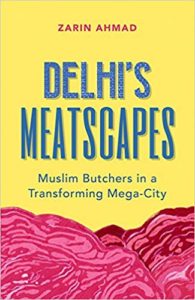
Zarin Ahmad’s Delhi’s Meatscapes: Muslim Butchers in a Transforming Mega-City is a history of predominantly Muslim butchers particularly the Qureshi community (biradri) but others in the meat sector are discussed as well. A fascinating history of how the butchers ( for halal and jhatka meat) have operated in Delhi for generations with the Idgah abattoir being established in the early twentieth century by the British when they moved the capital from Calcutta to Delhi. The next major shift was with Partition and the divisions created within the abattoir for butchering halal and jhatka meat keeping religious sentiments of the Muslims and Hindus in mind, respectively. At the same time it is a disturbing account of how there have been massive shifts in the business in recent years. These changes are mostly due to political and economic pressures such as shifting the abattoir to the outskirts of the National Capital Region where slowly even the state support is being taken away and only the private firm managing it allowed to operate. It has affected the business of local butchers. Also the rising intolerance towards Muslims and those who eat meat has also resulted in changing cityscapes.
Zarin Ahmad despite being a Muslim herself did not find it easy to be accepted in what is essentially a male-dominated industry. Women are never to be seen in or near abattoirs though some may sell meat in their shops. This gender dimension adds an equally interesting layer to the book for how Zarin Ahmad negotiates these spaces while gathering information. While it took the butchers a while to get used to the presence of a woman in the abattoir they were equally suspicious of her being a journalist. But small courtesies like wearing full-sleeved salwar-kameez with a dupatta and covering her head when the call for prayers ( azan) was heard helped get her accepted. Interestingly being a woman even though she was not a Qureshi allowed her to enter the women’s quarters in their homes and was readily accepted. She was able to have free flowing informal conversations that would inevitably venture into personal spaces but she also realised that it was not a one-way street. Field work research that involved asking questions of individuals meant that she too had to be prepared to answer a few in return from equally inquisitive people she met.
This is a multi-layered book that must be read by everyone for its witnessing by Zarin Ahmed of a tumultuous change in the meat sector of Delhi and its impact on the communities that are dependent upon it for survival. You do not need to be a academic to appreciate it.
Last week I announced that I am going to post every Monday a list of all the book parcels I have received in the past few days. Embedded in the book covers and post will also be links to buy the books on Amazon India. This post will be in addition to my regular blog posts and newsletter.
In today’s Book Post 2 I have included some titles that I received in the past few weeks and are worth mentioning and not necessarily confined to parcels received last week.
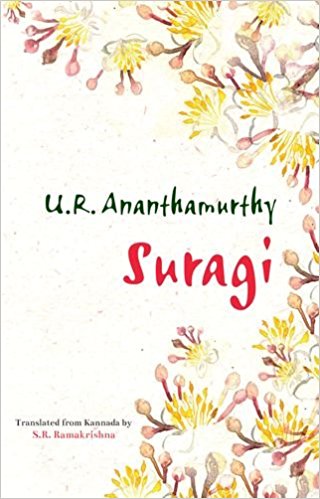
The distinguished Kannada writer and public intellectual U. R. Ananthamurthy ( 1932-2014) dictated his “memoir”, rather memories to Ja Na Tejashri, Kannada poet and professor, in the last few months of his life. He was extremely ill and was being dialysed regularly. The notes were structured in U. R. Ananthamurthy’s lifetime under his guidance. Initially his preference had been for a conversational and informal approach. When he saw the first few trasnscribed pages, he found the style difficult to read and called for a more formal approach. Eventually, Tejashri helped him find a balance he was comfortable with: she recorded him, scribbled notes, touched up her trasnscriptions, and rearranged the episodes in chronological order. Ananthamurthy was keen to see this work translated in English. It only happened a year and a half after he passed away when at the behest of his son-in-law and novelist Vivek Shanbhag who requested S. R. Ramakrishna to translate the 450-page book Suragi. Shanbhag was merely reiterating the request Ananthamurthy had asked of Ramakrishna.
U. R. Ananthamurthy was honoured with the Jnanpith Award in 1994 adn Padma Bhushan in 1998, and was one of the finalists of the Man Booker International Prize in 2013.
Suragihas now been published by Oxford University Press India. The memoir is so named after the flower Ananthamurthy loved which gives out more fragrance as it fades. This is an incredible book recounting his life as a writer and a public intellectual through India and England. It is an exceptionally absorbing read given how he acutely witnesses, observes and reflects often upon the role of a writer, particularly that of an Indian writer, in society. There are many parts of this book that are worth reflecting upon given their relevance even today. The section on “the Indian writer’s dilemmas” is particularly powerful. For instance while commenting upon the role of writers during the Emergency his statements assume wider ramifications, echoing into modern India, decades later:
India’s biggest problem is hypocrisy. Intellectual hypocirsy has taken root deeper than we imagine. …A mind that hesitates to what must be said becomes corrupt. …The spirit of the times is such that we have compromised with everything. Nothing troubles us. We feel no psychological torment. …We are not troubled as we should be. The reason is that our spirit is feeble. There is no connection between our convictions, our actions, and our truths. …That is why speech is devalued.
Ananthamurthy’s confidently outspoken voice is to be treasured and is deeply missed. Take for instance the following extract “Moment Transcending Time and Space” which is being reproduced here with the explicit permission of the publishers, Oxford University Press India.
Moment Transcending Time and Space
On the rare occasions we go beyond time and space, we see truths not just from the past but also those relevant to the present. I experienced this one night in Nepal. In 1996, some Indian writers spent three days with writers from Pakistan, Bangladesh, Nepal, and Sri Lanka. A Himalayan range loomed behind the resort where we were staying. The snow-clad mountains could be seen from the lounge and also from our rooms. It was an informal meeting, with no agenda, where the idea was to sit and chat and share our thoughts and feelings. This was after the demolition of the Babri Masjid. The anxiety of whether our nations could rise above communal hatred had brought us all together.
Siddhartha, a friend from Bengaluru, had organized this conclave. He has set up an ashram called Firefl ies in Bengaluru. Born a Christian, Siddhartha was drawn to Buddhism. He blends thought with action. Another writer at the conclave was my dear departed friend D.R. Nagaraj (1954–1998). He was drawn to two extremes—the Buddhist vision of emptiness that rejects even the idea of the soul, and the Nietzschean assertion of the intellect against the Christian concept of sin.
I will only name one participant who had come from elsewhere: Urdu writer Intizar Hussain (1923–2016). Each writer spoke openly about the truths of their experience, without trying to justify themselves. They spoke of things they couldn’t speak about in their countries. Women writers had come from Pakistan and Bangladesh, and I feel I should only convey what they expressed, keeping them anonymous.
Among the writers from Bangladesh was a Hindu. We gathered he was a big poet there. He was fidgeting with a palmtop he had bought in the Nepal black market. It was a device on which one could take notes. He was trying to fi gure out how it worked, and muttering in frustration when he couldn’t. He said the moment the Babri Masjid was demolished, several Kali temples in Dhaka had been brought down. ‘Why don’t any of you speak about it? I am no Kali devotee but I don’t like the hypocrisy of your secular position.’ No one argued with him. The other Bangla writers said he was speaking from the heart. Everyone was keen to break the vicious cycle of blaming the other to justify one’s own actions. Having said his bit, the Hindu writer from Bangladesh shared in our anxieties.
It has become a politically correct ritual for us to talk about Muslim violence when we want to condemn Hindu violence, and Hindu violence when we want to condemn Muslim violence. We respond with cleverness when we lose the ability to see the victims as humans like us. The objective of this meeting, with both Hindus and Muslims, was to rid ourselves of such self-justification. I share a conversation that suggests we were successful.
We were lounging around comfortably, resting on mats and lolling on cushions. A middle-aged woman writer from Bangladesh began her tale softly, with her friendly, smiling eyes closed. She was the only woman writer wearing a sari. Her luxuriant, uncombed hair cascaded on her breasts. Perhaps she was secure in the confi dence that all of us were looking at her with compassion.
When she began, she addressed everyone. As she progressed, she seemed to be directing her words to the male writers from Pakistan. Towards the end, her voice became tremulous. She was an ordinary woman speaking about the war Pakistan had fought with her country, then called East Pakistan. Her husband had been a professor at Dhaka University. He had campaigned for Bengali as a second official language. One day he routinely left for the university and didn’t return. The evening turned to night. A day passed, then two. Their two children didn’t go to school. They
stayed at home, awaiting his return. They couldn’t venture out— Pakistani soldiers were everywhere, brandishing their guns.
After two days she went to the university with other women looking for their husbands. What did they fi nd? A heap of corpses. They had to sift through the heap to fi nd their respective husbands. The writer must have told this story several times. But it was perhaps for the fi rst time she was telling it in the presence of writers from Pakistan, whose soldiers had killed her husband. I was sitting beside Intizar Hussain’s. Like his friend Bhutto, he had stood by Jinnah, believing a separate country was necessary to practise and promote Islam without let or hindrance. He had
migrated from his native place to become a Pakistani. He was a big writer in Urdu, and earned a living from writing for the Dawn. The Bangladeshi writer said, ‘Tell me, where is Islam in all this? What is the use of what the Quran says? My husband was a Muslim too but they killed him in the name of Islam. Can you imagine what I went through as I searched for him among hundreds of corpses?’
The sharp-nosed Intizar Hussain had placed his hands on his lap, in a meditative pose, and was listening to her. When the Bangladeshi writer concluded, a young woman writer from Pakistan began to sob uncontrollably. Intizar Hussain slowly raised his head. His eyes were moist, and tears rolled down his cheeks. ‘On behalf of my country I apologize to you,’ he said in English. ‘What can I say but that we are all unwittingly implicated in the murder of your husband?’ He looked at the other Pakistani writers for approval. The three women writers bowed their heads,
endorsing his words with tears.
This is an incident I will never forget. The human is dwarfed by the idea of the nation state. He loses his sense of right and wrong, and becomes a nationalist. In the Second World War, such nationalism made monsters of the Japanese and the Germans. Even ordinary folks turn blind. The atom bomb dropped by the Americans on Hiroshima and Nagasaki destroyed everything. Communist nations can justify their crimes using the words of Marx. Muslim nations can justify their crimes using the Prophet. It is equally true that Christian nations can use the Bible to justify
their actions. Those hiding behind nationalism wreak a lot of damage before we wake up and criticize them.
To escape the mass hysteria of nationalism, we must always fearlessly keep extending a hand of friendship to other humane thinkers. I recall an incident. When we met in Berlin, I mooted with Intizar Hussain the idea of our Sahitya Akademi publishing an anthology of Pakistani literature to mark the fi ftieth anniversary of our two countries attaining Independence. Like India, Pakistan has a diversity of languages: Punjabi, Sindhi, and others. I wrote to
Intizar Hussain asking if he could edit an anthology of stories from all such languages in Urdu translation.
At the Sahitya Akademi’s executive committee meeting, some friends expressed their reservations. How could we publish a story that might speak against India? I said, ‘Intizar is a sensitive writer. He will never choose anything that promotes hatred. Leave it to me. I will take the risk.’ As the book was being finalized for publication, we faced another problem. How do we pay the writers? The two nations had no agreement to make payments possible. I
explained this to Intizar, who then spoke to the contributors to the anthology. We got letters from them, with some saying they were honoured the Sahitya Akademi, which gets grants from the Indian government, was publishing them. Just send us some copies. We don’t expect any money. Our country didn’t have the vision that Nehru did. We don’t have an independent academy, they wrote. When I met Intizar at a SAARC literary conference in Delhi, he said, ‘We have no other book in Urdu with writing from other Pakistani languages. The anthology you published is now a
textbook in our colleges.’
U. R. Anathamurthy Suragi ( Transcribed and compiled by Ja Na Tejashri. Translated from Kannada by S. R. Ramakrishna ) Oxford University Press, New Delhi, 2018. Pb, pp.380 Rs.650